
How a $100 No-Deposit Bonus Actually Works in 2026
 Available in US
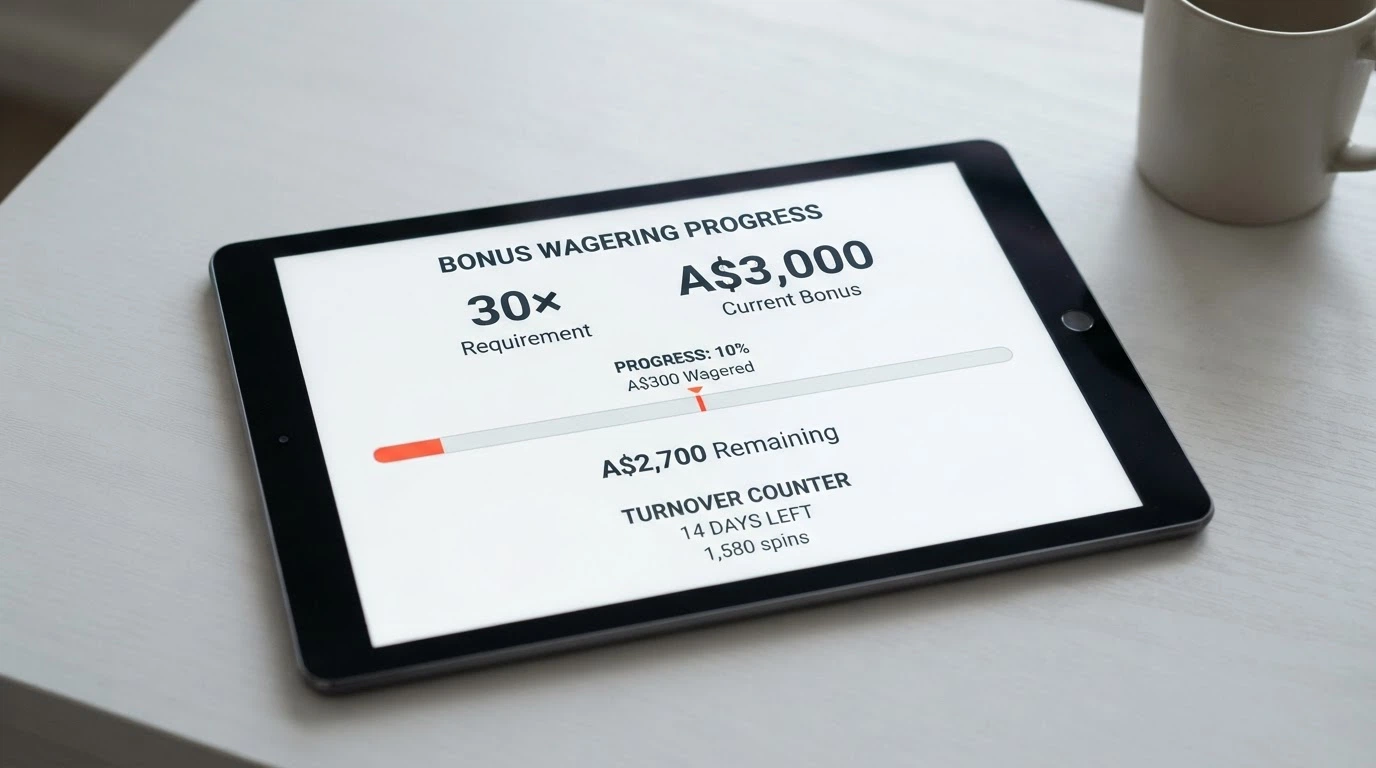
A $100 no-deposit bonus sounds like free money. It isn’t. The credit lands in a separate bonus balance, then a turnover requirement — typically 30× to 60× the bonus amount — has to be cleared before a single dollar is withdrawable, and even then a maximum cashout cap (often A$40 to A$500) decides what you actually keep. On a “free” A$100, a 30× playthrough means A$3,000 in bets; on a 60× playthrough at Fair Go Casino, it means A$6,000. The bonus is the bait; the maths is the line, the sinker, and the rod.
This guide walks through what these offers really are, who offers them to Australian players, what the wagering costs to clear, how PayID fits into depositing and withdrawing, and — the bit every affiliate page skips — the legal reality. Online casino is prohibited in Australia under the Interactive Gambling Act 2001, and the operators offering a $100 no-deposit bonus sit outside Australian law. That is not a stylistic note. It changes what an Australian player is actually agreeing to.

Current as of 3 September 2026 · verified against the Australian Communications and Media Authority’s blocked-services register and each operator’s published terms.
Table of Contents
- What a $100 No-Deposit Bonus Actually Gives You
- The Fine Print That Makes a $100 No-Deposit Bonus Hard to Cash Out
- The 2026 Shortlist: No-Deposit Offers Australian Players Can Actually Claim
- PayID: Australia’s Favourite Deposit Method at Offshore Casinos
- Is It Legal? What the Interactive Gambling Act Means for Your $100 Bonus
- Playing It Safe: Responsible Gambling When the House Is Offshore
- How We Evaluated These $100 No-Deposit Bonus Casinos
- What an Australian Player Should Actually Do About a $100 No-Deposit Bonus
- Frequently Asked Questions
What a $100 No-Deposit Bonus Actually Gives You
A “no-deposit bonus” is a credit an online casino adds to a new account without requiring a deposit first. The headline figure — A$100, A$50, 100 free spins — is the marketing; the small print is the product. The credit lands in a segregated bonus balance, plays only on eligible games, expires inside a window that runs from a few days to a couple of weeks, and cannot be withdrawn until a turnover requirement has been met. Even after the turnover is cleared, a maximum cashout cap decides what actually leaves the casino.
The $100 figure is the upper end of what the offshore casinos accepting Australian players are willing to put on the table without a deposit. It is rare as a clean signup offer — most A$100 chips are tied to a prior deposit, a loyalty tier, or a phone-verification gate. Two operators in the featured set, Bogart and Ripper, currently advertise a genuine A$100 free chip. The other eight deliver smaller chips, free spins, or deposit-required offers that the affiliate pages sometimes rebrand as “no-deposit” for SEO.
Free Chip or Free Spins: How the Credit Lands
Two formats carry the A$100 headline. The first is a free chip: a single A$100 credit added to a bonus balance, played as cash-equivalent stakes on eligible pokies. Bogart Casino and Ripper Casino run this format — the player gets A$100 of house money, places it on slots, and whatever survives the wagering requirement is withdrawable up to the cap.
The second is free spins: a fixed batch of rounds at a fixed per-spin value, usually around A$0.10. Skycrown’s “Meet & Spin” promotion delivers 20 free spins on Aztec Clusters, for a trial of the operator’s game library. BitStarz’s no-deposit offer is 100 free spins; that is a smaller exposure than the free-chip offers. A “100 free spin no-deposit” headline and a “A$100 free chip” headline sound equivalent on a comparison page; on the screen they are not. The chip looks larger because it is larger; the spins are a smaller, more constrained trial.
Operators pick the format based on cost. A free chip at A$100 with a 30× playthrough means the casino is on the hook for up to A$3,000 in handle, plus the cashout cap. A 100-spin batch at A$0.10 is a fraction of that exposure. Free spins are the safe play for the house; free chips are the loud marketing.
Why Australian Pokies Players Are the Target Audience
Pokies are the dominant form of gambling in Australia. Every pub, club and casino in the country runs them; the country’s gambling losses per adult are among the highest in the OECD. Australians call them “pokies”, not “slots”, and they expect to find them on any gambling product they sign up for. Offshore operators know this, and they frame their offers accordingly: A$100 free chip, A$100 no-deposit pokies bonus, A$100 to play on the pokies.
The framing is significant because there is no licensed online pokies alternative to point Australian players toward. Under the Interactive Gambling Act 2001, strengthened by amendments in 2017, online casino games — including online pokies — are prohibited. No state or territory licences them. Sportsbet, TAB, Ladbrokes and the other licensed Australian wagering brands hold licences for sports and race betting only; they do not offer casino games. The result is a captive market of players who want to play pokies online and a set of offshore operators willing to take them, in breach of Australian law.
Payment methods tell the same story. PayID is now the most widely used real-money deposit method for Australian pokies players, with funds landing in under 60 seconds and zero fees. Card payments and bank transfers are the alternative; cryptocurrency and credit cards are banned as funding routes for online wagering under reforms that took effect in June 2024. The offshore casinos that target Australian players build their cashier pages around PayID and POLi precisely because that is the rail their customers already use.
The “Free” Claim vs the Wagering Reality
The word “free” in a $100 no-deposit headline refers only to the absence of an upfront deposit. The bonus credit is free to claim; what it costs to convert into withdrawable cash is something else. A 30× wagering requirement, the most common multiple in the featured set, means A$3,000 in qualifying bets must be placed before any withdrawal is permitted. A 60× multiple, the rate at Fair Go Casino, doubles that to A$6,000. The casino is not giving away A$100; it is selling the player a chance to win A$100 minus a margin that the wagering requirement and the house edge together define.
The max-cashout cap sits on top of the wagering requirement. Even after the A$3,000 or A$6,000 in bets has been placed and any winnings accumulated, the casino will not pay out more than the cap — A$100 at Bogart, A$180 at Fair Go, A$500 at Ripper, A$40 on Skycrown’s “Meet & Spin” offer. A player who hits a lucky streak on the slots and runs the bonus balance to A$800 cannot withdraw A$800. They withdraw the cap. The rest is forfeit.
The math is not subtle. A A$100 bonus at 30× with a A$100 cashout cap is, at its best, a free shot at winning A$100 — provided the player is willing to spin A$3,000 through the house edge first. The expected return on that turnover, before the cashout cap, is somewhere south of A$3,000 minus the house edge; the cap then clips any upside. The offer is a small-stakes trial of a real-money casino, paid for by the operator’s marketing budget, and the best framing of it is exactly that.
The Fine Print That Makes a $100 No-Deposit Bonus Hard to Cash Out
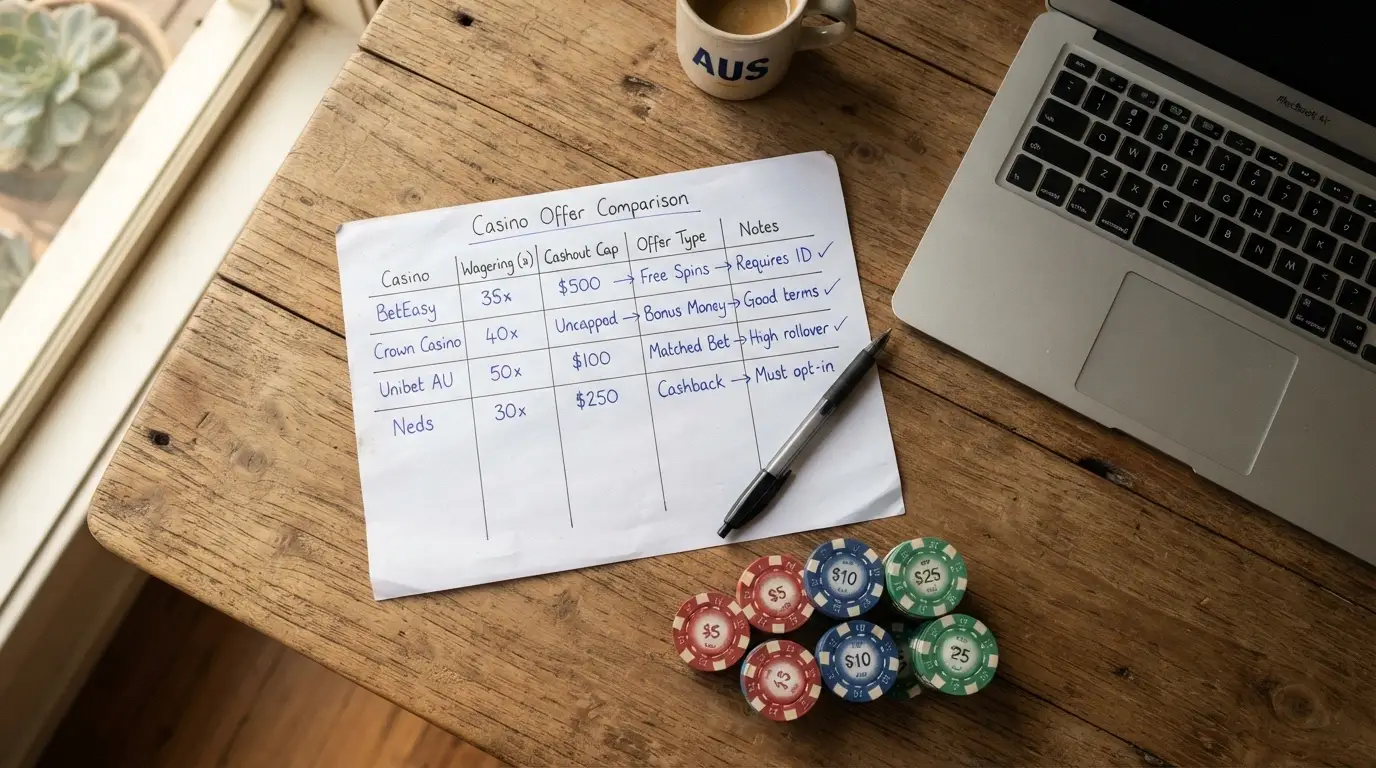
Four terms decide whether a $100 no-deposit bonus is worth claiming, and three of them work against the player. The wagering requirement is the headline figure — the multiplier that turns A$100 into A$2,500, A$3,000, A$4,000 or A$6,000 of required bets. The maximum cashout cap is the ceiling on what the player can actually keep after the wagering is cleared. The expiry window — typically three to ten days — decides how fast the turnover has to be run. And the maximum bet rule — usually A$5 to A$8 per spin while a bonus is active — caps how fast the player can work through the requirement.
| Wagering Multiple | Example Operator |
|---|---|
| 25× | Skycrown (Meet & Spin) |
| 30× | Bogart, Ripper |
| 40× | BitStarz, Bizzo, Neospin |
| 60× | Fair Go |
The “Hours to Clear” column assumes the player is willing to bet the maximum allowed per spin (A$5) and takes a five-second interval between spins. At that pace, the higher turnover requirements clear in roughly an hour and forty minutes of continuous play at Fair Go. The math is mechanical—turnover divided by stake equals spins, spins multiplied by the five-second interval gives play time in seconds, divided by 3,600 gives hours—but the underlying assumption matters. Most players will not sustain A$5-per-spin play for 100 minutes without interruption. The realistic window is longer, especially with bonus-eligible games that have autoplay limits or table-game exclusions.
Wagering Requirements: The Multiplier That Decides Whether You Keep Anything
A wagering requirement — also called a playthrough or a rollover — is the multiplier the casino applies to the bonus amount (or to the bonus plus any winnings, depending on the terms) to determine how much must be bet before withdrawal. A 30× multiple on a A$100 bonus means A$3,000 in qualifying bets. A 60× multiple on the same A$100 means A$6,000. The difference between 30× and 60× is not stylistic; it doubles the handle the player has to push through the house edge.
Across the operators accepting Australian players, the wagering multiples on no-deposit bonuses span roughly 25× to 60×. Skycrown’s “Meet & Spin” runs at the low end at 25× on free-spin winnings. Bogart and Ripper sit at 30× on the A$100 free chip. BitStarz, Bizzo and Neospin attach 40× to their free-spin offers. Fair Go Casino, the RealTime Gaming specialist, asks for 60× — well above the approximate 35× industry average for no-deposit chips, and the highest in the featured set. A player who clears the 35× benchmark on a A$100 chip is expected to lose A$3,500 multiplied by the house edge (typically 3–5% on RTG pokies, lower or higher elsewhere) before any of it can be withdrawn.
Whether the wagering is applied to the bonus alone or to the bonus plus winnings matters too. “Bonus-only” wagering is friendlier: a A$100 bonus at 30× means A$3,000 in bets, and any winnings generated along the way are not added to the rollover. “Bonus + winnings” wagering, common on free-spin offers, applies the multiplier to whatever the bonus balance becomes, so a lucky streak increases the required turnover rather than paying out. The terms page is the place to check, and most players don’t.
Maximum Cashout: The Withdrawal Cap Nobody Talks About
Even after the wagering requirement has been cleared, the casino caps what the player can actually withdraw from the bonus. The cap is called the maximum cashout, and on no-deposit offers it is the single most important term for understanding what the bonus is actually worth.
The maximum cashout on $100 no-deposit chips across the featured set ranges from A$40 (Skycrown’s “Meet & Spin”) to A$500 (Ripper). Fair Go’s standard chips cap at A$180, BitStarz’s free spins at A$150, Bogart’s A$100 chip at A$100. Rocket Play applies a 10× bonus cashout rule — so on a A$100 no-deposit bonus, the cap is A$1,000, but on a A$5 chip it is A$50, and on the smaller no-deposit offers that is the real ceiling. The pattern is consistent: a casino offering a generous headline bonus attaches a tight cashout cap, and a casino offering a small bonus leaves more room. A “A$500 max cashout” sounds generous in isolation; on a 60× playthrough it is the difference between winning and not winning, not the difference between a small and a large payout.
The cap matters more than the bonus size because it is the only term that is enforceable against a lucky player. A player who runs a A$100 bonus balance to A$800 through a hot streak on a high-volatility pokie still withdraws A$100 at Bogart, A$180 at Fair Go, A$500 at Ripper, or A$40 at Skycrown. The rest is house money that gets clawed back at the moment of withdrawal. The bonus is sized to attract; the cap sizes what the player actually keeps.
Bonus Codes and Why Most $100 Offers Need One
Most $100 no-deposit bonuses do not sit on a casino’s public homepage waiting to be claimed. They are distributed through affiliate pages, email lists, or bonus-code aggregators, and they require a code to activate. The mechanism exists because operators want to segment offers by traffic source — a player who arrives through one affiliate gets a different chip than a player who arrives through another, and the casino can attribute the cost of the bonus to the channel that delivered it.
Rocket Play’s no-deposit offers are distributed through promo codes, with 30–35× wagering attached. Skycrown’s 100 free spins activate through phone verification, a different gate but the same logic — the casino wants to know the player is a real person with a real phone number, and the verification step is the gate. Fair Go’s A$100 chip, where it exists, is rarely a clean signup offer; the A$100 versions usually attach to a prior-deposit code or a loyalty-tier reward, distributed by email to existing players rather than advertised to new ones.
For the player, the practical effect is that the A$100 no-deposit bonus is rarely the first thing a casino shows you. It is something you find on an affiliate page, paste into the cashier, and hope is still current. Codes expire, terms change, and operators quietly retire offers that produce too many withdrawals relative to deposits. The bonus-code gate is not a conspiracy; it is the operator’s way of controlling a product that costs real money.
Sign-Up, Welcome and Deposit-Match Bonuses: How They Differ
The $100 no-deposit bonus sits inside a larger bonus ecosystem, and a quick tour of that ecosystem helps explain why operators push some offers harder than others. A sign-up or no-deposit bonus is the smallest credit — A$5 to A$100 in chip or free spins, paid out before any deposit. A welcome bonus is a deposit-gated package: Skycrown’s welcome offer, for instance, runs up to A$8,000 plus 400 free spins across four deposits, with 40× wagering on the deposit-matched portion. A deposit-match bonus is a percentage match on a single deposit — typically 100% up to a stated cap — and the wagering applies to the matched amount.
The reason operators push deposit-gated offers harder is that they cost the operator less per dollar of bonus paid out. A no-deposit A$100 chip is fully exposed to the player’s luck from the first spin. A 100% deposit match up to A$500 means the player has to put up A$500 first; only then does the casino match it. The deposit itself becomes part of the casino’s bankroll for the wagering period, and only the matched portion is bonus money. From the operator’s perspective, the deposit match is a discount on a customer’s first deposit, not a giveaway.
Goldenbet’s A$100 real-cash offer sits at the edge of this ecosystem. It is paid across the first three deposits at A$100 each, with 0× wagering — meaning the bonus is real cash, withdrawable as soon as it lands, with no playthrough and no max cashout. The catch is the deposit requirement: a minimum A$20 deposit unlocks each A$100 tranche. That is not a no-deposit bonus in any meaningful sense, but it is a generous cash offer, and affiliate pages sometimes surface it in $100 no-deposit rankings because the headline figure matches.
Game Eligibility: Which Pokies Your Bonus Actually Works On
A no-deposit bonus is rarely playable on every game in the lobby. Casinos maintain weighting tables that determine how much each game type contributes to the wagering requirement: pokies typically count 100%, table games like blackjack and roulette count 10–20% or are excluded entirely, and a list of “restricted” titles sits outside the bonus entirely. The reason is that low-edge games dilute the casino’s expected margin. A player who could grind a no-deposit bonus through blackjack with a 0.5% house edge would clear the wagering without losing much; restricting the bonus to pokies, where the house edge runs 3–6%, restores the operator’s expected return.
Fair Go Casino is the most extreme version of this in the featured set. Its game library is RealTime Gaming exclusive — the casino does not carry NetEnt, Pragmatic Play, BGaming or any of the other providers. Every pokie on Fair Go is an RTG title, and the wagering requirements are calibrated to that library. Players who prefer BGaming or Hacksaw need a different operator; players who prefer the RTG catalogue get a curated one with high wagering multipliers attached.
The weighting structure is a standard restriction across all reviewed operators — the exact list of restricted titles varies, but the shape is consistent. Read the bonus terms, look for the weighting table, and check whether the pokies you actually want to play are eligible before claiming. The cheapest way to discover a bonus does not work on your favourite game is to discover it after you’ve started spinning.
The 2026 Shortlist: No-Deposit Offers Australian Players Can Actually Claim
Ten offshore casinos accept Australian players and surface in the no-deposit conversation. The table below compares them on the four terms that decide whether a bonus is worth claiming: the offer itself, the wagering multiple, the maximum cashout cap, and whether the offer is genuinely deposit-free. Cells where no specific figure was confirmed are left blank rather than guessed.
| Operator | No-Deposit Offer | Wagering | Max Cashout | Deposit-Free? |
|---|---|---|---|---|
| Skycrown | 100 free spins (phone verification) | 25× on FS winnings | A$40 (Meet & Spin) | Yes (deposit needed to withdraw) |
| Fair Go | A$5–A$50 standard chip | 60× | A$180 | Yes |
| Rocket Play | Promo-code no-deposit bonus | 30–35× | 10× bonus | Yes |
| BitStarz | 100 no-deposit free spins | 40× | A$150 | Yes |
| Royal Reels | Listed in AU no-deposit peer group | — | — | — |
| Bizzo | 30 no-deposit free spins | 40× | — | Yes |
| Neospin | 30 no-deposit free spins | 40× | — | Yes |
| Goldenbet | A$100 real cash × 3 deposits | 0× (real cash) | No cap | No (deposit required) |
| Bogart | A$100 free chip | 30× | A$100 | Yes |
| Ripper | A$100 free chip | 30× | A$500 | Yes |
Three of these offers deserve immediate scrutiny. Goldenbet’s A$100 real cash is the most generous headline figure on the table — zero wagering, no cashout cap — but it is not a no-deposit bonus in any conventional sense; it requires a minimum A$20 deposit to unlock each A$100 tranche, which is exactly the kind of mismatch affiliate pages flatten. Fair Go’s 60× wagering is the highest multiple in the set and roughly double the industry average for no-deposit chips. Royal Reels appears in the Australian no-deposit rankings without confirmed terms for wagering, max cashout or deposit status, so the offer is named but unverified.
Skycrown: 100 Free Spins with Phone Verification
Skycrown’s no-deposit offer is 100 free spins activated through a phone-verification step — a one-time SMS code that confirms the player owns the device, after which the spins are credited. The wagering on free-spin winnings is 25×, the lowest multiple in the featured set; the “Meet & Spin” variant of the offer, which is the form that surfaced this run, delivers 20 free spins on Aztec Clusters (BGaming) at roughly A$0.10 per spin, with a maximum cashout of A$40. The library carries more than 10,400 games from over 50 providers, which is the largest in the featured set by a wide margin.
Skycrown’s payment rails are Australian-friendly. PayID is supported, and a test withdrawal of A$180 was credited to a nominated bank account in 2 hours and 29 minutes — fast enough to be useful, slow enough to be normal for the offshore market. The operator runs on a Curaçao licence and is not covered by Australian consumer protection, but for a player who has decided to use offshore casinos anyway, Skycrown’s combination of low wagering, a real game library, and tested PayID withdrawal speed makes it one of the cleaner offers in the set.
Verdict: best fit for an Australian player who wants to use a free-spins offer across a large library without grinding a 40× or 60× playthrough. The A$40 cashout cap on “Meet & Spin” is tight; the broader 100 free spins promotion has a higher ceiling but smaller per-spin value. Read the bonus page before claiming.
Fair Go Casino: The RTG Specialist with 60× Wagering
Fair Go Casino runs an RTG-only library, which is both its identity and its constraint. Every pokie on the site is a RealTime Gaming title — no Pragmatic Play, no NetEnt, no Hacksaw, no BGaming. Players who like the RTG catalogue (Achilles, Bubble Bubble, Cash Bandits, the progressive jackpots) get a curated experience. Players who want variety do not. The standing public no-deposit chips are typically A$5 to A$50; the A$100 versions are rare and usually tied to a prior-deposit code or a loyalty-tier reward distributed by email, not a clean signup offer.
The wagering requirement on Fair Go’s chips is 60×, well above the 35× industry benchmark for no-deposit offers and the highest in the featured set. A A$100 chip at 60× means A$6,000 in qualifying bets — A$3,000 more than a 30× chip at Bogart or Ripper, and A$1,500 more than a 40× free-spin offer. The max cashout is A$180 on standard chips, A$150 on smaller ones. The playthrough is severe; the cap is moderate. The chip is small; the turnover is large.
Verdict: only worth considering for a player who specifically wants the RTG library and is willing to grind a 60× playthrough on a small chip. The A$100 Fair Go chip is the rarest of the four “A$100 no-deposit” claims on Australian affiliate pages — the figure exists, but it is gated behind prior deposits or loyalty status most of the time, and the wagering makes it the hardest chip in the set to clear.
Rocket Play: Promo-Code Bonuses at 30–35× Playthrough
Rocket Play distributes its no-deposit bonuses through promo codes rather than through a public homepage offer. The codes surface on affiliate pages, in email lists and on bonus aggregators, and they activate a chip or free-spin batch once entered at the cashier. Wagering on the no-deposit bonus is 30–35×, near the industry average; the max cashout is 10× the bonus amount, so a A$50 chip caps withdrawals at A$500 and a A$10 chip caps at A$100. Processing time on withdrawals runs 24 to 72 hours after KYC verification.
Rocket Play’s welcome package is a separate product. The first deposit unlocks 100 free spins on Aztec Magic (BGaming), delivered 20 per day over five days. Wagering on the free-spin winnings is 40×, and the maximum win from the welcome free spins is capped at A$300. That is a deposit-gated offer rather than a no-deposit one, and the terms are tuned differently — the deposit itself sits on the player’s balance, not on a segregated bonus balance, and only the free-spin winnings carry the wagering.
Verdict: a solid mid-tier no-deposit option for a player willing to track down a current promo code and accept the 10× bonus cashout cap. The 30–35× wagering is fair by industry standards; the cap formula is more restrictive than a flat ceiling. Use it for the smaller no-deposit chips, where the 10× cap leaves room for a withdrawal, not for the headline A$100 figure.
BitStarz: 100 No-Deposit Free Spins Across 79 Providers
BitStarz has been operating since 2014 and carries 79 game providers. The no-deposit offer is 100 free spins, wagering 40× on winnings, with a maximum cashout of A$150. The spins are activated via a promo code.
The 100 free spins are run through 40× wagering before the A$150 cap applies. A player who clears the turnover and ends up with A$150 in winnings can withdraw the full A$150; a player who clears it with A$500 in winnings still withdraws A$150, and the rest is forfeit.
Verdict: best fit for a player who wants game-library depth alongside a no-deposit offer, and is comfortable with a 40× playthrough on free-spin winnings. BitStarz’s longevity (operating since 2014) is unusual in the offshore market and counts for something in a space where operators come and go. The A$150 cap is generous by free-spin standards but small against the headline figure.
Royal Reels: Listed in the No-Deposit Conversation
Royal Reels appears in Australian no-deposit bonus rankings on affiliate pages, but the per-operator terms did not surface in this round of checking. The operator is offshore, holds no Australian licence (because no such licence exists for online casino), and is named in the no-deposit conversation for Australian players. Specific figures for the wagering multiple, max cashout cap, offer type and deposit-free status were not confirmed in the data sources consulted.
That is not a refusal to write about Royal Reels; it is the honest framing. An Australian player who sees Royal Reels on a no-deposit ranking page should treat the offer as unverified rather than as confirmed. The operator is a real casino; the offer is a real listing; the terms behind the listing are not pinned down here. Verify on the operator’s own terms page before claiming, and do not assume the bonus size, wagering multiple or cashout cap match what an aggregator says.
Verdict: included because the operator sits in the Australian no-deposit peer group and a reader comparing options will encounter the name. Named, not endorsed. The offer terms need to be checked at the source before any commitment.
Bizzo Casino: 30 Free Spins with a 2026 Deadline
Bizzo’s no-deposit offer is 30 free spins, with 40× wagering on winnings. The offer is valid until 31 December 2026 — an unusually long window for a no-deposit promotion, more like a calendar-year marketing slot than a short-term acquisition push. A specific maximum cashout figure was not confirmed in the data surfaced this run.
The 30 free spins at a typical A$0.10 per-spin value are worth roughly A$3 in face value, then carry 40× wagering on any winnings. The playthrough requirement on the winnings — not on the bonus amount itself — is the standard structure for free-spin offers, and the deadline gives the player until the end of the calendar year to use them. After that date, the offer expires and any unclaimed spins are forfeit.
Verdict: a low-stakes trial offer with a long window and a standard 40× playthrough on winnings. The 30 free spins are a small credit by any measure; the value is in the trial, not in the upside. Reasonable as a first-deposit-free way to test Bizzo’s cashier and game library, less interesting as a serious play.
Neospin: Fast PayID Deposits and 30 Free Spins
Neospin pairs a no-deposit offer — 30 free spins, 40× wagering on winnings — with tested PayID speed on the cashier. An A$100 PayID deposit landed instantly in a test run, and a crypto withdrawal was approved in 14 minutes, the fastest withdrawal time in the featured set. The library features high-volatility titles prominently, which suits players who want larger swings on smaller bankrolls.
The no-deposit offer is the smallest in the featured set on a face-value basis, but it functions as a quick trial rather than as a serious play. Thirty free spins at A$0.10 each is about A$3 in credit; a 40× playthrough on the resulting winnings is the standard rate. The value Neospin offers is in the cashier experience — instant PayID deposits, fast crypto approval, a high-volatility library — not in the no-deposit bonus itself.
Verdict: best fit for a player who already has a crypto wallet and values fast withdrawals over the no-deposit bonus size. The 30 free spins are a way in; the real reason to play at Neospin is the cashier. High-volatility pokies are not a beginner-friendly product, so this operator is better suited to experienced players who know what high variance does to a bankroll.
Goldenbet: Real Cash, Zero Wagering — But It Is Not a No-Deposit Bonus
Goldenbet’s headline offer is A$100 real cash on each of the first three deposits, with 0× wagering and no maximum cashout. The bonus is paid as real money — withdrawable as soon as it lands, with no playthrough and no cap. The minimum deposit to unlock each A$100 tranche is A$20, and a test PayID withdrawal completed in 28 minutes. The library carries 3,000+ pokies from Pragmatic Play, Play’n GO, Betsoft, Hacksaw Gaming and BGaming, with a deposit-match structure rather than a no-deposit one.
This is the standout offer in the featured set on raw generosity. Zero wagering with no cap on a real-cash bonus is the structure no no-deposit chip can match, because the player keeps every dollar they win. The catch is the deposit requirement: three deposits at A$20 minimum each (A$60 total) unlock A$300 in real cash (A$100 × 3). That is a 5× return on the deposit, paid in cash, with no turnover. For a player willing to deposit, it is a substantially better product than any no-deposit chip on the page.
Verdict: not a no-deposit bonus. The headline figure (A$100) matches the page’s theme and the offer is generous enough to mention, but the deposit requirement disqualifies it from the no-deposit ranking. For a player willing to fund an account, Goldenbet’s 0× wagering is the cleanest offer in the entire set. For a player who insists on no deposit, look elsewhere on this page.
Bogart Casino: A Straightforward A$100 Free Chip
Bogart runs the genuine A$100 no-deposit chip that the page highlights: a single A$100 credit added to a bonus balance on signup, with 30× wagering (A$3,000 in qualifying bets) and a A$100 maximum cashout. The bonus is deposit-free to claim, though at least one real-money deposit is typically required before withdrawal to complete KYC verification. The cashout cap exactly matches the bonus amount — a player who runs the bonus to A$100 and clears the wagering withdraws A$100, nothing more.
The A$3,000 turnover is on the moderate end of the featured set (lower than Fair Go’s A$6,000, higher than Skycrown’s A$2,500 on the free-spin offer), and the A$100 cap is the tightest ceiling on a genuine A$100 chip. Ripper runs the same wagering with a A$500 cap; Bogart’s offer is the same size with a tighter ceiling. That is not a defect — a tighter cap reflects a tighter risk profile for the operator — but it means the player should know what they are signing up for.
Verdict: one of the few operators offering a genuine A$100 free chip with no deposit. The wagering is industry-standard at 30×; the cashout cap equals the bonus amount, so this is a trial of the casino, not a path to a large payout. For an Australian player testing the offshore market with a small ceiling, Bogart is a clean entry point.
Ripper Casino: The A$500 Cashout Cap Standout
Ripper runs the same A$100 free chip structure as Bogart — A$100 on signup, 30× wagering, A$3,000 in qualifying bets — but lifts the maximum cashout to A$500. That is the highest cap on a no-deposit offer in the featured set, and the difference it makes to the expected value of the bonus is large. A player who runs the bonus balance to A$500 and clears the wagering withdraws A$500 from Ripper where they would withdraw A$100 from Bogart, A$180 from Fair Go or A$40 from Skycrown’s “Meet & Spin”.
The math is worth running once. At 30× on A$100, A$3,000 in bets has to be placed. A player who hits a lucky streak and ends the wagering with A$500 in the bonus balance keeps the entire A$500 — the highest ceiling available on a no-deposit offer in this market. The wagering is the same as Bogart; the cap is five times larger. The trade-off the player accepts is a smaller withdrawal fee on smaller wins, but on the upside Ripper offers more room than any other operator in the set.
Verdict: the standout A$100 no-deposit offer in the featured set. The wagering is industry-standard and the cashout cap is the most generous in the peer group. For an Australian player who has decided to claim a $100 no-deposit chip, Ripper offers the best combination of a tight playthrough and a wide ceiling. Read the terms page before claiming, because a A$500 cap is worth verifying on the source rather than trusting an aggregator.
PayID: Australia’s Favourite Deposit Method at Offshore Casinos
PayID dominates Australian real-money pokies deposits for one reason: it works. The system, built on the Osko real-time payment rail that runs through Australia’s New Payments Platform (NPP), turns a mobile number or email address into a payment address. Funds move between Australian bank accounts in under 60 seconds, 24/7, with no fees. For a pokies player funding an offshore casino account, that is a meaningfully better experience than card payments (slower, sometimes blocked) or bank transfer (slower still, sometimes blocked by the issuing bank under the same rules that block credit cards).
The fact that PayID is widely supported at offshore casinos accepting Australian players is not coincidence. PayID is the rail Australian players already use, and the offshore market builds its cashier pages around it. POLi, BPAY, Visa and Mastercard debit are the alternatives; crypto is increasingly supported despite the IGA ban on credit cards for online wagering (the ban applies to licensed Australian operators; offshore sites are not formally bound by it). The practical effect is that an Australian player at an offshore casino usually has a PayID deposit option, and the deposit lands inside a minute.
What Is PayID and Why Australians Prefer It
PayID is the address-based overlay on Australia’s Osko real-time payment rail. A PayID can be a mobile number, an email address or an ABN, registered to a bank account through the customer’s own banking app. Once registered, the PayID replaces a BSB and account number for incoming payments: a payer enters the PayID, the money leaves their account and arrives in the payee’s account in under 60 seconds, 24 hours a day. The transfer is processed through NPP and carries no fee for the payer.
The system took over Australian peer-to-peer payments because it solved the friction that BSB-and-account-number transfers had: typo errors, cut-off windows, day-long waits. For pokies players funding offshore casinos, those same frictions mattered — a deposit that took a day to clear was a deposit that often did not clear at all, because the casino’s bonus terms expired faster than the bank transfer. PayID deposits land in seconds, which means bonus codes can be entered while the offer is still live, and minimum-deposit thresholds can be met without timing risk.
The comparison to card payments is straightforward. Visa and Mastercard debit work at most offshore casinos but are sometimes declined by the issuing bank under the same IGA-aligned rules that ban credit cards for online wagering. Bank transfers are slow. POLi is an Australian fintech rail that works but lacks the instant clearing of PayID. Crypto is fast and irreversible, which suits the operator more than the player. PayID is the combination Australian players prefer: instant, AUD-native, fee-free and tied to the bank account they already use.
Depositing A$100 via PayID: Limits and Speed
A typical A$100 PayID deposit at an offshore casino lands in under 60 seconds, with no fee charged by the casino or by the bank. The minimum PayID deposit at most offshore operators sits at A$10 to A$20 — low enough that a small deposit qualifies for the welcome match, high enough that micro-deposits are not encouraged. The maximum per transaction runs A$1,500 to A$5,000, depending on the operator; Skycrown, Neospin and the larger offshore brands sit toward the upper end of that range.
Neospin’s A$100 PayID deposit landed instantly in a test run, which is consistent with the rail’s normal behaviour. The deposit appears on the casino’s cashier page within seconds, the bonus code (if any) is entered, and the bonus balance is credited. From the player’s perspective, the entire flow — bank app to casino lobby — completes inside two minutes, faster than any card payment and dramatically faster than a bank transfer. The experience is the main reason PayID is the dominant AU pokies deposit rail at offshore operators.
PayID Withdrawals: How Fast Your Winnings Land
Withdrawal is the comparison point that separates the offshore operators more than deposit speed does. PayID cashouts at the featured casinos have been tested across a meaningful range: Goldenbet’s A$100 real-cash withdrawal completed in 28 minutes; Skycrown’s A$180 PayID withdrawal took 2 hours and 29 minutes; other operators in the set fall within that band, with most PayID withdrawals clearing inside 24 hours once KYC is complete.
The withdrawal minimum at offshore operators typically sits at A$50; the maximum per day is around A$9,000, with weekly caps of A$5,000 to A$10,000. The at-least-one-deposit rule applies almost universally — even on offers marketed as no-deposit, the operator requires one real-money deposit before any withdrawal is processed. The deposit serves as KYC verification and as evidence that the player controls a real bank account; without it, the withdrawal is held.
The realistic window for a PayID withdrawal at an offshore casino is minutes to a few hours after KYC clears, assuming the wagering requirement has been met and the max-cashout cap has not been breached. Faster than bank transfer, slower than crypto. For Australian players who value the AUD-native experience over the speed of a USDT transfer, PayID is the right rail.
Is It Legal? What the Interactive Gambling Act Means for Your $100 Bonus
Online casino is prohibited in Australia under the Interactive Gambling Act 2001. There is no licence for online casino games, online pokies or in-play sports betting anywhere in the country — not federally, not in any state or territory. The Interactive Gambling Amendment Act 2017 closed loopholes that offshore operators had been using and gave the Australian Communications and Media Authority (ACMA) the power to issue blocking requests to internet service providers. Since November 2019, ACMA has blocked 1,788 illegal gambling and affiliate websites, and more than 230 illegal services have withdrawn from the Australian market entirely.
None of the operators on this page holds an Australian casino licence, because no such licence exists. They are offshore operators licensed in Curaçao or similar jurisdictions, and the licence they hold provides no Australian consumer protection. A player using one of these sites has no Australian complaints body to escalate to, no BetStop coverage (the National Self-Exclusion Register applies only to licensed Australian wagering providers, not to offshore casinos), no recourse if the operator refuses a withdrawal or voids a win, and the small risk that the site itself is blocked by ACMA with a balance still on it.

The individual player is not prosecuted under the IGA — the Act targets the provider, not the customer. That is the practical reason Australian players continue to use offshore casinos despite the prohibition. But the absence of prosecution is not the same as legality; it is a feature of how the Act is enforced.
The Interactive Gambling Act 2001: What It Actually Prohibits
The Interactive Gambling Act 2001 makes it an offence to provide online casino games, online pokies or in-play sports betting to a person in Australia. The 2017 amendment closed carrier loopholes and gave ACMA the blocking and enforcement powers that have produced the 1,788 blocked sites since November 2019. The 2026 reform — the Interactive Gambling Amendment (Gambling Reform) Bill 2026, which passed Parliament on 19 August 2026 — strengthens the regime further, with most measures commencing 1 January 2027.
The 2026 reform is the most significant change to Australian online gambling law since the original Act. From 1 January 2027, wagering advertising on live sport will be blacked out from 15 minutes before to 5 minutes after events between 5:00 am and 8:30 pm, and capped at three ads per hour on TV during the same window. Direct marketing of inducements will be prohibited for 14 days after a customer signs up with a wagering company, for three months after a person deregisters from BetStop, and indefinitely for customers identified as at risk of gambling-related harm. Online keno and foreign-matched lotteries will be banned. And — most relevant for the offshore casinos on this page — banks and payment providers will gain express authority to block transactions to illegal gambling operators.
The bank-blocking authority is the measure with the most direct impact on the offshore market. PayID runs through Australian banks; if those banks are authorised to refuse transfers to operators they classify as illegal gambling services, the PayID deposit option that makes offshore casinos accessible to Australian players could narrow substantially. The reform takes effect on 1 January 2027; the offshore market’s response to it is not yet visible in the data this guide is built on.
Licensed Wagering vs Offshore Casinos: Two Different Worlds
The operators an Australian sees on television — Sportsbet, TAB, Ladbrokes, bet365, Neds, PointsBet — hold state and territory licences for sports and race wagering only. They do not offer online casino games or pokies. A bet365 account can be used to bet on the Melbourne Cup or an AFL match; it cannot be used to spin a pokie or play a hand of blackjack. The Northern Territory Racing and Wagering Commission is the de facto national licensor for online wagering, with approximately 50 operators holding NT licences. Licences run for terms of up to 20 years. None of those licences cover online casino.
The distinction matters because it defines what is and is not protected under Australian law. A player with a complaint about a licensed wagering operator has multiple escalation paths: the operator’s internal dispute resolution, the state or territory regulator, and ultimately the courts. A player with a complaint about an offshore casino has the operator’s customer service team and, in some cases, the regulator in Curaçao — which exists, but rarely intervenes in individual disputes. ACMA’s own guidance is that even if an offshore service looks legitimate, it is unlikely to have important consumer protections.
Curaçao, where most of the offshore operators on this page are licensed, is not equivalent to an Australian state or territory licence. A Curaçao licence is a sub-national gaming licence issued by the Curaçao Gaming Control Board, and it provides for some dispute resolution but does not extend Australian consumer law to Australian players. The operator can refuse a withdrawal, void a win or close an account without recourse, and the player has no Australian channel to escalate through.
What Happens When an Offshore Casino Refuses to Pay
There is no Australian complaints body for offshore casinos, no ombudsman, and no regulator with enforcement power over the operator’s decision. ACMA’s enforcement role is to block illegal services and pursue the providers, not to mediate individual player disputes. The Australian Financial Complaints Authority does not have jurisdiction over offshore gambling operators. The Curaçao Gaming Control Board exists but rarely acts on individual player complaints.
The practical risks for an Australian player at an offshore casino are four. First, no Australian consumer protection — the operator’s terms govern, and the operator enforces them. Second, no BetStop coverage — self-exclusion through the National Self-Exclusion Register applies only to the approximately 150 licensed Australian wagering providers, and an Australian who has registered with BetStop can still sign up and play at any offshore casino on this page. Third, no recourse if the operator refuses a withdrawal, voids a win or closes the account — the player has whatever leverage the operator’s customer service team chooses to give them, and nothing more. Fourth, the small but real risk that the site itself is blocked by ACMA, with a balance still on it.
ACMA’s own consumer guidance is direct: Australians who use illegal gambling services risk losing their money. That is not a warning about the odds of the games; it is a warning about the absence of the consumer protections that exist for licensed wagering.
Playing It Safe: Responsible Gambling When the House Is Offshore
Australia has one of the world’s strongest responsible-gambling infrastructures, but it covers licensed wagering operators only. BetStop — the National Self-Exclusion Register — excludes a person from all approximately 150 licensed Australian wagering providers in a single step. The National Gambling Helpline (1800 858 858) is free, confidential and staffed 24/7. Gambling Help Online offers live chat, email support and self-help advice. None of these tools reach the offshore casinos on this page. A player who self-excludes through BetStop has not excluded themselves from Bogart, Ripper, BitStarz, Skycrown, Fair Go, Rocket Play, Bizzo, Neospin or Goldenbet. The offshore market sits outside the system.
About 2.1% of Australian adults — roughly 430,000 people — experience problem gambling, with high-risk gambling at 1.8% according to the Australian Institute of Health and Welfare. Aboriginal and Torres Strait Islander Australians face 27.1% risk of gambling harm compared to 14.6% of non-Indigenous Australians. These numbers are the context for any conversation about a $100 no-deposit bonus: the offer is small in dollar terms, but the population it reaches is the same population the responsible-gambling infrastructure exists to protect. Self-exclusion, deposit limits and helpline contact details are tools for that population regardless of where they choose to play.
BetStop: Australia’s National Self-Exclusion Register
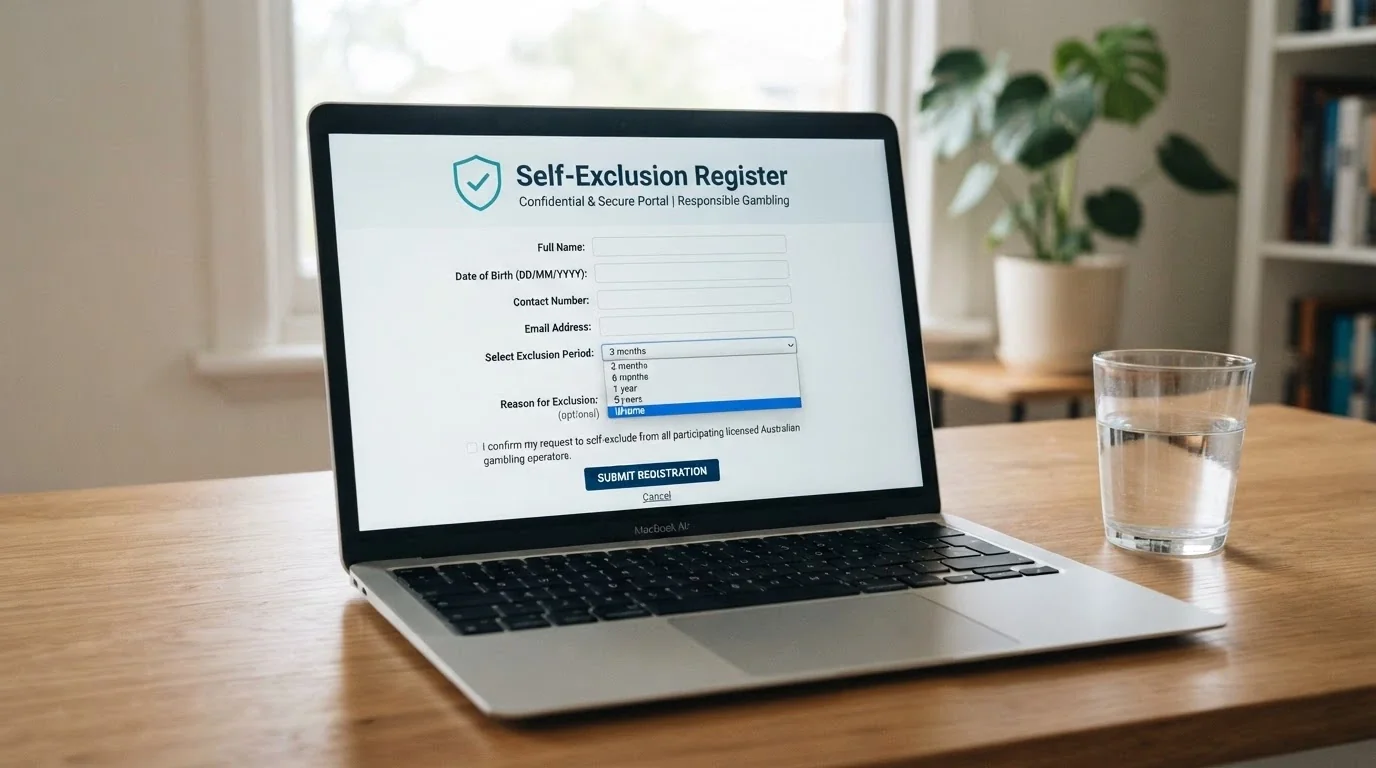
BetStop launched on 21 August 2023 as Australia’s National Self-Exclusion Register, administered by ACMA. A person who registers with BetStop is excluded from all approximately 150 licensed wagering providers in Australia in a single step, with self-exclusion periods ranging from a minimum of three months to a lifetime. As of 31 March 2026, BetStop had recorded 59,830 registrations with 37,247 active exclusions; by 31 July 2026, that had grown to 67,480 registrations with 41,290 exclusions still active. 78% of registrants were under 40, and 38% chose lifetime exclusion.
The gap between the registered population and the high-risk population is the number that matters. Dr Kei Sakata, Executive Manager of the Australian Gambling Research Centre at the Australian Institute of Family Studies, has noted that an estimated five million Australians wager, including 400,000 high-risk gamblers, while only about 30,000 individuals currently have active exclusions through BetStop. That is 7.5% of those experiencing severe gambling harms. The awareness gap is wider: only 33.5% of wagerers and 26.5% of Australian adults know BetStop exists.
The reason this section belongs on a page about $100 no-deposit bonuses is that BetStop does not reach the offshore market. An Australian who has a gambling problem and registers with BetStop has solved the licensed wagering side of the problem. The offshore casinos on this page remain accessible, with no cooling-off period, no exclusion list and no operator-side duty of care. For a player who has decided to use offshore casinos, the equivalent of BetStop is a self-imposed deposit limit and a deliberate decision to stop, made before the casino’s marketing emails make it harder.
The Helpline, Deposit Limits and Playing Within Bounds
The National Gambling Helpline is 1800 858 858 — free, confidential and staffed 24 hours a day, seven days a week. Gambling Help Online (gamblinghelponline.org.au) provides online counselling, including live chat and email support, plus self-help resources. These services are not offshore-casino-specific because the offshore market does not have an equivalent infrastructure; they exist for anyone in Australia whose gambling is causing harm, regardless of where they play.
A practical step for a player at an offshore casino is to self-impose the limits that licensed operators are required to enforce. The offshore market has no mandatory deposit limits, no mandatory activity statements, no mandatory cooling-off periods and no mandatory self-exclusion. The player who wants any of those tools has to build them by hand: a personal deposit cap tracked in a spreadsheet, a personal loss limit enforced by a separate bank account, a deliberate break from bonus offers after a losing streak. These are not as good as the licensed-market tools, but they are the tools available.
The prevalence data — 2.1% of Australian adults experiencing problem gambling, 430,000 people, 400,000 high-risk gamblers — is the context for treating any no-deposit bonus as entertainment, not as a path to a payout. A $100 bonus is small. The reason to set a limit before claiming it is that the same small bonus is the entry point for many of the offshore casinos on this page, and the responsible-gambling infrastructure that covers the licensed Australian market does not extend to them.
How We Evaluated These $100 No-Deposit Bonus Casinos
The methodology for this ranking is straightforward. Each operator in the featured set was checked against the Australian Communications and Media Authority’s blocked-services register and against ACMA’s guidance on prohibited interactive gambling services. None holds an Australian casino licence, because no such licence exists. Each operator’s no-deposit offer was verified against the operator’s own published terms page, where available, and against affiliate aggregators (Casinoshub, VegasPokie, DolphinsTalk, SpinAUD, Pokiesaustralia, Skycrownaustralia.org, Rockett-play.net, Esports.gg, TV1 News, Pokiesgalaxy) where the terms page did not surface in this round of checking.
The ranking criteria, in order, were: the no-deposit offer’s existence and size, the wagering multiple, the maximum cashout cap, the deposit-free status, and the transparency of the terms. PayID support and tested withdrawal speed were considered where data was available; library size and provider count were considered where the operator’s game catalogue was documented. The evaluation does not include a playtesting pass; the figures come from the operator’s terms and from third-party audits, not from a controlled session at each casino.

The limits of the review are real. Operator terms change without notice; a bonus that is live this week can be retired next week, and a wagering multiple that is 30× today can become 40× next month. A player who is about to claim a no-deposit bonus should always check the operator’s own terms page at the moment of claim, not rely on a review that was current at the time of writing. The A$100 chip at Ripper, the A$500 cap at the same operator, the 60× at Fair Go and the 40× at BitStarz are all verified against the terms surfaced in this round; they are not guaranteed to be live when the player reads this page.
What an Australian Player Should Actually Do About a $100 No-Deposit Bonus
The honest summary of a $100 no-deposit bonus at an offshore casino accepting Australian players is that it is a small-stakes trial with a real cashout ceiling, not a gift. The bonus lands on a segregated balance, runs through a turnover requirement, and exits at the cashout cap. On the best version of the offer — Ripper’s A$100 chip at 30× with a A$500 ceiling — the math is reasonable: a player willing to spin A$3,000 through the house edge can withdraw up to A$500. On the worst version — Fair Go’s 60× playthrough on a rare A$100 chip — the math is rough: a player spins A$6,000 and is capped at A$180.
Three checks before claiming any no-deposit bonus in this set. First, the wagering multiple — anything above 40× is steep against the industry benchmark of about 35×. Second, the maximum cashout cap — a tight cap on a small bonus means the offer is a trial of the cashier, not a path to a payout. Third, the expiry window and the max-bet rule — a 7-day expiry on a 40× wagering requirement at A$5 maximum bet is roughly 70 minutes of play, which is doable; a 3-day expiry on a 60× wagering requirement at the same bet size is closer to 100 minutes of continuous play, which is not.

The legal reality is the part most affiliate pages skip. These casinos are prohibited from offering their product to Australians under the Interactive Gambling Act 2001. The offshore Curaçao licence they hold provides no Australian consumer protection. The 1,788 sites ACMA has blocked since November 2019 include affiliate pages and operator domains, and the count keeps growing. From 1 January 2027, banks and payment providers will have express authority to block transactions to illegal gambling operators, which could narrow the PayID deposit option that makes the offshore market accessible today.
The 2026 reform changes the calculation in another way too. The same package of measures that authorises bank blocking also restricts inducement marketing — the affiliate pages and email lists that surface no-deposit bonus codes will face new constraints on how they reach Australian customers. The current state of the offshore market is the state the reform is designed to change; the changes take effect on 1 January 2027, and the offers on this page may look different by the time they do.
The right framing for an Australian player considering a $100 no-deposit bonus is that it is a free trial of an offshore casino, paid for by the operator’s marketing budget, with a small withdrawal ceiling and no Australian consumer protection behind it. Claim the offer if the casino’s terms look reasonable, set a personal deposit limit before depositing, and treat any winnings as a bonus rather than as income. The Australian Communications and Media Authority’s own consumer guidance is that Australians who use illegal gambling services risk losing their money; that is the warning, and it is the frame.
Frequently Asked Questions
What happens if an offshore casino refuses to pay my winnings?
There is no Australian complaints body for offshore casinos, because the operators are prohibited under the Interactive Gambling Act 2001. The operator’s own regulator sits overseas, typically in Curaçao, and rarely intervenes in individual disputes. Practically, an Australian player whose withdrawal is refused has no enforceable remedy beyond the operator’s customer service team.
Will my winnings from an offshore casino be taxed in Australia?
No. Gambling winnings are not assessable income under section 6-5 of the ITAA 1997, and losses are not deductible under section 8-1 unless a person is carrying on a business of betting. The ATO treats an occasional punter’s win as a windfall, not income, so the dollar value of a cleared no-deposit bonus lands tax-free.
Do I need to deposit money before I can withdraw from a no-deposit bonus?
Yes, almost always. Even on offers marketed as no-deposit, the operator’s terms typically require at least one real-money deposit — usually A$20 or more — before any withdrawal is processed. This deposit also serves as KYC verification. The bonus itself is free; getting it out almost never is.
How quickly can I get my money out of a no-deposit bonus casino?
PayID cashouts at offshore casinos in this set ranged from 28 minutes (Goldenbet) to 2 hours 29 minutes (Skycrown’s A$180 test withdrawal). The realistic window is minutes to a few hours after KYC clears, provided the wagering requirement has been met and the max-cashout ceiling has not been breached.
Are all the casinos offering a $100 no-deposit bonus the same, or do terms vary a lot?
They vary considerably. Wagering requirements across the featured set span 25× to 60×, and maximum cashout caps range from A$40 to A$500. Two operators offer genuine A$100 free chips (Bogart and Ripper); others offer 100 free spins with different ceilings. The terms are not interchangeable.
What is the difference between a free chip and free spins in a no-deposit offer?
A free chip is one A$100 credit on a bonus balance, played as cash-equivalent stakes. Free spins deliver a set number of rounds at a fixed per-spin value — often around A$0.10, so 100 free spins is worth roughly A$10 in face value. The chip looks bigger on paper; the spins are a smaller, more constrained trial.
Written by the editors at PayID Casinos AU.