
Why every VIP casino program an Australian player finds is offshore
No Australian company holds a licence to run an online casino. The Interactive Gambling Act 2001 makes the provision of online casino games, online pokies and in-play betting a criminal offence, and the Australian Communications and Media Authority has used that authority to block 1,564 illegal gambling and affiliate websites since November 2019, pushing more than 225 services out of the Australian market since enforcement was strengthened in 2017. Every VIP loyalty program an Australian player encounters — the tier ladder, the cashback on losses, the dedicated host, the personalised bonuses — sits on an offshore domain run from somewhere else, under a licence held somewhere else, and accountable to no Australian regulator. That is the structural fact that shapes everything that follows.

Current as of 16 October 2026 — licence claims verified against the ACMA register and operator T&Cs.
Table of Contents
- Why every Australian online casino VIP program sits offshore in 2026
- The VIP programs Australian players actually use in 2026
- VIP pokies and live tables — the games that earn your tier fastest
- Why your VIP bonus is smaller than its headline number
- Crypto VIP casinos — a payment method Australia banned
- Is any of this legal? What the Interactive Gambling Act actually says
- When VIP chasing becomes a problem — safer play for high rollers
- How we selected and ranked these VIP programs
- What Australian players should actually do about online VIP casinos
- Frequently Asked Questions
Why every Australian online casino VIP program sits offshore in 2026
The Interactive Gambling Act 2001 prohibits online casino games, online pokies and in-play betting outright. The 2017 amendment closed the offshore loopholes the early statute left open and handed the ACMA the enforcement and site-blocking powers it uses today. The result is a simple, hard rule: an online casino cannot be lawfully provided to a person in Australia, and no licence exists that would let it be. That rule creates a vacuum the offshore market has rushed to fill. Affiliate pages, search results, social media promotions — almost every “Australian VIP casino” surface points at a brand licensed in Curaçao, Malta, Anjouan or Kahnawake, accepting Australian dollars, processing Australian payment methods, and offering the full VIP ladder.
The player is not prosecuted under the Act — the IGA targets the provider. What the player does give up is every layer of Australian consumer protection: no complaints body, no recourse if the operator refuses a withdrawal, no BetStop coverage, no chargeback right under Australian law, no guarantee the site will exist tomorrow. The offshore market targets Australian players because the regulatory perimeter leaves room to target them, and the targeting is the point.
What a VIP casino program actually is
A VIP program is the retention engine a casino runs to keep a player depositing. Every offshore program in this market rests on the same scaffolding: a comp-point engine that converts wagers into points, a tier ladder that converts points into status, and a reward catalogue that converts status into cashback, faster withdrawals, a personal host, and event access. The arithmetic underneath is plain — SkyCrown’s published rate is one comp point for every A$15 wagered — and the value extracted from the player is plain too.
The reward mix varies by tier. Entry-level players see weekly cashback of 3–5% on net losses, modest reloads, and a faster withdrawal queue than the rank-and-file customer. The top tiers earn 15–20% cashback, deposit insurance that returns a slice of daily losses, dedicated hosts with direct phone lines, and tailored bonus offers the casino does not publish. What the program really sells, once the cashback and reloads are added up, is continued play. Cashback on losses is a rebate on behaviour the casino is happy to keep collecting from, and a host’s job is to make sure a high-value customer feels seen.
That is why the wagering load on these rewards stays light. Cashback in this market typically carries around 5x wagering, because the rebate comes out of money the player has already played through. A welcome bonus, by contrast, is built to be played through: wagering multipliers of 30x to 40x are standard, and the turnover they generate is the casino’s actual return on the headline number. The “reward” is the loss-leader; the wagering is the business.
How loyalty tiers actually work — sign-up to the top tier
The mechanics of a tier ladder are uniform across the offshore market, even where the published detail is not. A player wagers, the casino credits comp points or experience points against those wagers, the points accumulate into a balance, and the balance maps onto a level. Move up a level and the casino credits a level-up bonus — at SkyCrown, A$10 plus 25 free spins at Level 1, scaling to A$500 plus 150 free spins at Level 10. Stay on a level long enough to climb further and the same cycle repeats.
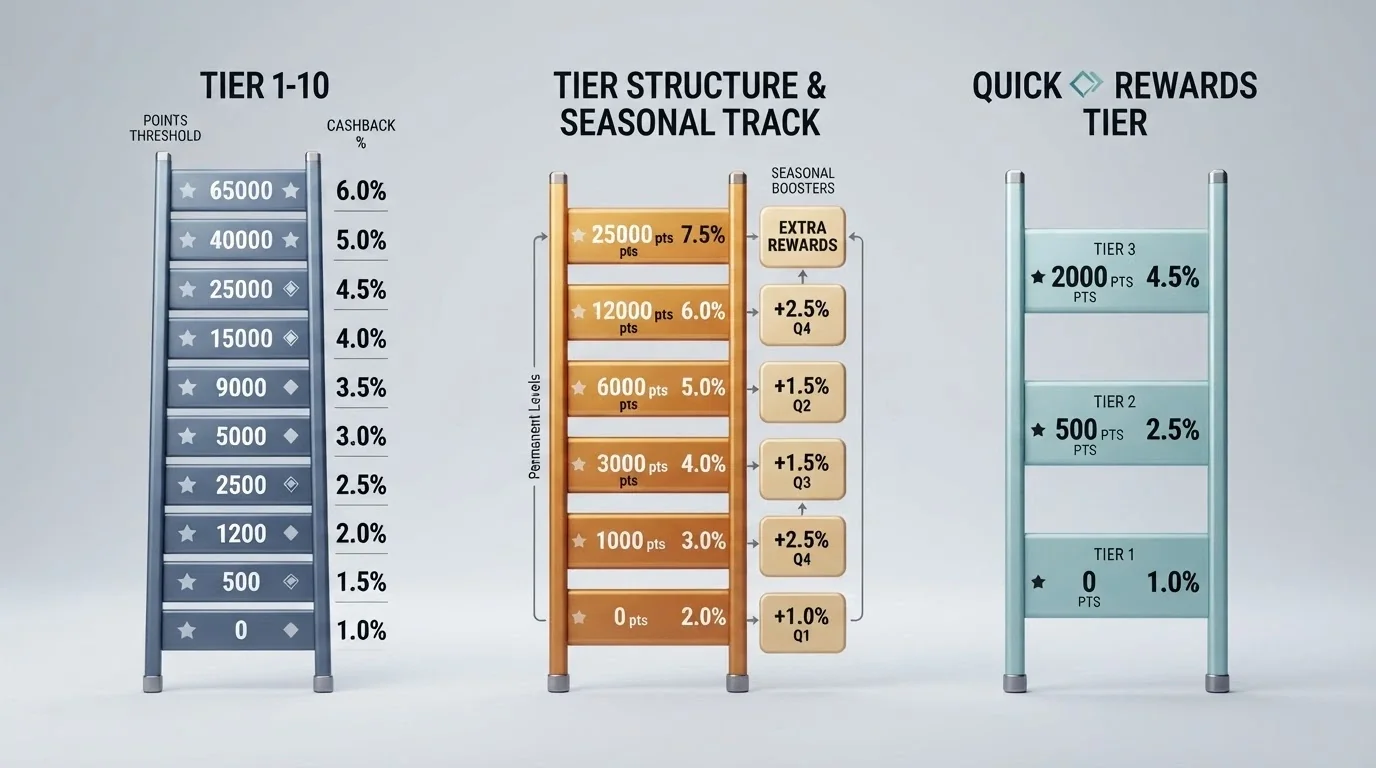
RocketPlay runs the most architecturally interesting version of this. The program is dual-track. The lifetime track runs Quark to Alloy and never resets, so a player who reaches the upper levels of that track keeps that status permanently. The seasonal track runs Bronze to Diamond and resets every three months — the seasonal tier ladder is wiped back down to Bronze every quarter regardless of how far the player climbed. The practical effect is that a player’s permanent status accrues slowly, but their active-season rewards reset on a clock the player can see.
The gap between mid-tier and top-tier is where the program’s real value, and its real cost, sits. Cashback scales across the tier ladder at a steeper rate than the level-up bonuses: entry-level players earn a small fraction of what the top tier does, and the rebate on losses, host, and exclusive offers sit at the top of the ladder. There is no deposit guarantee, and no operator provides a payout guarantee. Climbing to those levels requires substantial cumulative wagering, which is precisely what makes the program a retention engine rather than a reward. The casino pays out the most to the players who have already lost the most.
The Australian VIP landscape — offshore by default
The phrase “Australian VIP casino” describes a market, not a product. Every brand that ranks for the term is offshore, because no online casino licence exists in Australia to grant Australian status to. The state and territory licensing system that runs the licensed wagering market — the Northern Territory Racing and Wagering Commission as the de facto national licensor, with state-level point-of-consumption taxes layered on top — covers pre-event sports and racing wagering, lotteries, and keno. Online casino sits outside that scope entirely.
The contrast is sharpest with the land-based loyalty programs. Crown Rewards at Crown Melbourne runs five membership tiers; 500 Casino Points convert to one Status Credit for table games; the membership cycle is reviewed every 12 months on 1 October. The Star Club converts Casino Dollars at a rate of two to the Australian dollar, with Gold members earning at 1.25x and Platinum at 1.5x. SkyCity Adelaide’s VIP Gold tier requires an average of 500 points per week sustained over nine weeks and unlocks higher bet limits, bigger jackpots starting at over A$10,000, exclusive promotions, and free parking. These are licensed, regulated, and Australian — and they exist only because the player walks into a building.
For an Australian shopping the search results, the practical question is not “which VIP program is best” but “which offshore operator will let me deposit, pay me out, and still exist next week.” Two red flags identify the brands most likely to fail any of those three tests. The first is a payment method: any site asking for credit cards or cryptocurrency from an Australian customer is operating outside Australian rules — those payment rails were banned for online wagering on 11 June 2024, with operator penalties up to A$247,500. The second is a withdrawal process that requires the player to chase the operator rather than the operator chasing the player to keep them.
VIP membership benefits, rewards and the dedicated host
The catalogue of VIP rewards reads the same on most published programs, with the percentages and thresholds varying by tier. Cashback on net losses is the headline benefit — RocketPlay pays 7% weekly at Iron tier and scales to 10% at Diamond. This rebate on losses, sometimes termed loss-back, returns a slice of daily losses: RocketPlay’s structure covers up to 25%, with thresholds of A$1,000 for Bronze players, A$1,500 for Silver, and A$2,000 for the Gold and Diamond levels. Faster withdrawals and higher withdrawal limits arrive with the upper tiers. Birthday and anniversary bonuses appear as recurring calendar-based rewards. Exclusive event access, where it is published, takes the form of hospitality boxes, tournament invitations, and tournament prize-pool entries the casino underwrites for its top customers.
The dedicated host sits at the centre of the upper-tier experience. Rainbet’s published threshold is the highest in this set: a player becomes eligible for a VIP host after A$2.5 million in lifetime wagering. The host’s job is retention — a personalised bonus calibrated to the player’s recent play, a direct line to customer support that bypasses the queue, and the kind of attention that makes a high-value customer feel recognised. The same incentives that make a host valuable to a player make a host dangerous to a player who is chasing losses. The host does not exist to help a customer stop.
Managing your VIP status — login, support and porting between casinos
VIP status is not portable. The comp points, the tier level, the cashback rate, the host relationship — none of it transfers when a player opens an account at a different operator. Each casino runs its own program on its own ledger, and the only way to climb the ladder at the new brand is to wager at the new brand from the bottom. This is one of the structural differences between an offshore VIP program and a frequent-flyer or hotel loyalty scheme, where status earned at one airline can be matched or carried across an alliance.
What does carry over, in a sense, is the experience of being a VIP customer. A player who has reached an upper tier at one operator knows what to expect at the next: the cashback mechanic, the rebate on losses, the host, the calendar of personalised offers. Account management at VIP level typically adds a direct line to a personal host, priority routing through customer support, and faster verification of identity documents. The login experience itself is unchanged — the VIP player uses the same account portal and the same credentials, with the host and the tier benefits layered over the top.
Status maintenance requirements vary. RocketPlay’s lifetime track never expires, so the status a player reaches on that track stays put. The seasonal track resets every three months regardless. Other operators run maintenance requirements based on monthly or quarterly wagering floors, with status downgraded if the floor is not met. The published detail is thin across this market — most operators do not put their maintenance requirements on a public page — and a player approaching a meaningful tier should ask directly before assuming the status will hold.
The VIP programs Australian players actually use in 2026
The ten brands below are the offshore VIP programs that reach Australian players. None holds an Australian online casino licence, because no such licence exists. The table sets out what each program publishes about itself; the write-ups that follow cover the points a table cannot — what the operator actually offers, what is missing, and which readers each program fits.
| Operator | VIP Program at a Glance | AU Licence Status |
|---|---|---|
| SkyCrown | 10-level ladder, 1 CP per A$15 wagered, level-up bonuses A$10+25 FS to A$500+150 FS, 10% cashback (3x) up to A$1,500 | Offshore — no AU licence |
| RocketPlay | Dual-track: lifetime Quark–Alloy (never resets) plus seasonal Bronze–Diamond (3-month cycle); Iron at 15,000 XP; 7–10% weekly cashback; up to 25% deposit insurance | Offshore — no AU licence |
| Royal Reels | Tiered VIP with benefits noted in bonus T&Cs rather than published as a full ladder | Offshore — no AU licence |
| Stake | VIP program referenced in marketing; detailed tier structure not publicly disclosed at review time | Offshore — no AU licence |
| Rainbet | Recurring rakeback and reloads; VIP host eligibility from A$2.5 million lifetime wagering | Offshore — no AU licence |
| WinSpirit | Australia-facing brand; VIP terms not publicly disclosed at review time | Offshore — no AU licence |
| FairGO | Australia-facing brand name; VIP terms not publicly disclosed at review time | Offshore — no AU licence |
| Bizzo Casino | VIP terms not publicly disclosed at review time | Offshore — no AU licence |
| Rocket Casino | A separate operator from RocketPlay; VIP terms not publicly disclosed at review time | Offshore — no AU licence |
| Scream Casino | VIP terms not publicly disclosed at review time | Offshore — no AU licence |
SkyCrown
SkyCrown publishes the most transparent VIP ladder in this set. Ten levels, with comp points credited at one for every A$15 wagered, level-up bonuses that scale from A$10 plus 25 free spins at Level 1 to A$500 plus 150 free spins at Level 10, and a 10% cashback rate on net losses with 3x wagering. The ladder is on the public site, the conversion rate is explicit, and a player can work out their position at any time.
The welcome package is the deepest in the set: up to A$8,000 plus 400 free spins across four deposits, with 40x wagering on both the bonus money and the free spin winnings and a 14-day validity window. The catch is in the conversion cap — A$5,000 maximum bonus-to-real-money conversion on the welcome bonus, A$750 on regular bonuses — and the maximum bet during playthrough, set at A$7.50. The numbers are honest about what the offer is worth, and what it caps at, which is more than most operators in this market volunteer.
For a player who plans to climb a published ladder on a budget they can afford to lose, SkyCrown is the most legible option. For a player who wants an unlimited cashback ceiling or a higher level-up bonus at the top tier, the 10% rate and A$500 top-tier award are ordinary rather than generous. The operator is showing the work; that is the differentiator.
RocketPlay
RocketPlay’s dual-track program is the most structurally interesting in this set, and the only one a player can compare on the merits. The lifetime track runs Quark to Alloy and never resets — a player who reaches the upper levels keeps them. The seasonal track runs Bronze to Diamond and resets every three months regardless of the player’s wagering, which makes seasonal status a snapshot rather than an achievement. Iron, the entry to the seasonal track, requires 15,000 XP. Weekly cashback scales from 7% at Iron to 10% at Diamond. This rebate on losses covers up to 25% of daily losses, with thresholds of A$1,000 at Bronze, A$1,500 at Silver, and A$2,000 at Gold and Diamond. A dedicated VIP manager is attached to the upper levels.
The welcome offer is 100% up to A$1,000 plus 100 free spins with 40x wagering, a max bet of A$7.50 during playthrough, a maximum win of A$5,000, and a 5-day deadline. The deadline is the tightest in this set and is the single most likely reason a player fails to convert this offer into withdrawable cash — it is a sprint, not a marathon. The maximum win cap means a player who hits a big multiplier during free spins does not collect the full payout.
RocketPlay fits a player who values the seasonal reset mechanic: they can reach an upper seasonal tier quickly and use the deposit insurance while it lasts, then return to Iron and climb again. It does not fit a player who would rather build slowly on a single track or who plays in long sessions rather than short bursts. The two tracks are the program’s signature, and they reward a particular rhythm of play.
Royal Reels
Royal Reels publishes its welcome offer in detail and keeps the VIP tier ladder off the public page. The welcome is up to A$4,500 plus 250 free spins across three deposits: a 200% match up to A$2,000 plus 100 free spins on the first deposit, a 150% match up to A$1,500 plus 75 free spins on the second, and a 100% match up to A$1,000 plus 75 free spins on the third. Wagering is 35x by default, with a 7-day validity window. No-deposit bonuses that have appeared on the brand’s T&Cs carry a 50–100 USD equivalent maximum cashout.
For a player comparing entry bonuses, Royal Reels’ first-deposit 200% match is among the larger ones offered by offshore operators reaching Australian players. The 7-day window is tighter than the 14 days SkyCrown allows, which makes the playthrough harder to clear at a casual pace. The missing VIP ladder is the central gap: a player who wants to know what tier they are climbing toward, what the cashback rate is, and what the level-up bonuses look like cannot find that information on the brand’s public pages. The terms may exist; they are not visible.
Stake
Stake is one of the better-known crypto-first operators in the offshore market, and its Australian-facing presence is established. The VIP program is referenced in the brand’s marketing and on affiliate roundups, but the detailed tier structure — point thresholds, cashback rates, level-up bonuses, host eligibility — is not on Stake’s public pages at the time of review. This is a recurring pattern across crypto-first operators, where the brand’s surface is the wallet and the games rather than the loyalty ladder.
For a player evaluating Stake specifically, the central question is what the VIP program actually offers. A player who values a transparent ladder they can read before signing up will not find one here. The brand’s reputation, game catalogue, and crypto rails are documented; the VIP value proposition is not. Stake’s lack of a public loyalty ladder means the specific benefits remain unknown until a player commits.
Rainbet
Rainbet’s published VIP host threshold — A$2.5 million in lifetime wagering — is the highest explicit figure in this set. The recurring reward structure (rakeback, daily, weekly and monthly bonuses, pre-monthly rewards, daily reloads) is documented; the tier thresholds that gate the rakeback tiers and the reload rates are not in the same detail.
The Wager Lock Promotion is the brand’s first-deposit offer: a minimum deposit of $30, a maximum qualifying deposit of $700, 40x wagering on the first-deposit bonus, and free spins on Sweet Bonanza with 40x wagering. The max bet is capped at 2% of the deposit amount, and games with RTP above 97.4%, plus Hacksaw and Nolimit titles, are excluded from bonus play. The exclusion of high-RTP games during wagering is the central cost: a player who would normally pick a low-house-edge slot is steered to higher-house-edge games during the playthrough, which speeds the bonus consumption and the casino’s take.
Rainbet fits a player with a planned, sizable bankroll who can reach the VIP host threshold over time. It does not fit a player looking for a quick, legible welcome offer or someone who plans to play low-house-edge games during a bonus. The brand’s market position is clear; the ladder that gets a player to the host is not.
WinSpirit
WinSpirit markets to Australian players but does not publish its VIP program details on its public pages. The brand’s offshore status, market position, and Australian-facing presence are documented in affiliate roundups; the loyalty ladder is not. A player evaluating WinSpirit needs to ask, before depositing, what the VIP program offers, what the tier thresholds are, and what cashback rate to expect.
The honest assessment here is that nothing in the publicly available information allows a confident comparison with the programs above. The brand may offer a competitive ladder. The terms are simply not visible, and a player who deposits on the strength of marketing language alone is taking the operator’s word for what the loyalty rewards will be.
FairGO
FairGO’s name signals an Australia-targeted product, and the brand does have an Australian-facing presence. The VIP program terms are not published on the brand’s public pages at the time of review. A player who chooses FairGO is choosing the brand’s market position and reputation, not a published ladder, because there is no published ladder to choose.
The pattern is identical to WinSpirit’s: an offshore operator with Australian reach, no published VIP terms, and no public way to compare the program with the programs above. A player who is attracted to the Australian-facing positioning should be aware that the absence of published terms prevents any informed comparison of loyalty benefits before registration.
Bizzo Casino
Bizzo Casino’s VIP program details are not publicly available at the time of review. The brand’s offshore status and presence in the Australian market are documented. The loyalty ladder, the cashback rates, and the level-up bonuses are not. The operator offers no public transparency, and players should weigh this lack of information before choosing to sign up.
Rocket Casino
Rocket Casino is a separate operator from RocketPlay — the names are similar and the marketing surfaces overlap, but they are different brands. Rocket Casino’s VIP program details are not publicly available at the time of review. A player who is comparing the two should be precise about which brand they are reading about; the published program data above describes RocketPlay, not Rocket Casino. The two brands share a first word and a target market, and little else that the public pages document.
Scream Casino
Scream Casino’s VIP program details are not publicly available at the time of review. The brand has an Australian-facing presence. The ladder, the cashback, and the bonuses are not on the public pages. A player evaluating the brand against the programs above cannot do so on published terms, and the brand name signals nothing about the program’s structure that the player can verify before depositing.
VIP pokies and live tables — the games that earn your tier fastest
Game choice is tier strategy. Pokies contribute 100% of wager value toward VIP tier progression; table games and live dealer titles typically contribute 10–20%. A player who wants to climb a published ladder quickly plays pokies. A player who wants to play live tables is paying for the experience with progression speed — every A$100 wagered at a live blackjack table moves the tier needle by roughly A$10 to A$20 of equivalent contribution, where the same A$100 at a pokie moves it by the full A$100.

This weighting is not arbitrary. Pokies carry the highest house edge in the casino’s catalogue, often 3–6% per spin, and the full contribution weighting rewards the casino for the volume of play the games generate. Live dealer tables and traditional table games carry lower house edges — blackjack sits around 0.5% with basic strategy — and the reduced contribution weighting slows the rate at which a sharp player’s bankroll clears the tier ladder. The casino wants the player to keep playing, and the contribution table reflects that.
VIP slots and machines — the tier engine
Slots are the fastest route up any VIP ladder because they carry the highest house edge and the fullest contribution weighting. A player who wagers A$15 at a pokie earns 1 comp point at SkyCrown’s published rate; the same A$15 at a live table game earns the equivalent of 0.1 to 0.3 comp points, depending on the operator’s table.
Popular VIP-friendly titles in this market include Gates of Olympus, Sweet Bonanza, Book of Dead, and Sugar Rush 1000. These are the high-volatility, high-engagement pokies the offshore VIP programs steer their members toward — they cycle quickly, they hold attention, and they are the games on which the wagering requirements of bonus offers are most easily cleared. Per-title RTP figures were not confirmed at the level required to populate a comparison column, and the page does not attempt to manufacture one.
What a player can verify, before committing tier-building volume to a specific slot, is the operator’s published RTP for that title and the game’s volatility classification. Most providers publish both on the in-game information page. A 96% RTP slot returns A$96 per A$100 wagered on average over a long session; a 94% slot returns A$94. Over the volumes a VIP-tier-building session generates, the difference is the difference between a slower climb and a faster one, and the player who checks before playing pays for the check once and benefits from it for months.
Pokies — the Australian VIP favourite
Pokies is the Australian term for slot machines, and the offshore VIP programs targeting Australia use it deliberately. The word carries cultural weight that “slots” does not — the pub pokie on a Saturday afternoon, the RSL club after a meeting, the casino floor on a weekend trip. The offshore market routes the term directly into the product: VIP pokies, pokie tournaments, pokie-specific cashback, pokie-targeted reload bonuses. The word is not borrowed from the Australian market; it is borrowed at the Australian market.
The transition from pub pokies to online VIP pokies is more structural than it sounds. A pub pokie is a flat-rate, low-volatility machine on which a player drops coins and wins coins; an online VIP pokie is a high-volatility, high-engagement title on which a player wagers at a rate that would empty a pub bankroll in an hour. The offshore programs lean into the higher-volatility end of the catalogue because that is where the action is, and where the contribution-weighted wagering that drives tier progression sits.
The 2026 reform, from 1 January 2027, bans online keno — the small, quick-draw games marketed under the “pocket pokies” label — and foreign-matched lotteries. Online pokie play remains the offshore product it was before. For the Australian gambler, this means the offshore market operates independently of local regulatory safeguards.
Live-table VIP play — the high-roller room online
Live dealer VIP tables offer the closest thing to a casino floor the offshore market provides — a real dealer, a real table, real cards or a real wheel, streamed in real time. The bet limits scale up; the side-bet options multiply; the production quality of the higher-tier tables is closer to a casino studio than a webcam. What the contribution weighting charges for the experience is progression speed.
A live blackjack or roulette wager contributes 10–20% toward VIP tier progression at most operators. A A$100 hand at a live VIP table earns the comp-point equivalent of a A$10 to A$20 pokie spin. A player who wants to climb a ladder while playing live tables needs to wager five to ten times the volume they would wager at pokies. Over a six-month VIP-tier-building campaign, that gap is the difference between A$30,000 and A$150,000 of cumulative wagering.
For a player whose interest is the experience rather than the climb — the dealer, the camera, the social texture of a real table — this is a price worth paying. For a player whose interest is the tier rewards, the math is the math. The land-based contrast at SkyCity Adelaide, where VIP players access higher bet limits and bigger jackpots starting at over A$10,000, sits on the other side of the same calculation: in the building, the higher limits come with full Australian consumer protection and a tier ladder that resets on an annual cycle the regulator can enforce.
Why your VIP bonus is smaller than its headline number
| Operator | Welcome Bonus | Wagering | Max Cashout |
|---|---|---|---|
| SkyCrown | Up to A$8,000 + 400 FS | 40x | A$5,000 |
| RocketPlay | 100% up to A$1,000 + 100 FS | 40x | A$5,000 |

Take RocketPlay’s welcome offer as the worked example. The bonus is 100% up to A$1,000 plus 100 free spins, with 40x wagering on the bonus and a maximum bet of A$7.50 during playthrough. Assuming only the bonus amount is wagered at the maximum bet, the playthrough requires A$40,000 in turnover. At A$7.50 per spin, that means 5,333 spins. If each spin takes five seconds, the total play time is roughly 26,665 seconds, or 7.4 hours. This 7.4-hour figure is an estimate: actual results depend on the games chosen, how wagering is spread, and whether winnings are recycled. The arithmetic averages over a long session; a single player’s session can vary significantly from this mean.
The bonus is paid out, but it is paid out after the player has wagered forty times the bonus amount and run the clock for the better part of a working day. That calculation says nothing about how much the player will win, only about how long the bonus takes to clear.
Welcome bonuses — the big number that isn’t yours
The arithmetic of welcome bonus wagering is the same across the operators that publish it. SkyCrown’s A$8,000 plus 400 free spins package, with 40x wagering on bonus money and free spin winnings and a 14-day window, requires A$320,000 of bonus-money turnover and an additional wagering load on the free spin returns. The conversion cap of A$5,000 on the welcome bonus is the second constraint: a player who wins more than A$5,000 from bonus-funded play converts the excess to zero. The A$7.50 max bet during playthrough is the third constraint, and the one most likely to be breached by a player who is not reading the terms carefully.
RocketPlay’s 100% up to A$1,000 plus 100 free spins is smaller in headline size but tighter in deadline. The 5-day window is the constraint that defines the offer. A player who cannot clear A$40,000 of turnover in five days at A$7.50 per spin — roughly 7.4 hours of continuous play — will lose the bonus and any associated winnings when the clock runs out.
The arithmetic on welcome bonuses does not produce a guaranteed outcome. It produces an average. A 96% RTP slot returns A$96 per A$100 wagered on average over a long session; a 94% slot returns A$94. The expected loss across A$40,000 of turnover at a 96% slot is A$1,600. Across A$320,000 at the same rate, it is A$12,800. Welcome bonuses are paid out by the house edge as much as by the player’s luck, and the headline number on the offer is the target the house edge aims at.
Deposit-match bonuses — the percentage that hides the playthrough
A 200% deposit match sounds like the casino is doubling the player’s bankroll twice over. The reality is more careful. A 200% match on a A$1,000 first deposit credits A$2,000 in bonus money on top of the A$1,000 deposit. The total bankroll is A$3,000, but the bonus A$2,000 sits behind the wagering requirement. Whether the wagering applies to the bonus alone or to the bonus-plus-deposit base determines how much playthrough the player faces.
Royal Reels runs this exact structure across three deposits. First deposit: 200% up to A$2,000 plus 100 free spins. Second deposit: 150% up to A$1,500 plus 75 free spins. Third deposit: 100% up to A$1,000 plus 75 free spins. Total headline value: A$4,500 plus 250 free spins. Wagering multiplier: 35x. Validity window: 7 days.
A player who takes the full package on three A$1,000 deposits faces a combined playthrough of A$4,500 in bonus money multiplied by 35x, which is A$157,500 of bonus-side turnover, before any contribution from the deposit itself. The 7-day window is tighter than SkyCrown’s 14 days and tighter than RocketPlay’s 5 days applied to a much smaller bonus. The total package is generous in headline terms; the playthrough is the cost. The “200%” on the first deposit looks like the offer, until the 35x starts running.
No-deposit VIP bonuses — rare, small and tightly capped
No-deposit VIP bonuses — bonuses credited without requiring the player to deposit first — are the exception in this market, not the rule. Where they appear, the structure is uniform: a small bonus amount (or a small number of free spins), a high wagering multiplier (often 40x or more), and a low cashout cap.
Royal Reels’ T&Cs cap no-deposit bonuses at 50–100 USD equivalent maximum cashout, a small ceiling against a wagering load that typically sits in the 30–40x range. None of the ten featured operators currently publishes a confirmed, available no-deposit VIP bonus. A player searching for one is searching for a rarity, and the rarity’s terms are written for the casino, not the player.
The structural reason is plain. A no-deposit bonus removes the deposit friction that screens out players who would chase a bonus without intending to play, and the cashout cap and high wagering exist to recover the cost. A welcome bonus is the casino’s loss-leader; a no-deposit bonus is the casino’s loss on a stranger.
Promotions, cashback and exclusive VIP deals
Beyond the welcome offer, the recurring VIP promotions are where the program’s ongoing value sits, and they carry a fundamentally different wagering load. Cashback in this market typically carries around 5x wagering, against the 30–40x on welcome bonuses. The structural reason is that cashback is paid out of money the player has already wagered, so the casino’s effective loss is smaller and the wagering multiplier can be lighter.
RocketPlay’s weekly cashback runs 7% at Iron and scales to 10% at Diamond. The rebate on losses covers up to 25% of daily losses, with thresholds of A$1,000 at Bronze, A$1,500 at Silver, and A$2,000 at Gold and Diamond. Reload bonuses — smaller, regular, deposit-triggered offers — typically carry the same 30–40x wagering as welcome bonuses, with caps in line with the operator’s regular bonus ceiling. SkyCrown’s regular bonus cap is A$750.
The recurring rewards are where the program’s published value lies, in the sense that a player who climbs the ladder and plays consistently over months extracts more from cashback and rebate on losses than from any single welcome offer. No deposit is guaranteed, and no payout is guaranteed. They are also where the retention engine runs at its quietest. A player who is collecting weekly cashback is a player the casino does not need to chase.
Crypto VIP casinos — a payment method Australia banned
Australian players searching for crypto VIP casinos are shopping a payment rail the government banned for online wagering on 11 June 2024. The Interactive Gambling Amendment (Credit and Other Measures) Act 2023 prohibits the use of credit cards, credit-related products, and digital currency to fund online wagering. Operator penalties for accepting those payment methods run up to A$247,500.

The cryptocurrency itself is legal to hold. Using it to fund online casino play from Australia is not. The offshore operators that still accept Bitcoin, Ether, Litecoin and USDT from Australian customers are operating outside every Australian rule that touches payment — the IGA’s prohibition on providing online casino services, the payment-method ban, and from 1 January 2027 the express authority banks and payment providers will have to block transactions to illegal gambling operators.
A player funding a crypto VIP casino from an Australian bank account, an Australian exchange, or an Australian wallet is making a transaction the Australian system will, from 2027, be empowered to block. The payment method itself is a red flag, not because the player is doing anything wrong, but because the operator accepting the payment is doing something illegal.
Bitcoin-only VIP rooms — the niche that ignores the ban
Some offshore operators market Bitcoin-only VIP rooms to Australian players — exclusive tables, exclusive bonuses, a payment rail the brand presents as a feature. The legality for the Australian player is unchanged. Cryptocurrency as a funding method for online gambling is prohibited; a “Bitcoin-only VIP room” is a marketing wrapper on a prohibited transaction.
The operators running these rooms are doing so because the cryptocurrency rail removes the chargeback risk that a credit card carries, and because the customer base that holds crypto is a high-value demographic for the casino. The legal exposure for the operator sits with the ACMA’s blocking and enforcement powers. The legal exposure for the player is the absence of every Australian consumer protection: no recourse if the operator refuses a withdrawal, no chargeback, no complaint to an Australian body.
A player who holds Bitcoin and wants to use it for online casino play is making a choice the Australian regulatory framework has closed off. The offshore operator accepting that deposit is breaking Australian law by offering the product. Both sides of the transaction sit outside Australian rules.
Multi-currency crypto play — more coins, same prohibition
Operators offering Ethereum, Litecoin, USDT, and other digital assets alongside Bitcoin are widening the payment funnel, not the legality. Every crypto rail is equally blocked under the 2024 ban. The prohibition is on digital currency as a category, not on a coin-by-coin basis.
The multi-currency wallet is a feature for the player who holds diversified crypto, and a hedge for the operator against any single coin’s volatility. It is not a workaround for the Australian prohibition. A player who tries to fund an offshore VIP casino with USDT is breaking the same rule as a player who tries to fund it with Bitcoin, and from 1 January 2027 the bank and payment-provider blocking authority will apply to every crypto rail, regardless of the asset.
The 2027 commencement is the part of the story that will tighten. The 11 June 2024 ban made crypto funding illegal; the 1 January 2027 reform gives the financial system the express authority to refuse the transactions that fund it. A player who is funding an offshore crypto VIP casino today is funding a transaction the system will be empowered to block at the payment rail in 2026.
Is any of this legal? What the Interactive Gambling Act actually says
The Interactive Gambling Act 2001 prohibits online casino games, online pokies and in-play betting outright. Providing the service to a person in Australia is a criminal offence under the Act. The 2017 amendment closed the offshore loopholes and gave the ACMA the enforcement and blocking powers it has used since. The 2026 reform — passed by Parliament on 19 August 2026, with measures commencing 1 January 2027 — layers additional restrictions on top.

No online casino licence exists in Australia. None has ever existed. The state and territory licensing system that runs the licensed wagering market — the Northern Territory Racing and Wagering Commission administered through Licensing NT, with state-level point-of-consumption taxes layered on top — covers pre-event sports and racing wagering, lotteries, and keno. Online casino sits outside that scope. There is no licence an Australian company could hold that would make a “VIP casino Australia” lawful.
The individual player is not prosecuted. The IGA targets the provider. What the player gives up by playing offshore is every layer of Australian consumer protection. The site’s T&Cs govern. The site’s customer support is the only complaint channel. The site’s regulator — Curaçao, Malta, Anjouan — sits outside Australian jurisdiction. If the operator refuses a withdrawal, voids a win, or closes the account, the player has no Australian body to appeal to and no Australian court with jurisdiction to enforce.
Australian licensing and the regulator — what “regulated” actually means
The Australian Communications and Media Authority (ACMA) is the federal regulator that enforces the online prohibition. The ACMA investigates complaints, issues formal warnings and civil penalty proceedings, refers operators for enforcement, and directs Australian ISPs to block illegal sites. Since its first blocking request in November 2019, the ACMA has had 1,564 illegal gambling and affiliate websites blocked. More than 225 illegal services have withdrawn from the Australian market since enforcement was strengthened in 2017.
The state and territory licensing system is a different layer. The Northern Territory Racing and Wagering Commission, administered through Licensing NT, is the de facto national licensor for online wagering. The NT regime levies a 5% wagering tax on wagers minus payouts, plus a 0.05% racing levy. Each state layers its own point-of-consumption tax on top, typically 10–15% of net wagering revenue. The 2026 NT licensing reforms updated that regime. The licensed product is pre-event sports and racing wagering, lotteries, and keno. Online casino is not within scope.
A VIP program claiming Australian regulation is either claiming a state-level land-based licence it does not hold for online purposes, or claiming an offshore licence and dressing it as Australian. Neither is genuine. The minimum age for any commercial gambling in Australia is 18, set at the federal level, and the regulator that enforces it is the ACMA regardless of where the operator is licensed.
Offshore vs licensed — what Australian players give up
The consumer-protection gap is the central cost. BetStop — the National Self-Exclusion Register — binds approximately 150 Australian-licensed wagering providers. A person registered with BetStop is excluded from every one of those providers simultaneously. Offshore casinos are not connected to BetStop. A self-excluded person can still deposit, play, and lose at any offshore site.
The financial protection gap is the second cost. Australian licensed wagering operators offer deposit limits, activity statements, and take-a-break cooling-off periods under state and territory conditions. Offshore operators offer none of these as a structural matter. The site’s T&Cs may allow the player to set a deposit limit; the site has no obligation to enforce it.
The site-blocking risk is the third cost. The ACMA has blocked 1,564 illegal gambling websites since 2019. A blocked site is a site an Australian ISP cannot route to. A player with a balance on a blocked site may find the site itself has moved domain, and the operator may or may not honour the balance at the new address. The 1 January 2027 reform gives banks and payment providers express authority to block transactions to illegal gambling operators — a second layer of friction the player will hit at the deposit and the withdrawal.
The land-based loyalty programs are the licensed contrast. Crown Rewards at Crown Melbourne, The Star Club at The Star Sydney and The Star Gold Coast, and SkyCity Rewards at SkyCity Adelaide are state-licensed, regulated by the relevant state gaming authority, and covered by the full suite of Australian consumer protection. They offer tiered VIP programs with real cashback, real hosts, and real event access — and they require the player to walk into the building. The offshore market that ranks for “casino VIP program australia” is a different product, on different terms, under different rules, with no Australian regulator looking at it.
When VIP chasing becomes a problem — safer play for high rollers
VIP programs are retention engines designed to keep players depositing. The tier ladder, the cashback on losses, the rebate on losses, the personal host — every published reward is an incentive to keep playing, and the program is most generous at the tiers where the player has wagered the most. There is no guarantee of deposit safety or payout. The structural design is the same across the offshore market, because the design is what makes the programs profitable for the casinos running them.

The harm numbers in Australia are substantial and rising. As of March 2026, an estimated 15.1% of the Australian adult population — around 3.32 million people — are experiencing some level of harm from their own gambling or the gambling of those close to them. Some 13.0% of adults — an estimated 2.86 million — are experiencing harm from their own gambling behaviour. Risky gambling, measured by the PGSI, increased from 13.7% in 2024 to 19.4% in 2025, even as overall gambling participation declined to 58.8%. A model-based estimate puts the number of Australians aged five and over affected annually by gambling harm at around 3.29 million, including approximately 1.97 million adults with at-risk or problem gambling. The annual health loss associated with that harm is estimated at over 400,000 Years Lived with Disability.
About 2.1% of Australian adults — roughly 430,000 people — experience problem gambling. The Australian Institute of Health and Welfare put high-risk gambling at 1.8% in 2022. The gap between the high-risk population and the population registered with BetStop is stark: approximately 400,000 high-risk gamblers exist in Australia, yet only around 30,000 have active exclusions through BetStop. Only 33.5% of wagerers and 26.5% of Australian adults know BetStop exists. The BetStop registration numbers as at 31 March 2026 — 59,830 registrations, 37,247 active exclusions — represent a fraction of the population that the data suggests could benefit from registration.
Setting and respecting limits — the tools that exist and the ones that don’t
Australian licensed wagering operators must offer deposit limits, activity statements, and take-a-break cooling-off features under state and territory conditions. A player can set a daily, weekly, or monthly deposit ceiling; can request an activity statement that itemises their wagering history; can take a break from wagering for a defined period. These tools are mandatory on the licensed side.
On the offshore side, none of these tools are required. The site’s T&Cs may offer a deposit limit; the site may offer a cooling-off period; the site may publish responsible-gambling messaging on its homepage. None of it is enforceable through an Australian regulator, and a player who has set a limit that the operator would prefer to see raised has no Australian body to appeal to if the limit is overridden, ignored, or quietly removed.
The VIP host is the clearest case. The host’s job is to keep a high-value customer depositing. The host may be a thoughtful, professional, customer-focused employee who would never encourage a player to bet more than they can afford. The host is also incentivised — by bonus structure, by retention targets, by the operator’s revenue model — to keep the player playing. The two incentives are not the same, and the player who is climbing the ladder is on the wrong side of the gap.
Practical limit-setting for a player who chooses to play offshore is the same as it is on the licensed side: a written budget the player commits to before logging in, a session timer the player respects, a hard stop at the session end regardless of the outcome. The tools do not need an operator’s permission to work; they need the player’s discipline to apply them.
Help, self-exclusion and the National Gambling Helpline
The National Gambling Helpline is 1800 858 858. The call is free, confidential, and staffed 24 hours a day, 7 days a week. Online chat and counselling are available through Gambling Help Online at gamblinghelponline.org.au. The line is the one number every Australian player, regardless of where they gamble, should know.
BetStop — the National Self-Exclusion Register — has been live since 21 August 2023. As at 31 March 2026, 59,830 people had registered; 37,247 of those registrations were active exclusions. Exclusion periods range from a minimum of three months to a lifetime, and deregistration requires a statutory declaration confirming counselling or advice from a qualified counsellor, psychologist, or doctor. 78% of BetStop registrants were under 40; 38% chose lifetime exclusion. BetStop binds approximately 150 Australian-licensed wagering providers.
The limitation a player needs to understand is the coverage gap. BetStop covers licensed Australian wagering services only. Offshore casinos are not connected to the register. A BetStop registration does not stop a self-excluded person from depositing and playing at any offshore site; it stops them from doing so at the licensed operators. Self-exclusion from offshore casinos is operator-by-operator, requires the player to contact each brand directly, and is enforceable only at the operator’s discretion.
A player who is experiencing harm from offshore VIP play should call 1800 858 858 regardless of whether the operator they are playing at is connected to BetStop. The help is the same. The path out is the same. The offshore status of the operator does not change the help that is available.
How we selected and ranked these VIP programs
The ten operators above are the offshore brands reaching Australian players with VIP programs that have some published structure — a tier ladder, a comp-point earn rate, a cashback percentage, a host threshold. Operators whose entire VIP offering sits behind a registration wall are flagged in the table as having terms not publicly disclosed, because there is no published basis on which to rank them.
The selection basis was the search results for the head term and adjacent queries in the Australian market, the published VIP pages on the operators’ own domains, and the operator T&Cs pages where the bonus terms are documented. Government and regulator sources — the ACMA register, the BetStop statistics, the Parliament of Australia record on the 2026 reform — provided the legal and harm-prevalence context. No operator in this set was consulted directly; the article describes what each publishes about itself, not what each operator said in private.
The ranking is qualitative and transparent. Operators with fully published VIP ladders and explicit cashback, level-up bonus, and host terms sit at the top of the comparison table on the basis that a player can read the terms and plan around them. Operators whose programs are referenced in marketing but not published in detail are flagged with the missing data, not ranked above the published programs on the strength of marketing language. The article does not score the operators numerically; it sets out what each publishes and lets the player weight the variables that matter to them.
This article does not cover every offshore operator with an Australian-facing presence. It does not cover programs behind login walls that no public research pass can read. It does not cover the licensed Australian land-based loyalty programs as a primary subject — Crown, Star, and SkyCity appear as the licensed contrast, not as the focus. It does not name a brand a player should play at; the recommendation sits with the player, against the legal and structural facts laid out in the preceding sections.
What Australian players should actually do about online VIP casinos
The straight description of the offshore VIP market is the same at the start and at the end. The programs are real and active, with published ladders, published cashback rates, and published host thresholds. The structural cost is the absence of every Australian consumer protection: no BetStop coverage, no complaints body, no chargeback right, no Australian regulator to appeal to, and the constant risk that the site itself disappears or is blocked with a balance still on it.
Three paths are available to a player who finds themselves at this market. The first is to play offshore and accept the structural risk. The player accepts that the operator’s T&Cs govern, that the operator’s regulator sits outside Australian jurisdiction, and that a withdrawal dispute has no Australian remedy. The player sets a written budget, a session timer, and a hard stop at the session end, and the player does not chase losses.
The second path is to play at a licensed land-based casino loyalty program. Crown Rewards, The Star Club, and SkyCity Rewards are the three Australian options, all state-licensed, all covered by the full Australian consumer-protection framework, and all offering tiered VIP programs with real cashback, real hosts, and real event access. The constraint is that the player walks into the building; the benefit is that the player’s balance, the player’s dispute, and the player’s self-exclusion are governed by Australian law.
The third path is to avoid casino VIP programs entirely. For a player who is climbing a tier ladder to chase cashback on losses, the program is a tax on behaviour the player would be better off reducing. The 19.4% risky-gambling rate in Australia in 2025 is the population statistic; the individual statistic is whether the player is one of the 19.4%.
One step applies regardless of the path. Every Australian player should know the National Gambling Helpline — 1800 858 858, free, confidential, 24/7 — and should understand what BetStop covers and what it does not. BetStop covers licensed Australian wagering only. It does not cover offshore casinos. A player who is registering with BetStop to stop gambling is solving half the problem.
The decision is the player’s. The page is the analysis that makes it informed.
Frequently Asked Questions
Can I get in trouble for playing at an offshore VIP casino in Australia?
No. The Interactive Gambling Act 2001 targets the operator, not the player. The ACMA blocks illegal sites and refers operators for enforcement; it does not prosecute individuals. The player gives up every Australian consumer protection: no complaints body, no recourse if the operator refuses a withdrawal, and no BetStop coverage. The player’s status is unprosecuted; the operator’s status is illegal.
Does BetStop cover VIP accounts at offshore casinos?
No. BetStop binds approximately 150 Australian-licensed wagering providers; offshore casinos are not connected to the register. A self-excluded person can still deposit and play at any offshore VIP casino they choose, and operators have no obligation to enforce the exclusion. Self-exclusion at an offshore site is operator-by-operator and discretionary, so BetStop covers only the licensed half of the problem.
How many comp points do I need to reach the top VIP tier?
It depends on the operator, and most do not publish the figure. SkyCrown’s rate is 1 comp point per A$15 wagered across 10 levels; RocketPlay’s lifetime track never resets and the seasonal track resets every three months. Programs that publish ladders let the player calculate their position; programs that do not, do not.
What is the difference between land-based casino loyalty programs and online VIP programs?
Land-based loyalty programs are state-licensed. Crown Rewards, The Star Club, and SkyCity Rewards offer tiered benefits, real cashback, real hosts, and event access, with the player’s balance, dispute, and self-exclusion governed by Australian law. Online VIP programs at offshore operators offer the same benefit catalogue on the operator’s terms. The benefits can be similar; the protections are not.
How much do I need to wager to qualify for a dedicated VIP host?
Rainbet’s published threshold is A$2.5 million in lifetime wagering, the highest explicit figure in this set. Other operators do not publish host thresholds. A player approaching a threshold should ask the operator directly, in writing, before assuming the published number is what they have read. Lifetime wagering is cumulative, not per-period, and resets only if the T&Cs say so.
What payment methods actually work for Australian VIP players in 2026?
Credit cards and cryptocurrency have been banned as online wagering payment methods since 11 June 2024, with operator penalties up to A$247,500. Debit card, bank transfer, PayID/Osko, and BPAY are the legal alternatives on the licensed side; offshore operators still accept cards and crypto despite the ban. From 1 January 2027, banks and payment providers will have express authority to block transactions to illegal gambling operators, adding friction at deposit and withdrawal.