
No-Deposit Free Spins for Australian Players: What the Spins Are Worth After the Terms
No-deposit free spins sit at the top of nearly every Australian-facing casino list for one reason: they ask for nothing upfront. Ten spins, fifty spins, a hundred spins — the casino hands them over the moment you register, and the headline sounds like a gift. It rarely is. The wagering multiple, the cashout cap, the per-spin value and the expiry window each shave a layer off what looked like free money, and a player who reads only the headline walks away with a fraction of what they imagined.

That gap between the marketing promise and the take-home result is what this page is for. It walks through how no-deposit free-spin offers actually work for Australian players, compares the operators running them, and weighs the headline against the math. Every figure quoted comes from operator bonus terms or Australian regulator and research data; nothing is invented, and the legal position — every online casino offering pokies to people in Australia is operating outside Australian licensing — is laid out plainly rather than glossed over.
Currency and operator data current as of 16 October 2026. Wagering, cashout caps and bonus terms verified against operator bonus pages and the ACMA framework.
Table of Contents
- What a No-Deposit Free-Spins Offer Actually Is (and Isn’t)
- Why Your 2026 No-Deposit Free Spins Come With More Strings Than You Think
- The Best No-Deposit Free-Spins Offers Available to Australian Players in 2026
- Crypto Casinos and Free Spins: The High-Stakes Offshore Route
- Australian Gambling Law and Your Free Spins: What the Interactive Gambling Act Actually Means
- Staying Safe: Responsible Gambling Tools Every Free-Spins Player Should Know
- How We Selected and Ranked These No-Deposit Free-Spins Casinos
- What Australian Players Should Actually Do About No-Deposit Free Spins in 2026
- Frequently Asked Questions
What a No-Deposit Free-Spins Offer Actually Is (and Isn’t)
A no-deposit free-spins bonus is a small bundle of spins on selected pokies that the casino credits to a new account without requiring a deposit. The bundle is small by design — typically 10 to 100 spins — and the per-spin value sits in a narrow band, usually A$0.10 to A$0.50. The casino is not handing out A$500 in spin value; it is handing out A$5 to A$50 of spin value, then letting the player keep what survives the wagering requirement.
That structure is the entire game. A casino offering 50 free spins at A$0.20 each is putting A$10 of slot play on the table. The wagering multiple — usually 30x to 50x on winnings, with anything under 40x considered excellent and anything over 60x predatory — then turns that A$10 of slot play into A$300 to A$500 of required turnover before any winnings become withdrawable. A max-cashout cap, almost always in the A$50 to A$150 range and clustering around A$75 to A$100, sits above the wagering requirement and is the real ceiling on what a player can walk away with.
Australian-targeted casinos run these offers because they are cheaper than deposit-match welcome bonuses and they bring in registered users the casino can later market to. From the player’s side, the offer is useful for one of two reasons: trying the platform without committing funds, or extracting a small cashable amount from a session that costs nothing to start. It is not useful as a steady income stream, and treating it as one is the path the page’s later sections come back to.
How No-Deposit Free Spins Differ from Deposit Bonuses and Welcome Packages
The three offer formats a player meets on an Australian-facing casino read as variations of the same idea, but they are not. A no-deposit offer asks for nothing: register, verify and the spins land. A deposit-match welcome bonus demands payment first — 100% up to A$500, 200% up to A$1,000, the casino doubles (or triples) the deposit and ties the matched amount plus the bonus to its own wagering requirement. A sign-up spin bundle is a hybrid, where the casino drops a small free-spin package on registration and then gates a larger spin or cash bonus behind a first deposit.
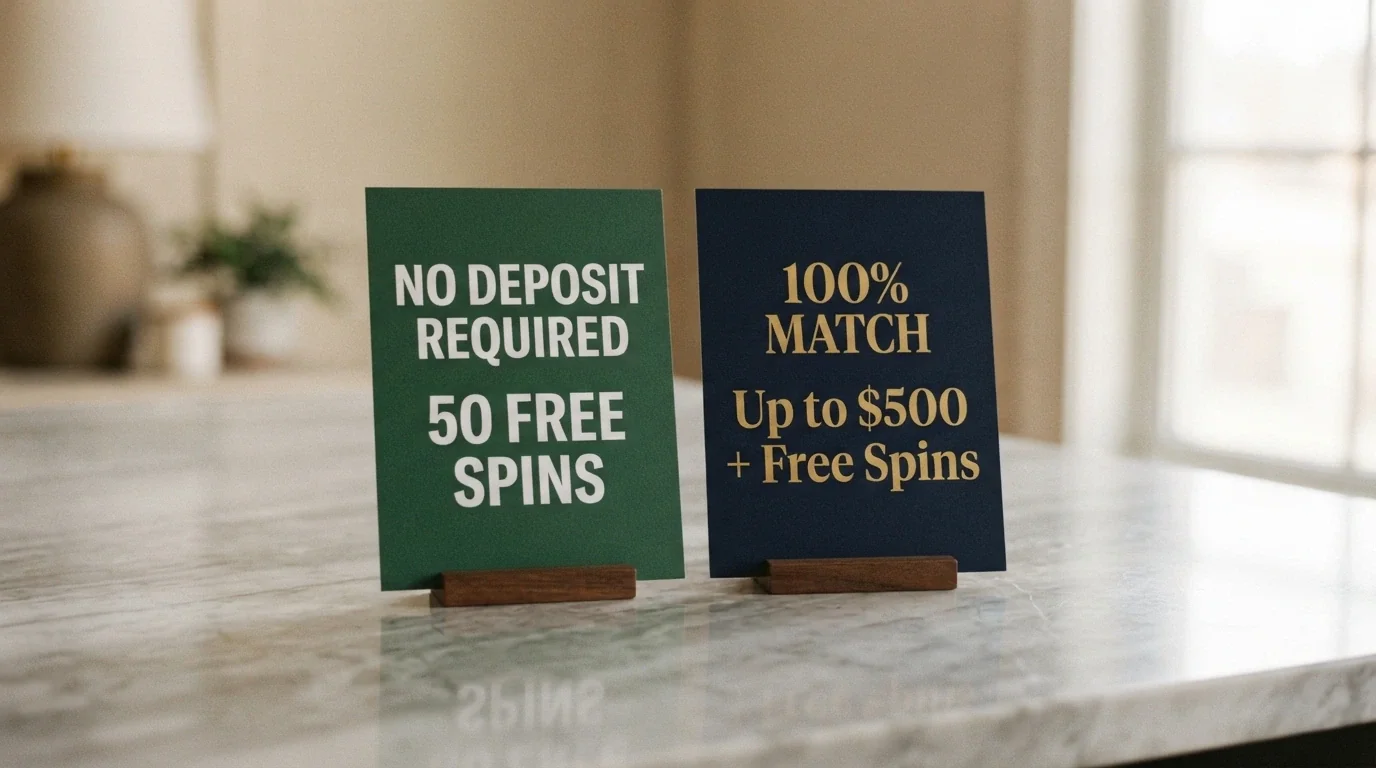
The structure matters because the math changes with each format. Skycrown runs 100 free spins on registration — phone verification is the only gate — and a separate welcome package kicks in once a player deposits A$20 or more. Royal Reels takes the opposite route: a small A$10 no-deposit cash bonus for registering, then a 100% up to A$500 + 50 free spins package once A$30 lands in the account. Same brand, two completely different value propositions, and a player who reads only the welcome offer misses the no-deposit step entirely (or vice versa).
The practical difference shows up in the wagering arithmetic. A no-deposit offer is small in absolute value but loaded with restrictions — high multiples, tight cashout caps, short validity windows — because the casino is taking on risk without taking on a depositor. A deposit bonus is larger but proportionally less restrictive, because the deposit itself is a commitment the player has already made. Neither is “better” than the other in any abstract sense; they are different products, and the player picks the one that suits the goal.
Pokies, Game Weighting and the Fine Print of a “Free” Spin
Free spins are not free on any pokie the casino chooses. They are almost always locked to specific titles — Big Bass Bonanza, Wolf Gold, Snoop Dogg Dollars, a handful of others — and the eligible-game list is the first thing a player should read. The reason is game weighting: pokies typically contribute 100% toward wagering requirements, while table games and live dealer games contribute as little as 1% and rarely more than 30%. A player who wanders from the eligible pokie to a blackjack table with bonus credit active will clear wagering at one thirtieth of the pace, and the bonus clock keeps ticking.
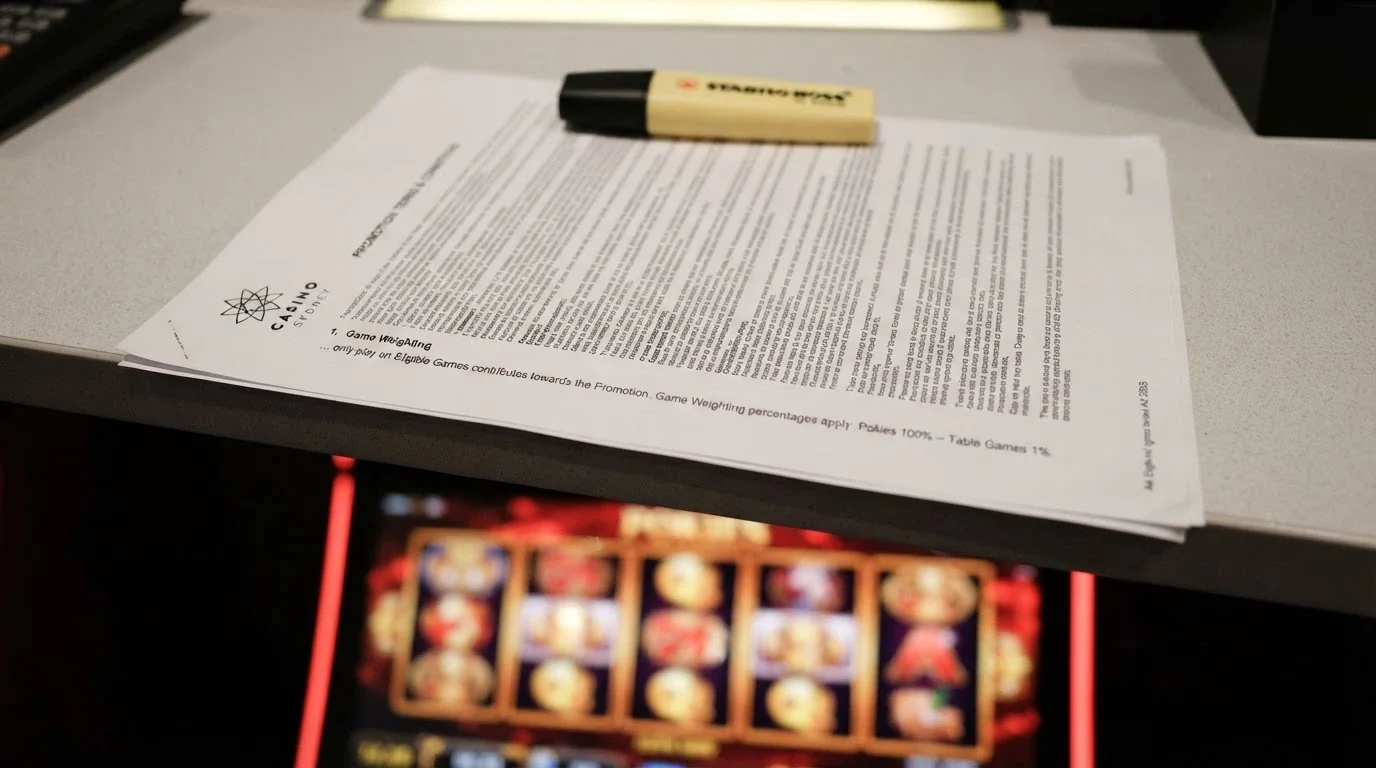
A second restriction sits on top of the eligible-game list: the max-bet cap during bonus play. Most casinos do not allow more than A$5 per spin when bonus credits are active; some, including RocketPlay, set the cap higher (A$7.50). Exceed the cap and the casino can void the bonus and the winnings that came with it. The cap exists because a single high-variance spin at A$50 could blow through the entire cashout ceiling, and the casino does not want to pay that.
The pokie the casino picks for its free spins is therefore not random. Big Bass Bonanza — Pragmatic Play’s 2020 release with an RTP of 96.71%, high volatility and a 2,100x max win on a five-reel, three-row, ten-payline grid — is the title that recurs across the featured set. High volatility matters because it means a session on fifty free spins at A$0.20 each will most often return nothing or close to nothing, with a small chance of a result well above the per-spin cost. The math on a free-spins session is closer to a lottery than to a steady earn, and reading the game’s volatility before claiming tells the player what shape their session is likely to take.
Why Your 2026 No-Deposit Free Spins Come With More Strings Than You Think
The headline of a no-deposit free-spin offer is the spin count. The actual value of the offer sits in four other numbers, and each one of them cuts the headline down to size.
The first cut is the wagering multiple. A typical Australian-facing no-deposit offer sits at 30x to 50x on winnings; the lower end of the band — 30x to 40x — is considered fair, and anything above 60x crosses into territory the rest of the industry treats as exploitative. The multiple applies to the winnings, not the spin value itself, so a player who converts A$5 of spin value into A$8 of winnings at a 40x requirement is being asked to turn over A$320 before those winnings become real money. A player who converts A$5 into A$50 is being asked to turn over A$2,000. The wagering requirement scales with luck, and a big early win is the most expensive outcome a player can have on a no-deposit bonus.
The second cut is the max-cashout cap. Even after wagering is cleared, the casino will not pay more than the cap — typically A$50 to A$150 on a no-deposit offer, with most clustering around A$75 to A$100. RocketPlay publishes the cap at A$75 on its no-deposit offer; Royal Reels sets it lower, at A$50. A player who clears wagering with a balance above the cap walks away with the cap, no matter what the bonus terms say about “winnings”. This is the single most consequential number on the page for a player who wants to know what they can actually take home.
The third cut is the validity window. Most no-deposit bonuses expire in 24 hours to 7 days; most give 7 days. Royal Reels publishes 7 days on its A$10 no-deposit cash bonus; RocketPlay publishes 5 days. A player who cannot sit down for two hours within a week cannot clear a 40x wagering requirement on fifty free spins and the bonus expires with whatever winnings remained inside it. The window is short because the casino wants the bonus to fail for most players, and for most players, it does.
The fourth cut is the max-bet cap during wagering. Most casinos hold the line at A$5 per spin; RocketPlay pushes it to A$7.50. The cap is the casino’s insurance against a single high-variance spin blowing through the entire cashout ceiling, and it doubles as a speed limit on clearing the bonus. Lower the cap and a player needs more spins; raise it and the player needs fewer. Either way, the casino sets the dial.
The expected loss on a typical no-deposit offer, run as a single worked example, is the number that ties these cuts together. Assume a player claims 50 free spins at A$0.20 each — the midpoint of the standard 10–100 spin range and the A$0.10–A$0.50 per-spin band — on Big Bass Bonanza, whose 96.71% RTP sets the house edge at 3.29%. Across all spins the player turns over A$10 of stake, and the expected loss on that turnover is roughly A$0.33 — the price of the session itself. The much larger number is the loss absorbed while clearing the wagering requirement: at 40x on A$10 of winnings, the player must turn over A$400 at the same 3.29% house edge, producing an expected loss of about A$13.16 across the clearing phase. Add the session and the clearing, and the player who completes the requirement gives back roughly A$13.50 on average — a figure that sits comfortably above the spin-value cost of A$10 and explains why the “free” label survives only in the headline.
No-Deposit Spins on Sign-Up: How Welcome Offers Work in Practice
The claim flow from registration to spinning is shorter than the marketing copy suggests. A player signs up, verifies their email and phone number, and the spins appear. The phone-verification step is not a polite suggestion — at Skycrown, the 100 free spins drop only once phone verification is complete, and a player who skips it sees the bonus sit dormant in their account. The whole sequence, on a working internet connection, takes two to five minutes.
What comes next is the part the marketing copy skips. The casino names the eligible pokie (or pokies), sets the wagering multiple, sets the cashout cap, sets the validity window and starts the clock the moment the spins land. The player now has between 24 hours and 7 days — usually 7 — to use the spins, accumulate winnings, clear the wagering requirement and request a withdrawal. If the bonus expires first, the winnings expire with it. If the player exceeds the bet cap, the casino voids the bonus. If the player hits the cashout ceiling mid-wagering, the bonus terms publish the number and the rest is forfeit.
A benchmark example makes the shape clear. Neospin’s no-deposit offer — 100 free spins at 40x wagering, A$75 max cashout, 7-day expiry — sits at the centre of the standard distribution. It is neither the smallest nor the largest offer in the featured set; it is the kind of structure most players will meet on most Australian-facing casinos they visit, and it is the one a player should hold in mind when comparing anything else.
No-Wager Free Spins: The Offer That Lets You Keep What You Win
A no-wager free-spins offer is what the marketing copy on standard offers implies but does not deliver. The spins land, the player wins, and the winnings are withdrawable immediately — no playthrough, no cashout cap, no bet limit, no expiry racing the wagering clock. From the player’s perspective it is the only genuinely “free” offer in the format.
It is also scarce. No specific no-wager free-spins offer was verified among the ten featured operators in this round. Standard no-deposit offers sit at 30x to 50x wagering on winnings, and the gap between that range and zero is the entire reason these offers carry the value they do. A no-wager offer is to a standard no-deposit offer what a free meal is to a buy-one-get-one: the same idea at a fraction of the casino’s risk, which is why the casino issues fewer of them and targets them tightly.
A player who finds one should read the small print as carefully as they would a wagered offer. Game eligibility still applies — the spins will be locked to specific pokies. Maximum cashout terms may still cap withdrawals, even on no-wager offers. The advertised spin count may be lower than a standard offer because the casino is paying out real cash on every win. The headline is more honest on a no-wager offer than on a wagered one, but the small print is still the small print.
Real-Money Free Spins for Australian Players: What You Can Actually Walk Away With
The path from a free spin to withdrawable Australian dollars runs through four gates, and a player has to clear all four before any of it becomes real. Gate one is the wagering requirement — typically 30x to 50x on winnings. Gate two is the cashout cap — A$50 to A$150, most often A$75 to A$100. Gate three is the validity window — 24 hours to 7 days, most often 7. Gate four is the identity check the casino runs before paying out, which on an offshore casino sits outside the Australian framework and has no Australian consumer protection behind it.
The arithmetic on a typical offer is what most players miss. Take fifty free spins at A$0.20 each, assume an average session outcome of roughly the spin value (most sessions on a high-volatility pokie come back close to the cost of the spins), wagering at 40x: a player turning over A$400 to clear the bonus is paying the house edge on every spin, and the expected loss on that turnover sits in the A$10 to A$15 range. The player who hits a hot streak and wins A$100 on the spins has to turn over A$4,000 to clear — and at a 3.29% house edge on Big Bass Bonanza, the expected loss on that clearing is around A$130, larger than the cashout cap that sits above it.
RocketPlay publishes its numbers unusually clearly: A$75 max withdrawal from no-deposit bonus funds, A$7.50 max bet during wagering, 5-day validity. Royal Reels publishes A$50 max cashout, 7-day validity, 40x wagering on an A$10 no-deposit bonus. These are the figures a player should hold against any other offer that comes their way, because the casino has done the work of stating the cap and the player can compare directly.
PayID, Mobile and No-Download Free Spins: How Australian Players Access Offers
The access layer is where Australian players and offshore casinos diverge most clearly. PayID and Osko — the instant-payment rails that settle between Australian bank accounts in seconds — are the preferred deposit and withdrawal methods at any Australian-facing casino that accepts Australian dollars. Skycrown’s PayID withdrawal of A$180 reached a nominated bank account in 2 hours and 29 minutes in testing, which is roughly the speed of the rail itself; the casino is not adding delay.
Mobile access is the default, not the option. Australian-facing casinos run on instant-play HTML5 platforms that load in a mobile browser without an app download, an iOS App Store listing, or a Google Play listing. The casino has no Australian app store presence to begin with — Apple and Google both enforce restrictions on real-money gambling apps in Australia — so the browser is the only channel, and the bonus claim flow happens on a phone the same way it does on a desktop. No download requirement, no install step, no compatibility concern beyond a working browser.
The payment ban since June 2024 reshapes the rail itself. Credit cards, credit-related products including digital wallets, and cryptocurrency are banned as payment methods for online wagering in Australia — PayID, debit card and bank transfer are the remaining legal routes for licensed wagering, and the penalty for non-compliance runs up to A$247,500. Offshore casinos sit outside this framework and accept methods the licensed market does not, but the ban was designed to cut off funding routes to illegal operators, and the player’s bank can decline a transaction to a flagged merchant even when the merchant’s own payment page accepts it.
Free-Spin Promotions at New Casinos: What Launch Offers Look Like
New offshore casinos chasing Australian players tend to run aggressive free-spin promotions to seed a customer base — more spins than an established operator would put on a no-deposit welcome, looser terms, sometimes a small cash bonus alongside. The calculus is straightforward: the casino has no reputation to defend, no withdrawal history to point to, and no player reviews to inherit, so it buys attention with terms it would not run once it has built a brand.
The risks line up on the other side. A new domain with no track record cannot be checked against a regulator register; the licence it claims — Curacao, Anjouan, occasionally Costa Rica — has no standing in Australia and is rarely verified independently. The ACMA can block the site at any moment with a balance still in a player’s account, and the IGA framework gives the player no Australian recourse if the operator refuses a withdrawal. The 1,564 sites blocked since November 2019 include a steady stream of new entrants, and the 225 services withdrawn from the Australian market since 2017 is the long tail of the same pattern.
A player who finds a generous launch offer on a brand they have never heard of should treat the offer the way a cautious reader treats an unfamiliar invoice: read the wagering multiple, read the cashout cap, read the validity window, and ask whether the casino has been around long enough for any of those terms to have been tested by a third party. A new casino with a 100-spin no-deposit welcome and no withdrawal history is offering a promise, not a track record.
No-Deposit vs Welcome vs No-Wager: Comparing Free-Spins Offer Types at a Glance
| Offer type | Typical spin count | Wagering multiple | Max cashout | Validity window |
|---|---|---|---|---|
| No-deposit spins | 10–100 | 30x–50x on winnings (under 40x excellent, over 60x predatory) | A$50–A$150 (most A$75–A$100) | 24 hours to 7 days (most give 7 days) |
| Deposit-triggered welcome spins | 50–200+ (as part of a deposit match package) | 30x–40x on bonus + spins | Higher than no-deposit (often A$500+ on the package) | 14–30 days |
| No-wager spins | 10–50 (smaller, because the casino pays real cash) | 0x | May still apply a cap | 7 days typical |
The table flattens three formats into a single grid, and the differences it shows are exactly the ones a player feels in the wallet. No-deposit spins carry the heaviest restrictions because the casino is not taking a deposit; deposit-triggered welcome spins carry looser terms because the player has committed funds; no-wager spins sit at the top of the value ladder because the casino is paying cash on every win. A player who can choose between the three should pick no-wager every time one is available, fall back to deposit-triggered when the casino asks for a deposit the player was going to make anyway, and treat no-deposit spins as a platform test rather than a money-making opportunity.
The Best No-Deposit Free-Spins Offers Available to Australian Players in 2026
The featured set spans ten Australian-facing operators. Five operators have a no-deposit free-spins offer with terms that were confirmed against the casino’s own bonus page or an established affiliate tracker; five others are listed because the brand targets Australian players, but their current no-deposit terms were not available for verification this round. The first five are the ones a player can compare directly; the second five are brands a player may encounter, but they should read the current bonus page before assuming any specific offer applies.

| Operator | Legal status in Australia | No-deposit free-spins offer | Wagering requirement |
|---|---|---|---|
| Skycrown | Offshore — no Australian online casino licence | 100 free spins (phone verification required) | 40x bonus / 30x on free-spin winnings |
| Rocket Play | Offshore — no Australian online casino licence | 50 free spins on Big Bass Bonanza | 40x on winnings |
| Royal Reels | Offshore — no Australian online casino licence | A$10 no-deposit cash bonus | 40x on bonus |
| Rocket Casino | Offshore — no Australian online casino licence | Up to 125 free spins | 45x on winnings |
| Bizzo Casino | Offshore — no Australian online casino licence | 10 free spins | 40x on winnings |
| Stake | Offshore — no Australian online casino licence | — | — |
| WinSpirit | Offshore — no Australian online casino licence | — | — |
| Rainbet | Offshore — no Australian online casino licence | — | — |
| Scream Casino | Offshore — no Australian online casino licence | — | — |
| FairGO | Offshore — no Australian online casino licence | — | — |
The columns that fill evenly across all ten rows are the legal-status column and the conclusion it carries. No Australian online casino licence exists, federally or in any state or territory, and every brand in the table sits outside that framework. The columns that fill unevenly — no-deposit offer and wagering — show the reader where the comparable data stops. Where the cell carries a confirmed number, that number came from the operator’s bonus page or an established affiliate tracker; where the cell is empty, no figure was verified in this round and the operator’s current bonus page is the only place a player can find one.
How We Ranked These Free-Spins Offers: The Criteria That Matter
The ranking on the comparison table follows three filters in order of weight. First is no-deposit spin count, because that is the headline a player reads and the primary sort key the table is built around. Second is wagering fairness — under 40x is excellent, 40x to 50x is standard, above 60x is predatory — because the wagering multiple is the single largest cut between the headline and the take-home. Third is max cashout, which is the real ceiling on what the player can walk away with and the number that decides whether the offer is worth the time.
Two factors did not earn their own column. Pokies range (how many eligible games the offer covers, how wide the eligible-pokie list is) is a secondary filter that mattered most between Skycrown’s 10,400+ game library and Bizzo’s narrower offering, and the ranking reflects it where the spread is wide. Bonus validity (5 days versus 7 days) is a smaller cut than the others and would have produced near-identical cells across the table; it appears in the operator write-ups instead. Where a cell is empty, the criterion was not confirmed in this round and a player should treat its absence as a reason to read the operator’s own bonus page rather than as a judgment about the brand.
Skycrown: 100 No-Deposit Free Spins with Phone Verification
Skycrown runs the largest no-deposit free-spin count in the featured set — 100 free spins, gated only by phone verification. The wagering split is unusual: 40x on the bonus balance and 30x on free-spin winnings, which means a player who wins A$50 from the spins turns over A$1,500 to clear, while a player who cashes out the bonus balance turns over A$400. The split is friendlier on the free-spin side than the headline suggests, and a player who reads it carefully can plan which path to take.
The library behind the offer is the deepest in the set. Skycrown runs more than 10,400 games from over 50 providers, including Pragmatic Play, NetEnt, Microgaming, Play’n GO, BGaming, Hacksaw Gaming and Nolimit City. Big Bass Bonanza, Wolf Gold and most of the standard free-spin-eligible pokies are inside that library; the eligible-pokie list on the bonus terms is where the player confirms the exact title. The PayID withdrawal tested at A$180 reached a bank account in 2 hours and 29 minutes, which is roughly the speed of the PayID rail rather than a Skycrown-specific advantage, but a player who chooses PayID over a card or crypto rail gets the same settlement either way.
The catch sits in the cashout cap, which the operator’s snippets did not publish in this round. The standard Australian-facing range is A$50 to A$150 on no-deposit offers, and the wagering split puts the free-spin path closer to the friendly end of that range. The player who claims should expect the cap to land somewhere in the band and confirm the exact figure on the bonus terms before spinning. The phone-verification step is fast — it is the price of admission, not a delay — and the welcome package that follows the no-deposit spins requires a minimum A$20 deposit.
The verdict on Skycrown is straightforward. The offer is the most generous on spin count in the set, the wagering split is more generous on the free-spin side than the typical 40x across-the-board structure, and the library is the largest. The unknown is the cashout cap; a player who proceeds should confirm it on the bonus terms page before committing.
Rocket Play: 50 Free Spins on Big Bass Bonanza with a Stated A$75 Cashout Cap
RocketPlay publishes its numbers unusually clearly, which is the single biggest advantage an offer can have over a competitor that hides them. The offer is 50 free spins on Big Bass Bonanza, at 40x wagering on winnings, with an A$75 maximum withdrawal from no-deposit bonus funds, an A$7.50 max bet during wagering and a 5-day bonus validity. Every cut is on the page; a player does not need to dig through small print to find any of them.
Big Bass Bonanza is the eligible pokie, and its 96.71% RTP sets the house edge at 3.29% — a number the rest of this section’s arithmetic depends on. A player turning over A$400 to clear 40x wagering on A$10 of winnings pays the house edge on every spin; the expected loss across the clearing sits in the A$13 range, which is what the previous section’s worked example walked through. The max-bet cap of A$7.50 is higher than the A$5 standard, and a player who wants to clear the requirement faster can run the cap on a high-volatility pokie; the variance is the player’s responsibility, not the casino’s.
The deposit welcome sits separately: 200% up to A$1,000 on the first deposit, minimum A$25, with a 14-day validity on the deposit bonus. A player who claims the no-deposit spins and then deposits is taking on two separate bonuses with two separate terms, and the second one does not invalidate the first. The cashout cap on the no-deposit side is the constraint that decides whether the offer was worth the player’s time, and A$75 is the midpoint of the standard range — neither generous nor stingy, and the figure a player should hold against every other offer in this market.
The verdict on RocketPlay is that the published terms are the product. An offer with a stated cashout cap, a stated bet limit and a stated validity window is one a player can plan around; an offer without those numbers is one the player has to take on trust. RocketPlay is the cleanest read in the set, and a player who values transparency over headline spin count should put it ahead of Skycrown.
Royal Reels: A$10 No-Deposit Cash Bonus — the Only Cash Format in the Set
Royal Reels is the only operator in the featured set whose no-deposit offer is cash, not spins. The bonus is A$10, the wagering is 40x, the max cashout is A$50 and the validity window is 7 days. The player has more flexibility in how to use the A$10 than a spin bundle gives — they pick the eligible pokie, set their own bet size within the A$5 cap, and run the bonus the way they would run any small cash session.
The trade-off is the smallest take-home ceiling in the confirmed set. A$50 max cashout on a 40x wagering requirement means the player has to turn over A$2,000 on the bonus path (40x on A$50 of winnings) before any of it becomes real. The expected loss on that turnover, at the standard 3.29% house edge, sits in the A$65 range — larger than the cashout cap, which is what the rest of this section’s arithmetic has been saying all along: the bonus’s expected cost to the player often exceeds the headline value. The deposit welcome sits separately: 100% up to A$500 plus 50 free spins, 40x wagering, 30-day validity, minimum A$30 deposit. A player who claims the no-deposit cash and then deposits is taking on a larger package with its own arithmetic.
The library behind the offer is mid-range — 5,000+ slots, including Brick House Bonanza and Gates of Olympus 1000, both of which sit in the high-volatility Pragmatic Play family. The eligible-pokie list on the no-deposit bonus is narrower than the deposit welcome’s, and a player who wants to run the A$10 on a specific title should confirm that title is on the list before claiming.
The verdict on Royal Reels is that the format suits a different player than the spin-bundle offers. A player who wants to choose their own pokie and their own bet size will take the cash; a player who wants the largest possible headline will take the spins. The A$50 cap is the constraint, and it is the smallest in the set, but for a player running the bonus as a platform test rather than a money-making opportunity, it is enough.
Rocket Casino: Up to 125 Free Spins — the Biggest Headline Count, but 45x Wagering
Rocket Casino’s headline is the largest spin count in the set: up to 125 free spins, no deposit required. The wagering multiple is 45x, which puts the offer above the 40x standard and into territory where the take-home cost climbs fast. A player who converts the spin value into even a modest win turns over a substantial amount before any of it becomes real money.
The numbers that should sit beside the headline did not surface in this round. The max cashout is not specified in available snippets; the validity window is not specified; the eligible pokie list is not specified. Each of those numbers is the kind a player needs before claiming, and each of them is the kind the operator’s bonus page should publish. A player who sees “up to 125 free spins” and reads nothing else is taking the offer on the casino’s own terms; a player who sees the same headline and reads the bonus page first has a real comparison to make against Skycrown’s 100 spins at 40x/30x or RocketPlay’s 50 spins at 40x with a stated A$75 cap.
The “up to” wording in the headline is itself a flag. “Up to 125 free spins” means the player may receive fewer, and the conditions that determine how many (a deposit level, a verification step, a promotional code) are usually on the bonus terms page. A player who claims expecting 125 and receives 50 has not been misled; they have not read the offer’s structure.
The verdict on Rocket Casino is that the headline is the largest in the set, the wagering is above the standard, and the cashout cap and validity window need to be confirmed on the bonus page before the offer can be compared directly to anything else in the featured set. Checking the operator’s bonus page before claiming is the only way to confirm these details.
Bizzo Casino: 10 Free Spins — the Smallest No-Deposit Offer in the Featured Set
Bizzo’s no-deposit offer is the smallest in the confirmed set: 10 free spins, no deposit required, at 40x wagering on winnings. The spin count is a fraction of Skycrown’s 100 or Rocket Casino’s headline 125, and the per-spin value (A$0.10 to A$0.50, in line with the market band) means the total spin value sits between A$1 and A$5 — the smallest stake a player can put on a no-deposit session in this market.
The shape of the offer suits a particular player. A player who wants to test the platform’s interface, see what an offshore casino looks and feels like, and burn a few minutes without committing funds will find 10 spins at 40x wagering does exactly that. A player who wants to extract a cashable amount will find the math works against them — a small spin bundle produces small winnings, and a 40x wagering requirement turns even a modest win into a multi-hundred-dollar turnover before any of it becomes withdrawable. The max cashout and validity window were not confirmed in this round; the offer is small enough that the cashout cap matters less than it does on larger bundles, but a player who claims should still confirm the figure on the operator’s bonus page.
The verdict on Bizzo is that the offer is a platform test, not a money-making opportunity, and the player who treats it as one is reading it correctly. Those seeking a larger bundle or clearer cashout rules have better options elsewhere in the table.
Stake: A Crypto-First Platform with No Confirmed No-Deposit Free-Spins Offer
Stake runs on a different model from the rest of the featured set. The platform is crypto-primary — deposits and withdrawals move in Bitcoin, Ethereum, Litecoin and a handful of other cryptocurrencies — and the bonus structure reflects that. The no-deposit free-spins terms for Australian players were not confirmed in this round, and Stake’s promotional model has historically leaned on rakeback, reload bonuses and community-led promotions rather than the spin-bundle format the rest of the featured operators use.
The legal layer around Stake’s crypto rails is sharper than on the fiat-friendly operators in the set. The credit-card and crypto ban since 11 June 2024 was specifically designed to cut off payment routes to illegal gambling operators, and a player depositing Bitcoin at Stake is using a method the licensed Australian market does not allow. Offshore casinos sit outside the ban’s enforcement — the penalty runs to A$247,500 and falls on the operator, not the player — but the architecture is the same: the Australian framework treats Stake-style crypto deposits as a payment route the law is trying to close.
A player who chooses Stake is choosing the crypto rail and the community-driven bonus model that comes with it. The no-deposit free-spins path the rest of this page is built around does not appear to be Stake’s primary offer, and a player who arrives expecting a 100-spin no-deposit welcome will find a different product. The verdict on Stake is that the brand suits a player who already prefers crypto rails and wants the bonus model that comes with them; it does not suit a player shopping for the largest no-deposit spin bundle in the market.
WinSpirit: An Offshore Operator with No Confirmed No-Deposit Free-Spins Offer
WinSpirit sits in the second half of the featured set — an offshore operator targeting Australian players whose no-deposit free-spins terms were not verified this round. The brand is known in the Australian-facing market as an offshore casino with a standard bonus structure, and the absence of a confirmed no-deposit offer in this round does not mean no offer exists; it means the operator’s current bonus page is the only place a player can find one.
A player considering WinSpirit should read the operator’s bonus page directly before claiming anything. The framework that applies is the same one that applies to every other operator in the set: offshore, no Australian licence, no BetStop connection, no Australian consumer protection. The IGA framework treats WinSpirit’s product offering as a prohibited interactive gambling service, and the ACMA can block the site at any moment. While this operator targets Australian players, it remains an offshore entity without confirmed terms.
Rainbet: An Offshore Operator with No Confirmed No-Deposit Free-Spins Offer
Rainbet is another offshore operator in the second half of the featured set, with no no-deposit free-spins terms verified this round. The brand runs an Australian-facing casino with a standard offshore structure, and a player who arrives at the site will see the operator’s own bonus terms — which are the only terms that apply to that visit.
The same offshore caveats apply as on every other brand in the second half. No Australian licence, no BetStop connection, no Australian consumer protection, ACMA blocking authority, the IGA framework treating the service as prohibited. A player who wants to read the offer before claiming should read it on the operator’s own page; the comparison table’s empty cell for Rainbet’s no-deposit column reflects what was not verified this round, not a judgment that no offer exists.
Scream Casino: An Offshore Operator with No Confirmed No-Deposit Free-Spins Offer
Scream Casino is the ninth operator in the featured set, and the no-deposit free-spins terms were not confirmed this round. The brand runs an offshore casino targeting Australian players, and the structure of the offer — if one exists — is on the operator’s current bonus page.
A player who considers Scream Casino should weigh the same offshore trade-off the rest of the featured set involves, with the additional uncertainty that no-deposit terms were not verified. The legal framework, the lack of Australian consumer protection and the absence of BetStop coverage apply identically. The empty cell on the comparison table is a verification gap, not an offer denial, and the operator’s own terms page is the source a player should trust before claiming anything.
FairGO: An Australian-Facing Offshore Brand with No Confirmed No-Deposit Free-Spins Offer
FairGO rounds out the featured set as an Australian-facing offshore brand with a longer history in the Australian market than some of the operators above it. The no-deposit free-spins terms were not confirmed this round, and the offer — if one exists — is on the operator’s current bonus page.
FairGO’s longer presence in the market is itself information. A player comparing FairGO to a brand that launched this year is comparing a brand with more withdrawal history, more player reviews and more time under ACMA’s enforcement lens. None of that produces an Australian licence — no offshore casino has one — but it does change the practical risk a player takes on. A brand that has been paying out Australian players for years is a different proposition from a brand that has been paying out Australian players for months, and the player’s read of “offshore” should account for that spread.
Crypto Casinos and Free Spins: The High-Stakes Offshore Route
The crypto-casino segment changes three things at once. Payment becomes faster — bitcoin and Ethereum settle in minutes rather than the hours or days a card or bank transfer takes. Identity verification becomes optional — no-KYC casinos let a player deposit, play and withdraw without submitting documents, because the blockchain record is the identity. Australian protection disappears entirely — no licence, no BetStop, no complaints body, no recourse for a refused withdrawal.

The legal layer makes the picture sharper. From 11 June 2024, credit cards, credit-related products including digital wallets, and cryptocurrency are banned as payment methods for online wagering in Australia; an operator that fails to enforce the ban faces penalties up to A$247,500. The ban targets licensed Australian wagering, which is sports and racing through NTRWC-licensed operators — it does not enforce against offshore casinos, which accept crypto freely. The point of the ban is to cut off funding routes to illegal operators, and from 1 January 2027, banks and payment providers gain express authority to block transactions to illegal gambling operators, extending the closure into the fiat rails.
Bitstarz sits inside this segment as a benchmark. The platform runs 50 free spins on Alien Fruits — a BGaming title — at 40x wagering, and the rest of the bonus structure follows the standard offshore pattern: no-deposit spins, deposit welcome package, wagering requirements on winnings, max cashout cap, validity window. The crypto rail is what makes Bitstarz a different product from Skycrown or RocketPlay, and the no-KYC onboarding is what makes it a different experience from any licensed Australian wagering operator.
Paying and Withdrawing with Bitcoin at Free-Spins Casinos
The crypto deposit flow is fast and the withdrawal flow is faster. Bitcoin deposits confirm in minutes; withdrawals on most crypto-friendly casinos process in under an hour once the casino approves the request, and the player sees the funds in their wallet before the next session begins. Compare that to a PayID withdrawal — fast on a casino like Skycrown, where the A$180 test reached a bank account in 2 hours and 29 minutes — and the speed advantage is clear, even before the identity question comes up.
The conversion-rate risk is the trade-off. A player depositing Bitcoin at a casino denominating balances in Australian dollars is exposed to the BTC/AUD rate on both ends of the transaction: a 2% adverse move on deposit and a 2% adverse move on withdrawal is a 4% round-trip cost before a single spin is played. Casinos that denominate balances directly in Bitcoin or Ethereum remove that risk on the balance side but expose the player to the AUD conversion when they cash out to a bank account. The June 2024 ban on crypto as a payment method for licensed wagering does not apply to offshore casinos, but the ban is the architecture the Australian framework is building toward, and a player who treats crypto as a permanent payment route is betting on the offshore rail staying open.
The bank-blocking authority from 1 January 2027 is the next layer of that architecture. Banks gain express authority to block transactions to illegal gambling operators — not just licensed wagering, but the offshore casino segment too — and a player who relies on a fiat on-ramp to buy crypto and deposit at an offshore casino may find that on-ramp closed. The crypto-casino segment does not disappear, but the path into it narrows.
Anonymous No-KYC Crypto Casinos and What Inclave Means for Free Spins
The no-KYC segment is where the speed advantage and the protection gap line up most starkly. A no-KYC casino lets a player deposit and play without submitting identity documents, because the casino does not run a verification step — the cryptocurrency wallet is the identity. The product sells itself on privacy and speed; the cost is everything that comes with playing at an unlicensed offshore casino.
Inclave sits inside this segment as a single-sign-on layer for crypto casinos, allowing a player to register and log in across multiple platforms without re-submitting credentials. It is a convenience layer; it is not a regulatory layer. An Inclave login does not connect to BetStop, does not connect to the ACMA, and does not give the player any Australian consumer protection. The 1,564 sites the ACMA has blocked since November 2019 include no-KYC crypto casinos, and the 225 services withdrawn from the Australian market since 2017 include no-KYC operators whose domains went dark overnight.
The trade-off a player makes at a no-KYC crypto casino is the trade-off the rest of the offshore segment makes, intensified: faster payments and weaker protections. A player who has self-excluded through BetStop and opens an account at a no-KYC crypto casino will find the casino accepts the deposit, because BetStop does not cover offshore operators and the casino has no way of knowing the player is on the register. The protections BetStop was designed to provide — a single registration that closes the door on every licensed Australian wagering platform at once — are exactly the protections the offshore segment is built to bypass.
Australian Gambling Law and Your Free Spins: What the Interactive Gambling Act Actually Means
The Interactive Gambling Act 2001 prohibits the provision of online casino games, online pokies and in-play sports betting to anyone in Australia. There is no Australian licence for online casino — not federally, not in any state or territory. Any page suggesting that online casinos are licensed in Australia describes something that does not exist; every brand in the featured set, and every brand a player will find on a search for this type of service, sits outside the Australian licensing framework.

The IGA targets the provider of the prohibited service, not the individual player. No Australian has been prosecuted for placing a bet at an offshore casino, because the Act is built to go after the operator, not the customer. The penalties — up to A$247,500 for credit-card and crypto ban non-compliance, plus the broader civil penalty regime under the IGA — sit on the operator side. The player’s exposure is not criminal; it is the loss of every protection the Australian framework offers, which is the subject of the section that follows.
What is legal under the Australian framework is licensed wagering on racing and sport placed before the event begins, lotteries, and keno through state-licensed operators. The licences concentrate in the Northern Territory, where the Northern Territory Racing and Wagering Commission (NTRWC), administered through Licensing NT, issues terms of up to 20 years to operators who meet the fit-and-proper, financial and technical standards the Commission requires. SportsBet, Ladbrokes, Tabcorp, Bet365 Australia and the rest of the licensed wagering market sit inside this framework; they do not offer online casino games because the product is prohibited, and the framework does not extend a pathway to offering it.
The ACMA, the IGA and Why No Online Casino Holds an Australian Licence
The ACMA — the Australian Communications and Media Authority — is the federal regulator enforcing the online prohibition. The IGA 2001, strengthened by the Interactive Gambling Amendment Act 2017, gives the ACMA the power to issue formal warnings, accept enforceable undertakings, issue infringement notices and seek civil penalty orders against providers of prohibited interactive gambling services. The same statute authorises the ACMA to request that Australian ISPs block illegal websites — a power the ACMA has used 1,564 times since November 2019, with 225 services withdrawing from the Australian market entirely since 2017.
The 2017 amendment closed the loopholes the original 2001 Act left open. Before 2017, an offshore operator could continue serving Australian customers in a legal grey area; after 2017, the prohibition is unambiguous, and the ACMA’s enforcement record reflects the change. The June 2024 credit-card and crypto ban — passed as the Interactive Gambling Amendment (Credit and Other Measures) Act 2023 — extended the framework into the payment layer, cutting off the funding routes the prohibition alone could not close.
The absence of any Australian online casino licence pathway is the structural fact this page rests on. No state or territory has issued one; no federal framework permits one; the ACMA does not have a process for one. A player who believes they have found a “licensed Australian online casino” has found an offshore casino claiming a licence from Curacao, Anjouan or another jurisdiction that has no standing in Australia. The claim is not necessarily false — those jurisdictions do issue licences — but it is not an Australian licence, and the protections an Australian licence confers (BetStop connection, Australian consumer law, state complaints bodies) do not apply.
What the 2026 Gambling Reform Changes for Free-Spins Players from January 2027
The Interactive Gambling Amendment (Gambling Reform) Bill 2026 passed Parliament on 19 August 2026 and commences on 1 January 2027. The reform is the largest update to the IGA since 2017, and its measures reach the bonus and promotion layer that this page sits on.
The advertising measures cap wagering advertisements at three per hour between 5:00 am and 8:30 pm, ban wagering advertising during live sporting events (from 15 minutes before to 5 minutes after), and prohibit athletes, celebrities and influencers from promoting wagering. The inducement measures prohibit direct marketing of inducements — sign-up offers, referral bonuses, free bets — for 14 days after a customer signs up to a wagering service and for three months after a customer deregisters from BetStop, with the ban indefinite for customers the operator has identified as at-risk. The product measures ban online keno (the format marketed as “pocket pokies”) and foreign-matched lotteries. The payment measures give banks and payment providers authority to block transactions to prohibited gambling services.
For a player reading a free-spins listicle, the inducement ban is the measure that lands directly. A 14-day cooling-off period after sign-up means the operator cannot send the player a follow-up bonus offer for two weeks; a 3-month post-BetStop-deregistration ban means an operator cannot target a player who has come off the self-exclusion register with the offers the register was meant to push back from. These rules apply to Australian-licensed wagering operators; offshore casinos are not subject to them, and the inducement flow on the offshore side does not pause.
The bank-blocking authority is the measure that reaches the offshore segment most directly. From 1 January 2027, a bank can decline a transaction to a flagged illegal gambling operator, and the player finds their deposit declined at the bank layer rather than at the casino layer. The architecture is the same one the June 2024 credit-card and crypto ban built — close the funding routes, and the offshore segment shrinks.
Offshore Casinos, No-KYC Platforms and the Protections You Give Up
An Australian player who plays at an unlicensed offshore casino gives up a checklist of protections, and the checklist is worth reading once and remembering.
BetStop coverage is the first item gone. BetStop — the National Self-Exclusion Register, live since 21 August 2023 — binds Australian-licensed wagering services only. A self-excluded Australian who opens an account at an offshore casino will find the casino accepts the deposit, because BetStop has no connection into the offshore segment. The 59,830 people registered by the end of Q3 FY 2025–2026 are protected from licensed wagering, not from offshore casinos.
Australian consumer protection is the second item gone. The Australian Consumer Law, the Australian Financial Complaints Authority, and the state and territory gambling regulators do not have jurisdiction over an offshore operator. A player who is refused a withdrawal at an offshore casino has no Australian complaints body to approach; the casino’s own terms, which the player agreed to on signup, are the only terms that apply.
Recourse for refused withdrawals is the third item gone. An offshore casino can refuse a withdrawal for any reason the terms allow — a max-cashout breach, a wagering requirement not cleared, a “bonus abuse” flag, a payment method mismatch — and the player has no escalation path. The casino’s internal dispute process, if it exists, is the only process.
ACMA blocking is the fourth item. The ACMA can request that Australian ISPs block the casino’s domain at any moment, and the player can find their account inaccessible with a balance still inside it. The 1,564 sites blocked since November 2019 include a steady churn of new domains, and the ACMA’s enforcement pace has not slowed.
The credit-card and crypto ban is the fifth item. Since 11 June 2024, the licensed Australian wagering market has been cut off from credit cards and crypto, and from 1 January 2027 banks gain authority to block transactions to illegal gambling operators. The architecture is closing the funding routes the offshore segment relies on, and the segment’s growth in Australia is constrained by that closure.
Staying Safe: Responsible Gambling Tools Every Free-Spins Player Should Know
The Australian harm-minimisation infrastructure is built around licensed wagering, and most of it does not reach the offshore casino segment. A player who understands what exists and what does not is a player who can make the trade-off openly.
BetStop is the most concrete tool. The National Self-Exclusion Register, launched on 21 August 2023, lets a player exclude themselves from every Australian-licensed online and phone wagering provider in a single registration. The exclusion periods range from three months to lifetime, and the largest group of registrants — 38% — chose lifetime. By the end of Q3 FY 2025–2026, 59,830 people had registered; as of 31 March 2026, 37,247 had active exclusions.
The National Gambling Helpline — 1800 858 858 — is the immediate-action tool. The line is free, confidential and staffed 24 hours a day, 7 days a week, with online chat and counselling available through Gambling Help Online. The number is the same for any Australian, regardless of which operator they play with, and the service is independent of any casino or wagering provider.
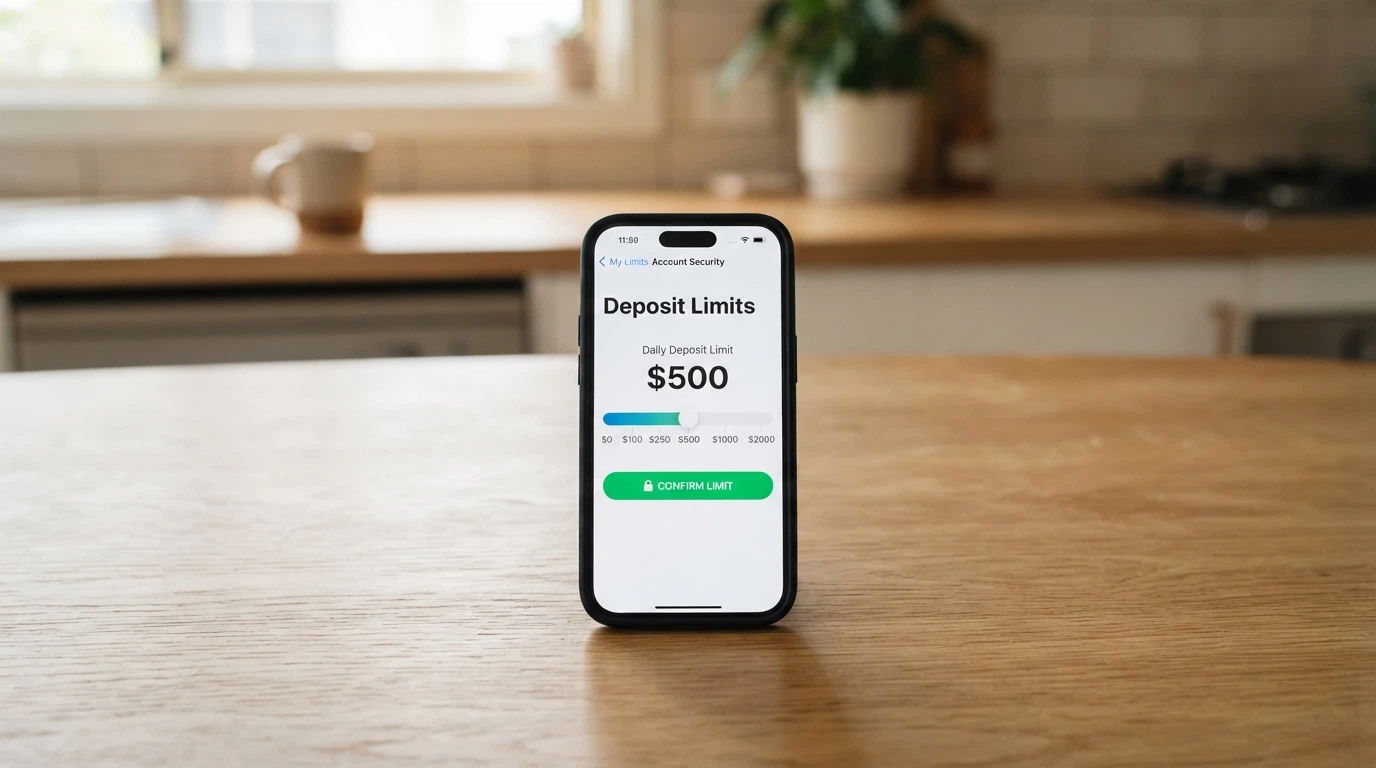
Deposit-limit setting, activity statements, take-a-break and timeout tools are standard on Australian-licensed wagering platforms, where they are required by the platform’s licence conditions. None of them apply at an offshore casino, and the player at an offshore casino manages their own limits with no safety net.
BetStop and the National Self-Exclusion Register: How It Works and Who It Misses
BetStop’s reach into the offshore segment is zero, and that is the limit a player should understand before self-excluding.
A player who registers with BetStop chooses an exclusion period — three months, six months, one year, five years, or lifetime — and the registration applies to every Australian-licensed online and phone wagering provider in a single step. The casino or bookmaker cannot accept the player’s deposit, open a new account, or send marketing material during the exclusion period. The outcomes from ACMA-commissioned research are striking: 77% of registrants reported a better overall quality of life after self-excluding, 79% reported improved mental health, 69% reported better personal relationships, and 96% had either stopped betting entirely (81%) or decreased their betting (15%).
The gap sits in the awareness and the offshore reach. Only 33.5% of Australian wagerers know BetStop exists; 26.5% of Australian adults do; younger adults aged 18 to 35 are less likely to know. The Australian Gambling Research Centre’s Dr Kei Sakata framed the gap bluntly: despite an estimated five million wagerers nationwide, including 400,000 high-risk gamblers, just 30,000 have used BetStop. The reach into offshore casinos is the structural gap: an offshore operator is not licensed in Australia, is not connected to BetStop, and will accept a self-excluded person’s money.
A player who self-excludes through BetStop and then opens an account at an offshore casino has not defeated the self-exclusion — they have moved outside its coverage. The protections the registration was designed to provide stop at the licensed border, and the offshore segment sits on the other side of it.
Deposit Limits, Activity Statements and the Tools Offshore Casinos Do Not Offer
Australian-licensed wagering operators are required to provide deposit-limit setting, activity statements, take-a-break and timeout tools as part of their licence conditions. A player can set a daily, weekly or monthly deposit ceiling, receive a statement of their wagering activity, take a break of 24 hours to several months, or apply a short timeout to pause the account.
None of these tools are mandatory at an offshore casino. Some offshore operators offer them as a product feature, and the player who uses one finds the same kind of limit-setting they would find on a licensed platform. Most do not, and the player at those operators manages their own limits with no safety net — no deposit ceiling enforced by the platform, no activity statement sent by the operator, no take-a-break button on the dashboard.
The asymmetry is the point. The Australian framework builds harm minimisation into the licence conditions; the offshore segment treats it as optional, and the bulk of the offshore segment treats it as a cost it does not need to bear. A player who values deposit-limit enforcement and activity statements as harm-minimisation tools will find them at a licensed wagering operator and will not find them at most offshore casinos.
Recognising Problem-Play Signs: When Free Spins Stop Being Free
The behavioural red flags a free-spins player should watch for are the same red flags the broader gambling-harm literature identifies, and the prevalence data makes the population they describe concrete.
Roy Morgan’s August 2025 estimate puts 2.9% of Australian adults — approximately 622,000 people — at or above the Problem Gambling Severity Index (PGSI) threshold for problem gambling. A further 8.6% report having bet more than they could afford. ANU POLIS 2025 data shows risky gambling increased from 13.7% in 2024 to 19.4% in 2025, and online gambling increased to 56.1% of individuals who mainly gambled online. The Journal of Gambling Studies’ 2026 model estimates 3.29 million Australians aged 5 and over are affected annually by their own or another person’s gambling, with an annual health loss of over 400,000 Years Lived with Disability.
The signs a player should watch for in their own behaviour are the signs the helpline is built to hear. Chasing losses with the next bonus offer. Betting more than planned on a free-spins session. Returning to the casino the day after a session to “win back” what was lost. Borrowing money to fund the next deposit. Hiding the gambling from family or friends. The Gambling Help Online service and the National Gambling Helpline — 1800 858 858 — are the immediate action step, free, confidential and independent of any operator.
The free-spin format sharpens one of these signs in particular. A no-deposit offer costs nothing to claim, and the player who treats each new bonus as a fresh chance to “win back” what the previous bonus cost is in the chasing-losses pattern, even though no cash has moved yet. The bonus structure makes the loss invisible, and the invisibility is what makes it dangerous.
How We Selected and Ranked These No-Deposit Free-Spins Casinos
The ten Australian-facing operators featured here were selected because they target Australian players and publish bonus terms that allow for direct comparison. The list is designed to help players navigate the offshore market, where bonus structures vary significantly and terms change frequently. The first five operators have confirmed terms, while the second five are brands a player may encounter but whose specific offer details were not verified for this update.
The evaluation criteria — no-deposit spin count as the primary sort, wagering fairness as the value filter, max-cashout cap as the real ceiling, pokies range as a secondary factor, payment accessibility for AU players — match the framework the rest of the page uses. The ranking measures what the operator publishes, not what the player will experience, and a player who claims any of these offers should read the operator’s current bonus page before claiming, because terms change and the page is the source a player trusts.
The verification caveat is the one that matters most. Offshore status is confirmed against the ACMA framework — no Australian online casino licence exists, and none of the ten operators in the set holds one. Individual bonus terms are sourced from operator sites and affiliate trackers; no operator’s offshore licence was independently verified on a regulator register this round, and the licence claims (Curacao, Anjouan) are taken from affiliate sources rather than from the regulator’s own register. The terms on the operator’s own page are the terms that apply to a player’s visit, and the comparison table is built around what those terms say, not what the affiliate tracker says.
What Australian Players Should Actually Do About No-Deposit Free Spins in 2026
The honest picture is the one this page has been drawing since the first section. Every brand in the featured set operates outside the Australian licensing framework, and every player who claims a no-deposit free-spins offer at one of them gives up the consumer protections the Australian framework provides. BetStop does not reach the offshore segment. The ACMA can block the operator’s domain with a balance still inside. The June 2024 credit-card and crypto ban was built to cut off the funding routes, and the 1 January 2027 bank-blocking authority extends that closure into the fiat rails. The offshore segment is legal for the player and illegal for the provider, and the asymmetry leaves the player carrying the risk.

A player who decides to proceed should check five things before claiming any offer. The wagering multiple — under 40x is fair, 40x to 50x is standard, above 60x is predatory, and the number sits on the bonus terms page. The max-cashout cap — A$50 to A$150 is the standard range, and the exact figure is on the same page. The payment method — PayID, debit card and bank transfer are the legal routes for licensed Australian wagering; crypto deposits at an offshore casino sit outside the ban’s enforcement but inside the architecture the framework is building. The eligible pokie list — the spins are locked to specific titles, and the player should confirm the title before claiming. The validity window — 24 hours to 7 days, most often 7, and the clock starts the moment the spins land.
The single most important takeaway is the harm-minimisation infrastructure, not the bonus comparison. BetStop registration, the National Gambling Helpline at 1800 858 858, Gambling Help Online — these are the tools an Australian player has regardless of which operator they play with. The free-spin offers in the featured set are a product the player can choose to engage with or not; the harm-minimisation tools are the framework that surrounds the choice, and the framework reaches further than any individual offer.
The real cost of a no-deposit free-spins offer is almost always higher than its headline value. The expected loss on a 50-spin, 40x-wagering bonus on Big Bass Bonanza sits in the A$13 range across the clearing phase alone, larger than the A$10 spin value the headline implies. A player who clears the requirement gives back roughly A$13 on average, before counting the spin-value cost of the session itself; a player who fails to clear it gives back the session cost and walks away with nothing. The math is what the headline does not say, and the math is what the player should read first.
The safest choice is not to play. The next-safest choice is to claim an offer only after reading the wagering multiple, the cashout cap, the payment method and the eligible pokie list, and only on a casino whose terms the player has compared against the rest of the market. The framework that surrounds the choice — BetStop, the helpline, Gambling Help Online, the awareness of the prevalence data — is the framework an Australian player has regardless of the choice, and it is the framework this page leaves the reader with.
Frequently Asked Questions
Do I need a bonus code to claim free spins no deposit in Australia?
Most Australian-facing casinos credit no-deposit free spins automatically once registration and verification are complete, with no bonus code required. A handful run opt-in promotions where the player enters a code at signup, and the code is published on the casino’s promotions page or sent via email. The operator’s current bonus terms are the source a player should trust, because terms change and the comparison table on this page reflects what was confirmed in this round.
Can I use PayID to deposit at casinos offering free spins in Australia?
PayID works at any Australian-facing casino that accepts Australian dollars and has PayID configured as a deposit method, which includes Skycrown and most of the fiat-friendly operators in the featured set. PayID withdrawals settle in hours rather than days, and Skycrown’s A$180 test reached a bank account in 2 hours and 29 minutes. PayID is one of the legal deposit routes for licensed Australian wagering, alongside debit card and bank transfer; credit cards and crypto have been banned since 11 June 2024.
How does BetStop affect my access to online casino free spins?
BetStop — the National Self-Exclusion Register, live since 21 August 2023 — binds Australian-licensed wagering services only, with 59,830 registrations and 37,247 active exclusions as of 31 March 2026. An offshore casino is not licensed in Australia, is not connected to BetStop, and will keep accepting a self-excluded person’s money. A player who self-excludes through BetStop closes the door on every licensed Australian wagering platform at once, but the offshore segment sits on the other side of that closure.
Are crypto deposits accepted at Australian online casinos?
Crypto deposits are banned for licensed Australian online wagering since 11 June 2024, with penalties up to A$247,500 for operators that fail to enforce the ban. Offshore casinos sit outside this framework and accept crypto freely, with bitcoin and Ethereum deposits confirming in minutes and withdrawals processing in under an hour on most crypto-friendly platforms. From 1 January 2027, banks and payment providers gain express authority to block transactions to illegal gambling operators, extending the closure into the fiat rails that buy crypto.
What happens if I win a jackpot with no deposit free spins?
A jackpot win on a no-deposit free-spins session is treated as bonus winnings under the casino’s terms, and the max-cashout cap applies regardless of the jackpot size. Most no-deposit offers cap cashout at A$50 to A$150, with most clustering around A$75 to A$100, and the player walks away with the cap even if the spin produced a five-figure result. The wagering requirement also applies — a player who wins A$1,000 on a single spin still has to clear 40x on the winnings before any of it becomes withdrawable, and the expected loss on that turnover sits well above the cashout cap.