
Best Online Casino with High Cashback Bonus Australia 2026: What the Percentage Hides and Where It Lands
A cashback bonus is the most marketable word in any offshore casino promotion. The headline rate sits there in bold, the percentage looks like a refund on losses, and the offer feels like the casino giving something back. That is the picture the marketing wants. The actual picture is messier, and it depends on the net-loss arithmetic, the cap, the wagering attached to the credited amount and the cadence on which it is paid out. A 20% offer can return less than a 10% offer once those four mechanics are set against each other.
This page works through how cashback actually pays out, ranks the ten offshore brands Australian players most commonly reach for cashback deals, and addresses the underlying question every comparison on the internet politely skips: no online casino in Australia holds an Australian licence, because no such licence exists. Every operator on this page operates from outside the country. A page that ignores that is selling a list of prohibited services as if they were licensed products.
Last updated: 16 October 2026 · Licence claims cross-checked against the ACMA register and operator terms pages where named.
Table of Contents
- What a Cashback Casino Bonus Actually Means for Your Money
- How Cashback Rates Really Work: Percentages, Caps and the Fine Print
- Top 10 Online Casinos with Cashback for Australian Players in 2026
- Crypto Cashback Casinos: Higher Returns, Fewer Protections
- Online Casino Cashback Is Illegal in Australia — What That Means for Your Play
- Cashback Bonuses and the Harm They Can Hide
- How We Assessed and Ranked These Cashback Casinos
- Your Cashback Casino Decision in 2026: What Matters Most
- Frequently Asked Questions
What a Cashback Casino Bonus Actually Means for Your Money
How a Cashback Bonus Actually Works
A cashback bonus returns a percentage of your net losses over a defined period — not a percentage of your deposits, and not a top-up on every transaction. Net losses are calculated as the difference between what you deposited and what you withdrew over the window, with the result being a loss figure rather than a turnover figure. SkyCrown Casino’s published terms, for instance, state the weekly cashback is 10% of net losses, with a minimum loss of A$50 to qualify, credited every Monday. The credit arrives as a balance that the player can either withdraw or play with — and what it actually becomes depends on whether wagering is attached.
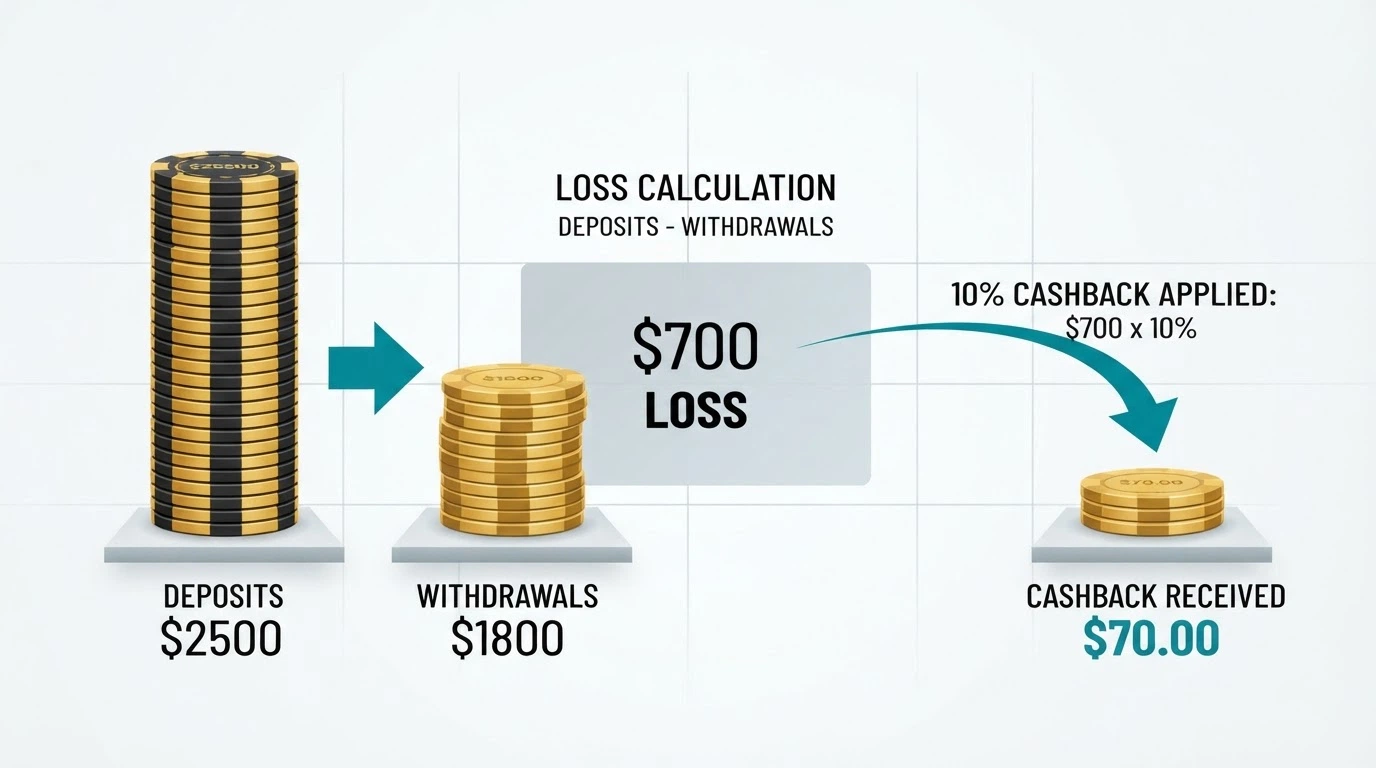
Two structural points separate cashback from every other bonus type. The first is that cashback rewards losing sessions rather than playing sessions — a 10% rate on a A$500 losing week returns A$50, but the player still ended A$450 behind. The second is that the cashback figure is calculated AFTER the loss has happened, which means the casino’s house edge has already done its work on the full loss amount. The bonus returns a slice of what was already lost. It does not reverse the loss.
The reset cycle matters because it sets the rhythm at which losses accumulate. Daily cashback resets every 24 hours; weekly programs pool losses across seven days; monthly programs stretch further still. The cadence affects how visible the cashback is to the player. A daily 5% program returns small sums every evening; a weekly 10% program returns a single larger sum on a set weekday. Neither is inherently better — but the cadence changes how the offer feels when the player is reviewing their week.
Minimum loss thresholds are the gate every cashback offer sits behind. If the player did not lose enough, no cashback is paid. The most common thresholds sit between A$20 and A$50 in net losses. Players who break even for the week or finish ahead have no cashback to claim. The minimum loss gate is what makes cashback structurally a reward for losing rather than for playing.
Calculating Cashback: Net Losses, Percentages and Caps
The arithmetic is straightforward once the structure is understood. A 10% cashback rate on A$500 of net losses returns A$50. A 15% rate on the same A$500 returns A$75. A 20% rate returns A$100.
Cashback Examples by Rate and Cap
| Cashback Rate | Net Losses | Cap | Effective Return |
|---|---|---|---|
| 10% | A$500 | A$300 | A$50 |
| 15% | A$500 | A$300 | A$75 |
| 20% | A$500 | A$300 | A$100 |
Caps are where the headline rate breaks down. A cashback offer with a A$500 cap cannot pay more than A$500, regardless of how large the losses were. At a 10% rate, the cap kicks in at A$5,000 in losses. At a 15% rate, it kicks in at A$3,333. At a 20% rate, it caps out at A$2,500. Above those thresholds, the rate effectively drops to whatever the cap divided by the losses produces — and that effective rate can fall well below the advertised headline. A 20% headline on A$5,000 of losses with a A$500 cap returns A$500, an effective rate of 10%. The headline and the reality diverge sharply once the cap engages.
Cashback rates across Australian-facing offshore casinos cluster between 3% and 20%. Caps most commonly sit between A$300 and A$500, though premium tiers push much higher — SkyCrown’s VIP tier carries a A$5,000 cap, and ZetCasino’s weekly cashback caps at A$4,500 for loyal members. The shape of the spread is what matters: the percentage is the marketing figure, the cap is the ceiling, and the gap between the two determines whether the offer rewards small losses disproportionately or scales linearly with the size of the loss.
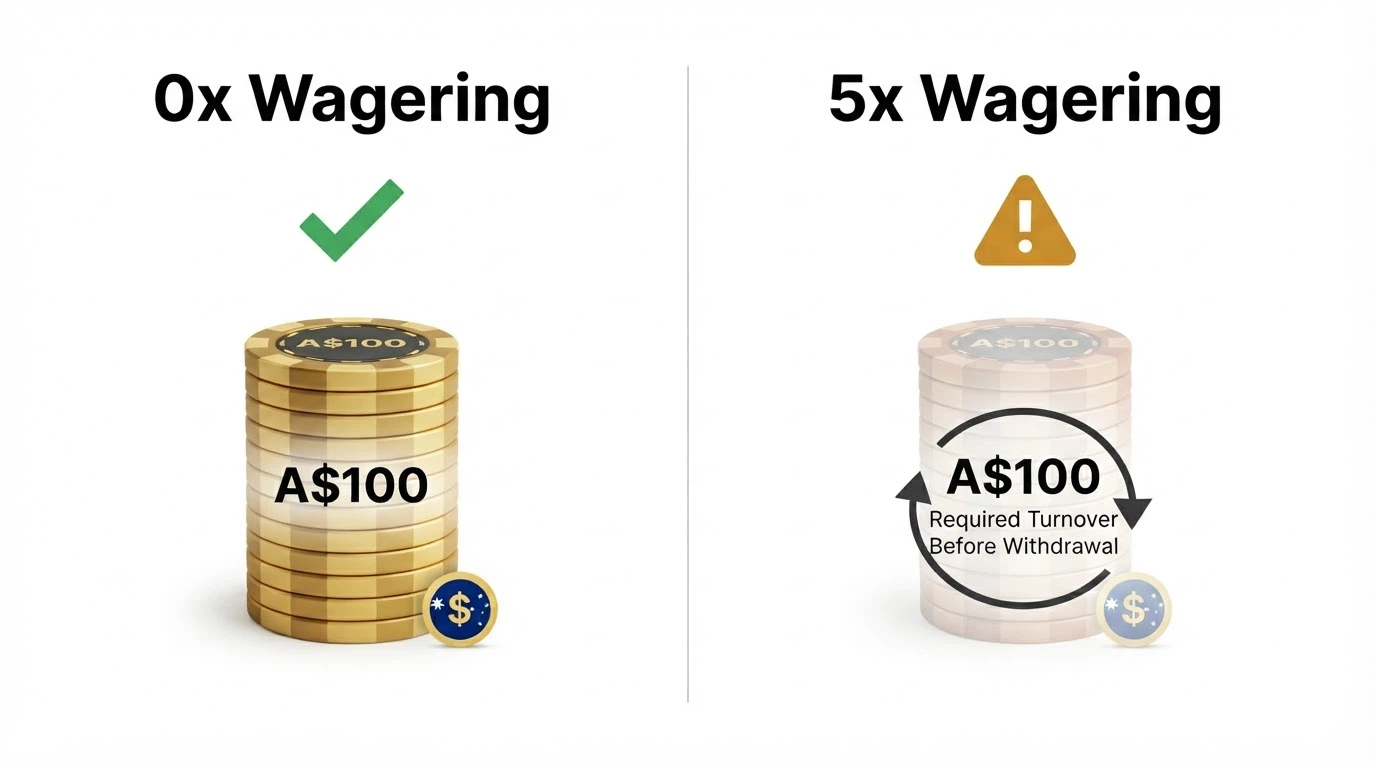
The wagering multiple on the cashback amount is the third mechanic. Cashback wagering requirements rarely exceed 10x and most often sit between 3x and 5x — though a growing number of offers carry zero wagering, which means the credited amount is withdrawable as cash immediately. A A$100 cashback credit at 0x wagering is worth A$100 in the player’s hand. The same A$100 credit at 5x wagering requires the player to turn over A$500 before any of it can be withdrawn. Zero-wagering cashback is the most valuable structure in the entire category because it removes the second layer of house edge — the playthrough — from the calculation.
Real cash versus bonus cash is the fourth distinction. Some operators credit cashback as withdrawable real money from the moment it lands. Others credit it as bonus funds that can be played with but cannot be withdrawn until wagering is satisfied. The label is rarely prominent on the bonus page. It sits in the fine print, and it decides what the credited amount is actually worth.
The Australian Cashback Landscape: Offshore-Only Reality
Every online casino offering cashback to Australian players is offshore. This is not a choice the operators have made for convenience — it is the only legal posture available to them. Under the Interactive Gambling Act 2001, providing online casino games, online pokies or in-play betting to a person in Australia is prohibited. No Australian licence for online casino exists, because none has ever been issued. A casino advertising itself as “licensed in Australia” for online play is describing a product that does not exist under Australian law.
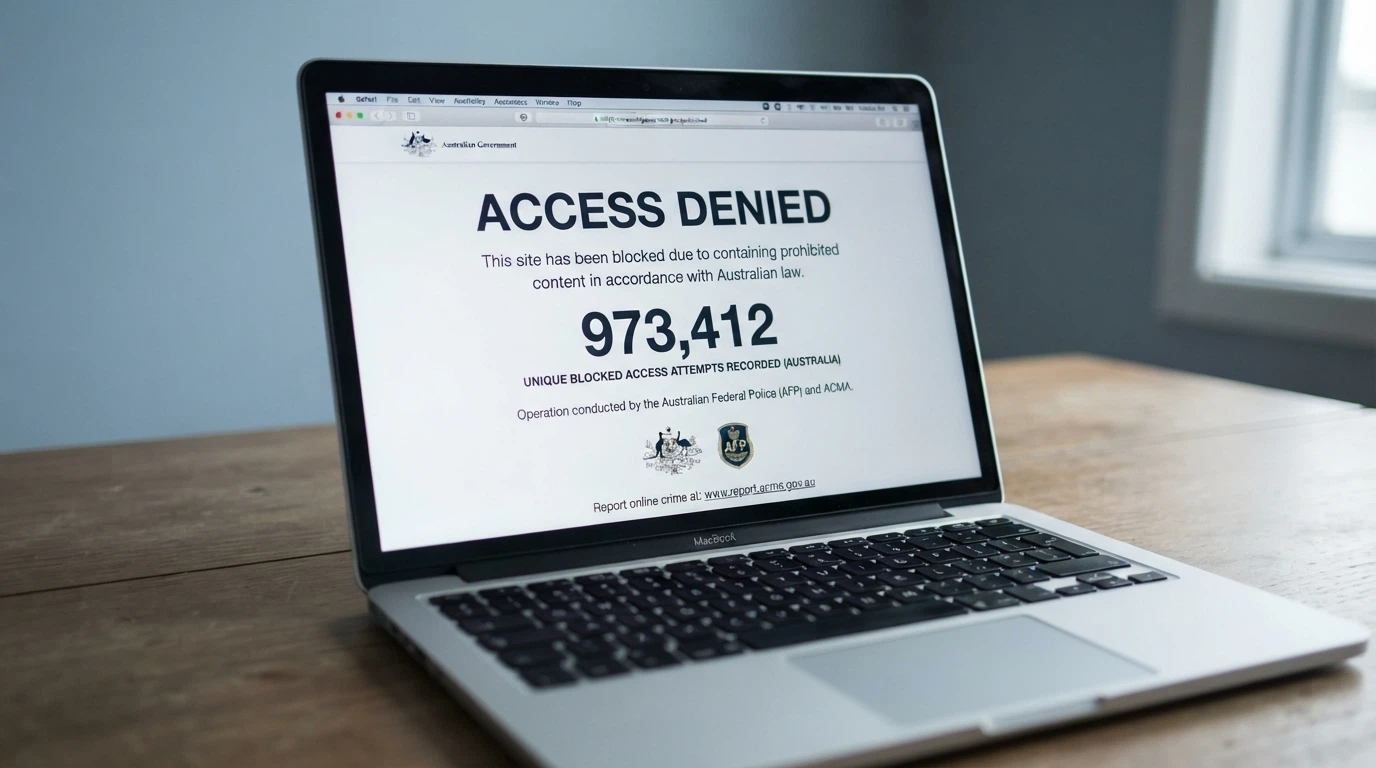
The Australian Communications and Media Authority enforces the prohibition on the supply side. Since November 2019, the ACMA has had 1,788 illegal gambling and affiliate websites blocked at Australian ISPs. Since the ACMA began active enforcement in 2017, more than 230 illegal services have withdrawn from the Australian market rather than face continued action. The blocklist is not static — it grows as the ACMA identifies new operations, and operators respond by rotating mirror domains, opening new URLs and cycling through front brands to stay one step ahead of the blocking requests.
The demand side has grown alongside the enforcement. The share of Australian adults participating in online gambling rose from 8% in 2017 to 33% in 2025. In 2024, online participation surpassed in-venue gambling for the first time. Australians lost A$36.0 billion to gambling in the 12 months to March 2026, an increase of A$15.3 billion — 75% — on the COVID-19 baseline of 2020. The market for offshore casino cashback is large because the underlying market for online play has expanded sharply, not because the operators are doing anything that Australian authorities regard as legitimate.
The player’s position in this landscape is not symmetrical with the operator’s. The IGA targets the provider — the individual player is not prosecuted. What the player loses is not legal standing but consumer protection. There is no Australian regulator to complain to when an offshore operator refuses a withdrawal. There is no dispute resolution scheme. There is no enforced honesty about advertised terms. The protections that an Australian-licensed wagering operator is required to provide — deposit limits, activity statements, BetStop connection — do not apply to any offshore casino, and applying them voluntarily is at the operator’s discretion.
How Cashback Rates Really Work: Percentages, Caps and the Fine Print
Cashback Percentages: What 5%, 10% and 20% Actually Return
The percentage spread in the cashback category is wide, and the numbers carry different meanings depending on which tier a player sits in. The entry tier — 5% daily programs — is what most offshore casinos offer as a baseline. The standard weekly tier — 10% — is the most common headline figure across the operators Australian players reach. The premium tier — 15% to 20% — is reserved for VIP accounts, high-roller programmes or crypto-linked offers, and it is usually gated behind a deposit volume, a wagering threshold or a loyalty status that takes time or money to reach.
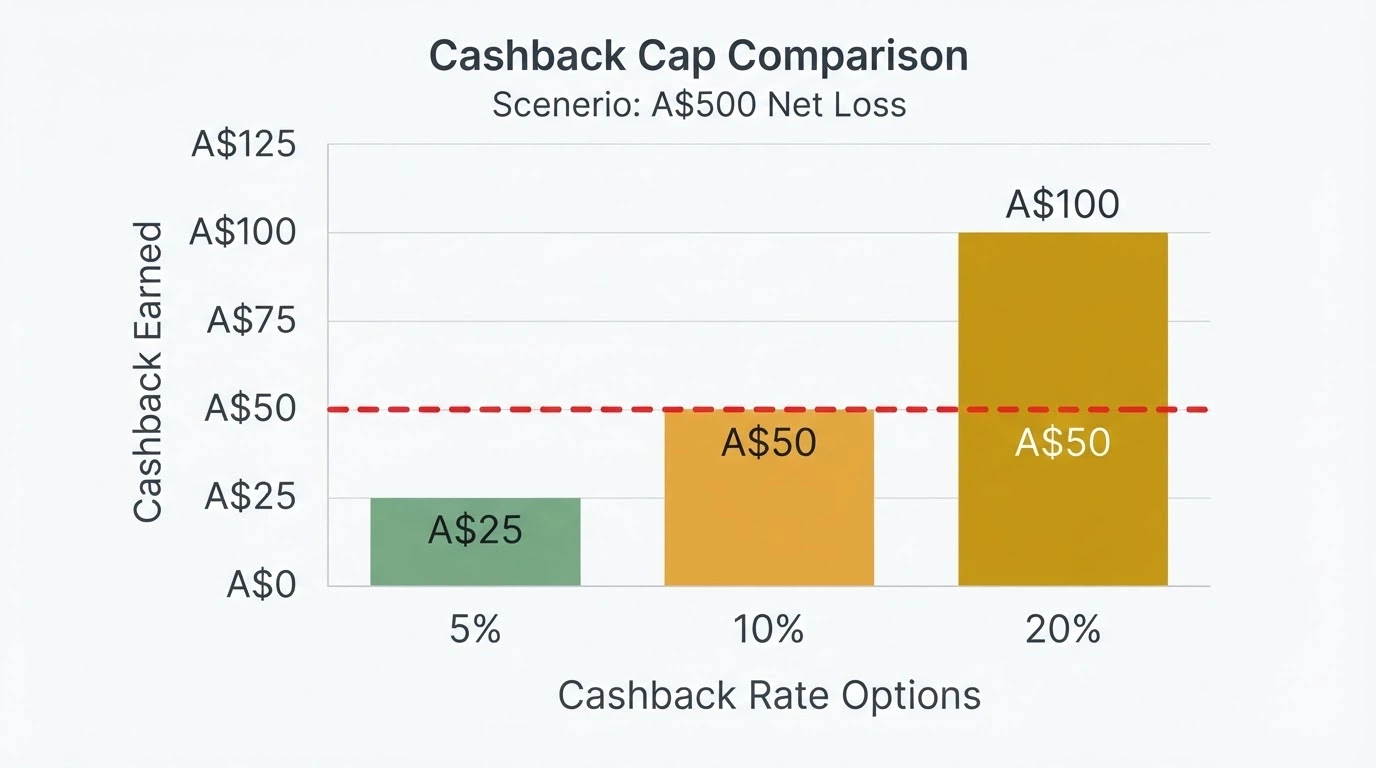
Worked against a A$500 net-loss scenario with a A$300 cap, a 5% rate returns A$25, a 10% rate returns A$50 and a 20% rate returns A$100 — the cap is not yet reached. At a A$500 cap, the same numbers become A$25, A$50 and A$100 for a A$1,000 cap. The cap is the binding constraint, and the rate is only binding up to the cap. Above the cap, every rate converges on the same ceiling.
SkyCrown’s 10% weekly rate carries a A$500 standard cap, scaling to 20% with a A$5,000 VIP cap. ZetCasino’s 15% weekly rate for loyal members carries a A$4,500 cap. Winz’s flat 20% rate carries no cap. The progression across these three offers illustrates the gap between the marketing number and the player experience: a 20% rate with no cap and zero wagering returns the full 20% on every dollar of net losses, while a 10% rate with a A$500 cap returns 10% only on losses up to A$5,000 — beyond which the effective rate drops.
Weekly vs Daily vs Instant Cashback: Which Cadence Suits You
Cadence is the rhythm on which cashback resets and is paid out. Daily programs run at lower rates — typically 5% to 10% — with small caps and quick turnaround. They suit players who play in short bursts and want a small refund at the end of each session. Weekly programs sit at the higher end of the range — 10% to 20% — with roomier caps, and they pool losses across a longer cycle. They suit players whose play is spread across the week rather than concentrated in single sessions.
The weekend-only variant is a narrower window. Jackpot City’s published terms, for instance, set cashback at 15% on net losses from Friday to Sunday, credited Monday morning with a A$400 cap and zero wagering. This narrows the qualifying period to three days, which increases the volatility of the cashback — a player who wins over the weekend has nothing to claim, while a player who loses heavily across the same window sees the full 15% applied.
Monthly cycles sit at the top of the VIP ladder. They accumulate losses over longer periods, which means the cap engages sooner relative to the loss — but the rates tend to be higher to compensate. VIP monthly cashback is also where zero-wagering becomes more common: operators reward loyalty status by removing the playthrough on the cashback credit.
Instant or on-demand cashback is the rarest model. A few operators allow the player to request cashback through customer support at any time, often subject to a balance condition (the balance must be below a set threshold, typically A$1) and a wagering multiple attached. Goldenbet’s terms describe a 10% cashback requestable through support when the balance is below A$1, with 45x wagering, a A$500 cap and a 5x cashback maximum withdrawal. The 45x playthrough is high enough that the offer’s real value depends heavily on whether the player is willing to grind through the wagering requirement.
Zero-Wagering Cashback: The Offer That Pays Real Money
Zero-wagering cashback is the single most valuable structure in the category. It means the credited amount can be withdrawn immediately, without the player having to turn over the funds a set number of times first. The mechanic matters because wagering requirements are a second layer of house edge — the player must risk the cashback amount through the casino’s games before any of it becomes withdrawable, and during that playthrough the house edge operates on the cashback itself. A A$100 cashback credit at 5x wagering means A$500 in additional turnover, on which the house retains its edge.
SkyCrown’s weekly cashback carries zero wagering requirements on the credited amount. Winz’s flat 20% cashback is credited as real cash with 0x rollover and no cap. Jackpot City’s weekend cashback carries zero wagering. The Pokies’ VIP cashback is processed as real money with zero wagering requirements. These offers represent the high-water mark of the category — what the cashback is actually worth when the operator does not claw back the credit through a playthrough.
The contrast is sharpest against offers that carry high wagering. Goldenbet’s 45x wagering on cashback is the steepest figure in the comparison set. At 45x, a A$100 cashback credit requires A$4,500 in turnover before the credit can be withdrawn — and the house edge over A$4,500 in spins is substantially larger than the edge over the original loss that generated the cashback in the first place. A player comparing two offers — one with zero wagering and a 10% rate, another with 45x wagering and a 15% rate — needs to do the turnover arithmetic to know which is worth more. The headline percentage alone will mislead.
The reason zero-wagering cashback is uncommon is that it is genuinely expensive for the operator. Cashback already represents a real cost on net losses; removing the playthrough removes the operator’s ability to recover some of that cost through additional house edge on the cashback funds. Operators that offer zero wagering are either making a deliberate loyalty play, operating on a cashback-first model where the bonus is the product, or structuring the cashback in a way that limits the cost — through tight caps, minimum loss thresholds or VIP-only eligibility.
How to Earn and Claim a Cashback Bonus
Cashback is rarely automatic. Most offers require the player to clear a minimum loss threshold before any cashback is credited, and the threshold varies by operator. SkyCrown’s A$50 minimum loss is the most common gate. Royal Reels’ cashback is tied to “eligible net losses” within a defined period, with the exact threshold sitting in the operator’s terms. Some operators — particularly at the VIP tier — drop the minimum loss requirement entirely, replacing it with a flat weekly credit based on account status.
The claiming process falls into two camps. Automatic credit is the simpler model: the player meets the threshold, the cashback is calculated at the end of the period, and the credit lands in the account. Manual request is the other model: the player contacts customer support, often with a balance condition attached (the balance must be below A$1), and asks for the cashback to be processed. Goldenbet’s model falls here — requestable through support, gated by balance, and attached to a 45x wagering requirement.
The game eligibility question matters because not every game contributes equally to net losses. Most operators restrict cashback calculation to slots and selected table games; live casino cashback is often a separate programme with its own rate. ZetCasino runs two parallel cashback tracks: a 15% weekly cashback for loyal members and a separate 10% live casino cashback capped at A$225. Players whose play is concentrated in live casino games need to check which programme applies to their activity.
The claiming window is the period after the cycle closes during which a player can request or verify the cashback. Some operators run a narrow window — 24 to 72 hours — beyond which the cashback is forfeited. Others allow retroactive claims within a longer period. The window is rarely advertised prominently, and missing it means the player loses the cashback entirely. A player who plays through a losing week and then forgets to check the Monday credit has, in some cases, left money on the table.
Top 10 Online Casinos with Cashback for Australian Players in 2026
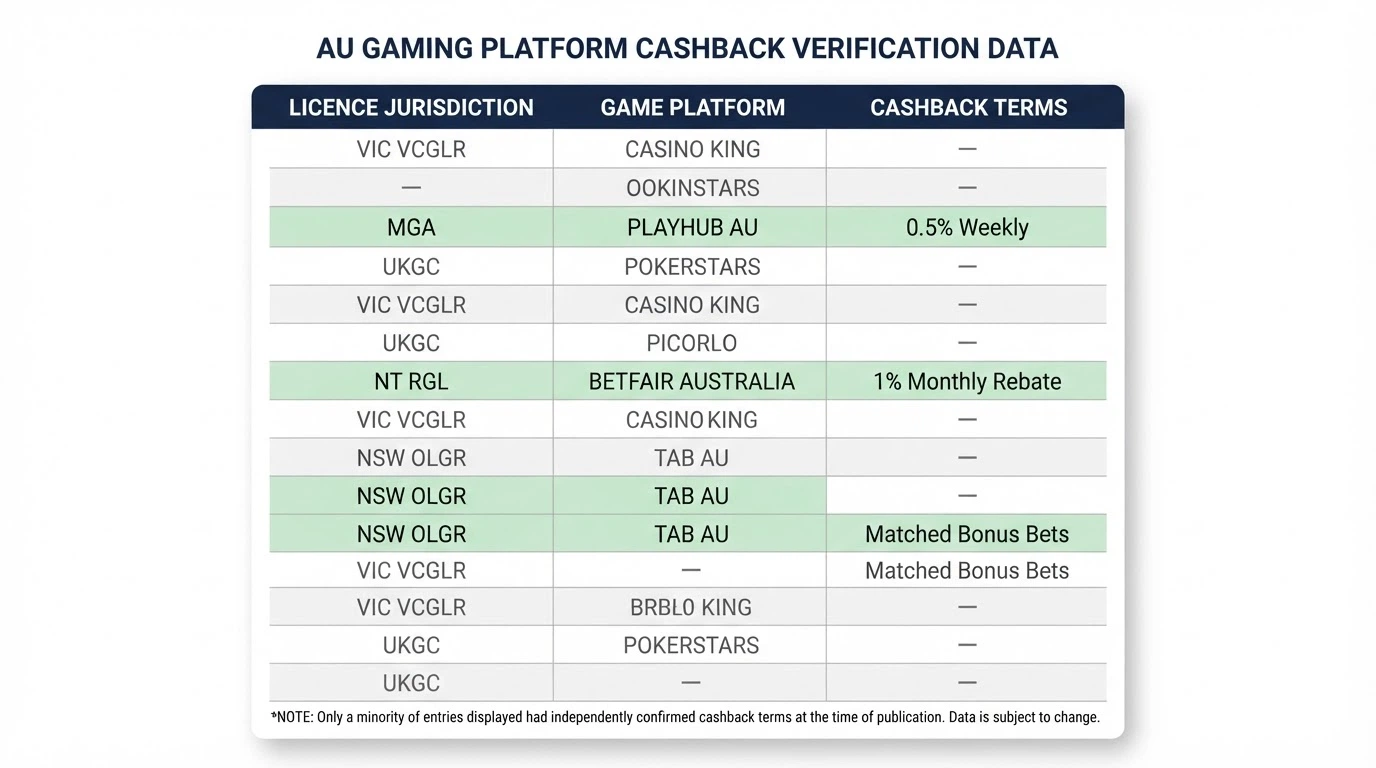
The table below covers the ten offshore casinos Australian players most commonly reach for cashback offers. Only three of the ten had independently confirmed cashback terms this run — SkyCrown, Royal Reels and ZetCasino. For the remaining seven, the cashback terms were not confirmed against the operator’s own published pages, and the table reflects that absence rather than inventing figures. Every operator below is offshore and unlicensed in Australia.
| Operator | Licence | Game Platform | Cashback Rate | Wagering on Cashback | Cap | Cadence |
|---|---|---|---|---|---|---|
| SkyCrown | Curacao (OGL/2023/176/0095) | SOFTSWISS aggregator | 10% weekly (20% VIP) | 0x | A$500 (A$5,000 VIP) | Monday |
| Royal Reels | Curacao-style claims, unverified | — | 10–15% weekly | — | — | Weekly |
| Stake | Curacao | Proprietary + major providers | — | — | — | — |
| Rocket Play | Curacao | — | — | — | — | — |
| FairGO | Curacao | RTG | — | — | — | — |
| WinSpirit | Curacao | — | — | — | — | — |
| Scream Casino | Curacao | — | — | — | — | — |
| ZetCasino | Curacao | — | 15% weekly (loyal), 10% live casino | — | A$4,500 (weekly), A$225 (live) | Weekly |
| Bizzo Casino | Curacao | — | — | — | — | — |
| Rainbet | Curacao | — | — | — | — | — |
The gaps in this table are the point. Where research did not confirm a figure, the cell carries an em dash rather than a guessed number. An offshore casino a reader sees named but never reviewed — or reviewed with invented figures — is worse than a table that shows exactly where the data stops.
SkyCrown Casino
SkyCrown is the operator with the clearest independently confirmed cashback terms in the featured set. The weekly cashback is 10% of net losses, scaling to 20% for VIP accounts, with a minimum loss of A$50 to qualify and a maximum cashback of A$500 for standard players (rising to A$5,000 for VIPs). The credit is paid every Monday, and the cashback funds carry zero wagering requirements — meaning the credited amount is withdrawable as real cash from the moment it lands.
The licence is Curacao OGL/2023/176/0095, issued to Hollycorn N.V. The game platform runs on the SOFTSWISS aggregator, which provides a broad library across multiple providers. SkyCrown is not an Australian-licensed operator — the Curacao licence is the only licence it holds, and it is not recognised for consumer protection purposes in Australia.
The welcome package runs separately from the cashback programme: a 450% deposit match up to A$8,000 plus 400 free spins across the first four deposits, with a A$30 minimum deposit, 40x wagering on the bonus, 40x on the free spin winnings, a A$7.50 maximum bet and a 14-day bonus validity. The welcome bonus is deposit-gated and carries standard industry wagering; the cashback is what differentiates SkyCrown within the comparison set.
For a player prioritising cashback terms over welcome size, SkyCrown’s combination of 10% weekly, zero wagering and a Monday credit cadence makes it the most legible offer in the featured set. The VIP scaling to 20% with a A$5,000 cap is genuinely generous — though the VIP tier is gated behind volume thresholds that not every player will clear. For a casual player losing A$100–A$500 per week, the standard 10% / A$500 cap / 0x wagering combination is the cleanest available.
Royal Reels
Royal Reels carries a strong cashback headline — 10% to 15% weekly, depending on account status — behind an operator profile that is harder to verify. The welcome package runs up to A$4,500 plus 250 free spins across three deposits: a 200% first-deposit match up to A$2,000 plus 100 spins, a 150% second-deposit match up to A$1,500 plus 75 spins, and a 100% third-deposit match up to A$1,000 plus 75 spins. Minimum deposit is A$20. Wagering on the welcome bonus is 40x on the bonus plus deposit combined, with 30 days validity per tier.
The cashback details — the percentage — were confirmed against the operator’s own published terms, but the surrounding mechanics like caps and wagering require direct verification. The 10–15% figure is sourced from the operator’s bonus page.
The licence situation is the more material concern. Royal Reels displays Curacao-style licensing seals, but their verifiability is unreliable this run. The brand operates through rotating mirror domains to maintain accessibility from Australia, which is itself a tell — operators that rotate URLs regularly are typically doing so to stay ahead of ACMA blocking requests. A player evaluating Royal Reels is evaluating an operator whose legal standing is opaque and whose accessibility depends on infrastructure designed to evade Australian enforcement.
The welcome package size is competitive within the offshore set, but the 40x bonus-plus-deposit wagering is on the steeper end. Combined with the licence verification gap, Royal Reels is a higher-trust operator to engage with than SkyCrown or ZetCasino — its offer looks strong, but the verification chain behind it is weaker.
Stake
Stake operates a cashback-focused model rather than a deposit-match welcome model, which is a structural choice that sets it apart from most of the featured set. The platform is proprietary, supplemented by major game providers, and runs under a Curacao licence. Stake is active in the Australian market and is among the brands Australian players most commonly reach for casino play.
The specific current cashback terms — the rate, the cap, the cadence, the wagering on cashback funds — were not confirmed against the operator’s own published pages this run. A player evaluating Stake for cashback should verify the current terms directly on the operator’s site rather than relying on third-party listings, which often carry stale figures.
The cashback-first model is worth flagging on its own terms. An operator that leads with cashback rather than a deposit welcome is signalling that ongoing player value — what the player gets back over weeks and months of play — is the priority, not the sign-up bonus. That is a structural difference, and it matters even where the specific rates cannot be quoted. For those who prefer a consistent, ongoing rewards structure over a one-time welcome bonus, a cashback-first model provides a distinct alternative.
Rocket Play
Rocket Play holds a Curacao licence and is active in the Australian market. Its current cashback terms — the rate, the cap, the cadence and the wagering attached — were not confirmed this run. The operator’s position in the Australian market is established, which makes the absence of confirmed cashback figures more notable rather than less — an established brand with no independently verifiable cashback page is a gap worth flagging.
A player evaluating Rocket Play for cashback should treat the offer as unconfirmed until verified directly. The brand’s market presence does not substitute for verified terms, and the comparison set’s other entries (where research did carry figures) are the ones with the clearest picture of what the player is actually getting.
FairGO
FairGO runs on the RealTime Gaming (RTG) platform under a Curacao licence. RTG is one of the older online casino software providers, and FairGO’s game library reflects that lineage — a focus on pokies and a narrower selection of table games than the SOFTSWISS-aggregated operators in the comparison set.
The current cashback terms at FairGO were not confirmed this run. The RTG platform is well-established in the Australian-facing offshore market, and FairGO has a recognisable brand among Australian players, but neither the brand recognition nor the platform pedigree substitutes for verified cashback terms.
For a player prioritising platform familiarity — someone who has played RTG-powered casinos before and prefers the interface — FairGO is a recognisable option within the offshore set. Given the data gap, readers should verify terms directly on the operator’s site before proceeding.
WinSpirit
WinSpirit holds a Curacao licence and is active in the Australian market. Data on its cashback terms remains unverified this run. The brand carries an established presence among Australian-facing offshore operators, which gives it some market recognition, but the absence of independently verified cashback data is a material gap for any player comparing offers.
A player reaching WinSpirit for cashback should treat the offer as unconfirmed and verify the current terms on the operator’s own page. The comparison set’s other entries — SkyCrown, ZetCasino, Royal Reels — are the ones with confirmed figures, and a reader comparing options should weight the comparison toward the operators where the data is in hand.
Scream Casino
Scream Casino holds a Curacao licence. Independent verification of its cashback terms was unavailable this time. The operator is part of the broader Australian-facing offshore set, but no independently verified cashback figure — rate, cap, cadence, wagering — was available for this comparison.
A player considering Scream Casino for cashback should verify the current offer directly with the operator. The gap in confirmed data is not unusual within the featured set — seven of the ten operators carry it — but it means Scream Casino cannot be ranked on cashback terms specifically, only on its position within the broader offshore market.
ZetCasino
ZetCasino carries the highest confirmed weekly cashback cap among the featured operators — 15% on net losses for loyal members, up to A$4,500 per week. The live casino cashback runs separately at 10%, up to A$225. Both figures are sourced from the operator’s published terms as described.
The welcome bonus is 100% up to A$750 plus 200 free spins plus one Bonus Crab. Wagering is 35x on the bonus plus deposit combined, and 40x on the free spin winnings. The bonus validity is 10 days, the maximum bet is A$7.50, and the maximum cashout on the bonus is 10x the bonus amount in some regions. The welcome terms are tighter than SkyCrown’s — a shorter validity window and a lower bonus ceiling — but the cashback structure compensates in a different direction.
The A$4,500 cap is the headline feature. At a 15% rate, the cap engages at A$30,000 in weekly net losses, which means the offer scales linearly across a much wider range than the A$500 caps common elsewhere in the market. For a player with a larger bankroll or a heavier weekly volume, ZetCasino’s cap is the one that does not engage early. For a player with smaller weekly losses, the 15% rate still applies in full — the cap is a ceiling, not a floor.
Bizzo Casino
Bizzo Casino holds a Curacao licence. We could not independently confirm its cashback terms. The operator is part of the broader Australian-facing offshore set, but the cashback-specific data was not available for independent verification.
A player evaluating Bizzo Casino for cashback should verify the current terms directly. The gap in confirmed data places Bizzo in the same position as several other operators in the featured set — the brand is present in the market, but the comparison cannot be completed on cashback terms until the operator’s own page is checked.
Rainbet
Rainbet holds a Curacao licence. Cashback terms for this brand were not independently verified. The operator is active in the Australian-facing offshore market, but no independently verified cashback figure was available for this comparison.
A player considering Rainbet should treat the cashback offer as unconfirmed and verify the current terms on the operator’s own page. The gap is consistent with seven of the ten operators in the featured set, and the comparison is strongest where the data is in hand.
Crypto Cashback Casinos: Higher Returns, Fewer Protections
How Crypto Cashback Differs from Dollar-Denominated Offers
Crypto cashback is often quoted at a higher percentage and credited in Bitcoin, Ethereum or USDT rather than Australian dollars. The headline rate is typically set higher than the fiat equivalent — partly to compensate the player for the volatility risk, partly because the operator’s cost basis on a crypto credit is structurally different. The rate is the visible difference. The invisible difference is what happens between the credit and the cashout.
The AUD value of a crypto cashback credit can move between the moment it is credited and the moment the player converts it. A cashback credited at 0.001 BTC when Bitcoin is trading at A$100,000 is worth A$100 at credit. If Bitcoin moves to A$90,000 before the player converts, the same credit is worth A$90. The volatility risk is borne entirely by the player. A fiat-denominated cashback credit carries no equivalent exposure — the A$50 stays A$50 until it is withdrawn.
Withdrawal friction is the other structural difference. A fiat cashback credit can usually be withdrawn to a bank account, a debit card or a PayID transfer, depending on the operator’s payment methods. A crypto cashback credit requires a crypto wallet, a conversion to fiat at some point, and an awareness of the on-chain fee structure. The friction is not large for a player who already holds crypto and manages their own wallet, but it is a real cost for a player who needs to convert the credit to spend it.
Bitcoin Cashback and the Australian Payment Ban
Using cryptocurrency to fund an online casino account from Australia has been illegal since 11 June 2024. The Interactive Gambling Amendment (Credit and Other Measures) Act 2023 banned credit cards, credit-related products and digital currency — including Bitcoin, Ethereum and stablecoins — as payment methods for online wagering. The ban took effect on 11 June 2024, with non-compliant operators facing penalties of up to A$247,500.

The ban targets the operator, not the individual player. An Australian player who deposits Bitcoin at an offshore casino is not prosecuted under the IGA. What the ban tells the player is structural: a casino that requests a crypto deposit is operating outside Australian rules, because no Australian-licensed operator would accept crypto in the first place. The payment method is itself a tell — it marks the operator as offshore, unregulated for Australian consumer protection purposes, and outside the BetStop network.
A player who holds a crypto balance at an offshore casino from before the ban — or who deposited crypto after the ban, accepting the legal position — sits in a grey zone. The balance exists. The operator may or may not allow fiat conversion. The withdrawal route depends entirely on the operator’s policies. The Australian government has no mechanism to compel the operator to release the funds if the operator refuses, because the operator is outside Australian jurisdiction.
From 1 January 2027, the picture tightens further. The Interactive Gambling Amendment (Gambling Reform) Bill 2026 passed Parliament on 19 August 2026, and its measures commence on that date. Among the new powers: banks and payment providers gain express authority to block transactions to illegal gambling operators. A bank transfer or card payment to an offshore casino can be refused at the banking layer. Crypto transactions sit outside that banking infrastructure, which means the new blocking power does not reach them directly — but the broader enforcement architecture around offshore gambling tightens across the board.
Online Casino Cashback Is Illegal in Australia — What That Means for Your Play
What the Interactive Gambling Act Actually Says About Online Casino
The Interactive Gambling Act 2001 prohibits the provision of online casino games, online pokies and in-play betting to people in Australia. The prohibition is on the supplier — the individual player is not the target of enforcement. What this means in practice is that the ACMA’s enforcement record (1,788 sites blocked since November 2019, over 230 services withdrawn since 2017) reflects action against providers, not against players. The player using an offshore casino is not committing an offence. The player is also not receiving any Australian consumer protection.
The IGA’s scope is specific. Prohibited services: online casino games (including slots, table games and live dealer), online pokies, and in-play betting on sporting events once they have started. Permitted and licensable: wagering on races and sport placed before the event begins, and lotteries and keno, through operators licensed by a state or territory. The de facto national wagering licensor is the Northern Territory Racing and Wagering Commission, though each state and territory sets its own licensing framework. There is no online casino licence anywhere in Australia because the IGA does not provide for one to be issued.
The ACMA’s enforcement record in 2025 and 2026 shows the pace of action. In Q4 2025, the ACMA received 483 enquiries and complaints, completed 23 investigations into 45 gambling sites, found 69 breaches of the IGA and issued 10 formal warnings. In Q1 2026, the ACMA received 422 enquiries and complaints, launched 25 formal investigations covering 60 gambling websites and identified at least one breach in 23 cases. The numbers are not static — they reflect an active enforcement pipeline targeting offshore operators serving Australian customers.
The player’s legal position is straightforward and frequently misunderstood. The IGA does not prosecute the player. It targets the provider. The consequence for the player is the loss of every Australian consumer protection that would otherwise apply — no deposit limits enforced by an Australian regulator, no activity statements, no BetStop coverage, no dispute resolution through an Australian body, no guaranteed withdrawal if the operator refuses to pay. The ACMA’s own guidance is blunt: “even if a service looks legitimate, it’s unlikely to have important customer protections. This means Australians who use illegal gambling services risk losing their money.”
Licensed vs Offshore: Why the Difference Matters for Your Money
An Australian-licensed wagering operator is bound by a specific set of requirements. BetStop connection is the central one — every Australian-licensed wagering service must check new sign-ups against the National Self-Exclusion Register and refuse registration to anyone on it. As at 31 July 2026, BetStop had 67,480 registrations, of which 41,290 exclusions were still active. Seventy-eight per cent of registrants were under 40, and 38% chose lifetime exclusion. An Australian-licensed operator cannot onboard these people.
Offshore casinos are not connected to BetStop. The register binds only Australian-licensed wagering services. A player who has self-excluded through BetStop can still open an account at any offshore casino listed on this page, because none of them check the register. This is the offshore protection gap in its sharpest form: the strongest self-exclusion tool Australia operates does not reach the operators Australian players actually use for online casino play.
Beyond BetStop, Australian-licensed operators are required to provide customer-set deposit limits, activity statements showing play history and spend, and oversight by a state or territory regulator. Disputes go to the regulator. Refused withdrawals can be escalated. The regulator can compel compliance. None of this applies to an offshore casino. An offshore casino’s terms are its own. A refused withdrawal at an offshore casino has no Australian escalation path — the player is relying on the operator’s goodwill, the operator’s own dispute process, or the operator’s licensing body’s complaint mechanism in Curacao, which is not an Australian body and does not have Australian enforcement reach.
The Curacao licence that every operator in the featured set holds is the minimum regulatory framework. It permits the operator to run an online casino. It does not require the operator to connect to BetStop, to enforce deposit limits, to provide activity statements or to subject itself to Australian jurisdiction. It is a real licence, issued by a real regulator, and it is not equivalent to Australian licensing for any consumer-protection purpose.
The 2026 Reforms and What They Change in 2026
The Interactive Gambling Amendment (Gambling Reform) Bill 2026 passed Parliament on 19 August 2026. Its measures commence on 1 January 2027. The reform does not legalise online casino. It does not create an Australian online casino licence. It does not open the offshore market to domestic competition. What it does is tighten the existing prohibition and add new enforcement tools.
The advertising restrictions are the most visible change. From 1 January 2027, wagering advertising on broadcast media is capped at three ads per hour between 6:00 am and 8:30 pm. A live-sport blackout applies 15 minutes before to 5 minutes after live events. Radio ads are barred during school drop-off and pick-up times. Broadcasting sporting odds is banned. Online ads are restricted to logged-in, age-verified 18+ users. Venue and uniform advertising is prohibited. Athletes, celebrities and influencers are barred from promoting wagering. The reform closes the channels through which offshore operators reach Australian audiences through licensed Australian media.
The inducement rules are the second layer. From 1 January 2027, direct marketing to new sign-ups is prohibited for 14 days after registration. Marketing to former BetStop registrants is prohibited for three months after deregistration. Marketing to at-risk customers is prohibited indefinitely. A bonus offer targeted at a recently registered Australian player — including cashback promotions — falls within these rules for any operator that has an Australian-licensed relationship. Offshore operators are not directly subject to the inducement rules, but the broader advertising net reduces their reach.
The banking power is the most consequential new tool. From 1 January 2027, banks and payment providers gain express authority to block transactions to illegal gambling operators. A deposit at an offshore casino funded by a bank transfer or debit card can be refused at the banking layer. This does not reach crypto transactions — those sit outside the banking infrastructure — but it does reach the fiat routes that most Australian players use. The practical effect is that depositing at an offshore casino from an Australian bank account becomes harder, not impossible, but harder enough to change the calculus for some players.
BetStop itself is being strengthened as part of the reform. The specific measures were not fully detailed in the public-facing reform materials this run, but the direction is toward a more robust register with tighter coverage of licensed operators and clearer escalation paths for self-excluded individuals. None of this reaches offshore casinos, because none of them are connected to BetStop regardless of how the register is strengthened.
Cashback Bonuses and the Harm They Can Hide
BetStop, Self-Exclusion and the Offshore Protection Gap
Cashback bonuses are structurally designed to reward continued play after losses. The mechanic is simple: the player loses, the casino returns a percentage, and the credit is available to play with. The psychological effect is that the loss feels partially absorbed. The next session starts with a balance that was not there before. The cashback credit reduces the sting of the loss, and the reduction is the casino’s way of keeping the player at the table.
This is not an accident. Cashback is a retention mechanic. It works because the alternative — the player walking away after a loss — is what every casino is trying to prevent. The bonus is the hook. The wagering requirements on the cashback credit, where they exist, are the second hook: the player must play through the credited amount before it becomes withdrawable, which means additional turnover, additional house edge, additional opportunity to chase the next session.
The Australian harm landscape puts the structural concern in context. About 2.1% of Australian adults — roughly 430,000 people — experience problem gambling, with the AIHW putting high-risk gambling at 1.8% in 2022. Risky gambling measured by the Problem Gambling Severity Index (PGSI 1+) rose from 13.7% in 2024 to 19.4% in 2025 — almost doubling since the COVID-19 lockdowns of 2020–2021. As of March 2026, 15.1% of the Australian population — approximately 3,320,000 people — were experiencing some form of gambling harm from their own or others’ gambling behaviours. A model-based estimate from 2026 puts the total affected annually at approximately 3.29 million Australians, including 1.38 million adult affected others, with over 400,000 years of healthy life lost each year.
BetStop is Australia’s strongest self-exclusion tool. As at 31 July 2026, it had 67,480 registrations, of which 41,290 exclusions were still active. Seventy-eight per cent of registrants were under 40. Thirty-eight per cent chose lifetime exclusion. The register binds Australian-licensed wagering services — sportsbooks and race wagering operators licensed by a state or territory. It does not reach any offshore casino. A player who has self-excluded through BetStop remains able to open an account at every operator on this page, because none of them check the register.
The offshore protection gap is the structural problem. Every protection that an Australian-licensed wagering operator is required to provide — BetStop connection, deposit limits, activity statements, regulator oversight, dispute resolution — is absent at every offshore casino. The protections exist because Australian licensing requires them. The offshore operators are not required to provide them, and most do not voluntarily. A player who has self-excluded and is managing a gambling problem has no Australian-levied safety net at any offshore casino.
Where to Get Help in Australia
If cashback-driven play is costing more than the cashback returns, Australian help services are free, confidential and available 24 hours a day. They do not require the player to name the casino they used.

- The National Gambling Helpline is 1800 858 858. It is free, confidential and staffed 24 hours a day, seven days a week.
- Gambling Help Online (gamblinghelponline.org.au) provides online chat and counselling for players and affected others.
- BetStop registration is available for Australian-licensed wagering operators. It does not cover offshore casinos, but it covers the licensed Australian wagering market, which is the part of the market where the protections apply.
The harm prevalence figures — 2.1% of adults experiencing problem gambling, 19.4% at risky levels, 15.1% experiencing some form of gambling harm, 3.29 million Australians affected annually — are the scale of the problem. They are also why the help infrastructure exists. A player who is reading this page and recognising their own situation in the numbers is the player the help lines were set up for.
How We Assessed and Ranked These Cashback Casinos
The ranking above is built on the cashback terms each operator actually publishes, not on affiliate commissions or marketing copy. The evaluation criteria were: cashback percentage, wagering on the cashback credit, cap, cadence, and the verifiability of the operator’s licensing claim. Where an operator’s cashback terms were not independently confirmed against the operator’s own published page this run, the table reflects the absence rather than supplying a guessed figure.
The source basis was the operator’s own bonus pages and independent casino review sites accessed this run. The verification standard was binary: either the cashback terms were confirmed against the operator’s own published terms, or they were not. SkyCrown, Royal Reels and ZetCasino fall into the first category for at least their core cashback figures. The remaining seven operators fall into the second, and their cashback cells carry em dashes.
The ranking does not measure game library size, withdrawal speed, customer support quality or payment method breadth. Those belong to a different review. This page is about the cashback specifically — the mechanic, the terms, the comparison, and the legal standing of the operators offering it. A player prioritising those other dimensions should read a different resource.
The legal anchor is the same throughout: no operator on this page holds an Australian online casino licence, because no such licence exists. Every brand is offshore. Every brand operates outside Australian consumer protection law. The ranking is a comparison of offshore offers, not a comparison of licensed products, because the licensed product does not exist in this category.
Your Cashback Casino Decision in 2026: What Matters Most
The cashback percentage is the figure the marketing leads with, and it is the figure the player remembers. It is also the figure that matters least once the other terms are set against it. Three mechanics decide what a cashback offer is actually worth: the wagering on the cashback credit, the cap, and the operator’s legal standing.
Wagering on cashback is the binding constraint for most offers. A 20% rate with 45x wagering is worth less than a 10% rate with 0x wagering once the player has to grind through the playthrough. The zero-wagering offers — SkyCrown, Winz, Jackpot City, The Pokies — are the ones where the cashback credit translates directly into withdrawable cash. Every multiplier above zero is a second layer of house edge the player must absorb before the credit becomes theirs.
The cap is the ceiling that determines how the offer scales. A A$500 cap engages early for any player with significant weekly losses — the effective rate drops below the headline rate above the cap. A A$5,000 VIP cap (SkyCrown) or a A$4,500 weekly cap (ZetCasino) keeps the rate linear across a wider range. The right cap depends on the player’s volume: a small weekly loss ceiling makes the cap irrelevant, a large weekly loss makes it the binding constraint.
The operator’s legal standing is the third mechanic, and it is the one that no comparison can fix. No operator on this page is connected to BetStop. No operator on this page is subject to Australian consumer protection law. No operator on this page has a regulator an Australian player can escalate a dispute to. A player choosing between SkyCrown’s zero-wagering cashback and an offer from a less verifiable brand is making a choice between an offshore operator with clear terms and an offshore operator with opaque terms — and both are offshore, both are outside Australian jurisdiction, and both leave the player without the protections that an Australian-licensed wagering operator would provide.
The decision framework is plain. Check the wagering before the percentage. Check the cap before the cadence. Check the licence verifiability before the welcome bonus. A 20% rate with 45x wagering and an unverifiable Curacao seal is not the same offer as a 10% rate with 0x wagering and a verifiable licence. The first is a marketing number. The second is a cashback you can actually withdraw.
The legal reality cannot be separated from the offer. Every cashback bonus on this page is offered by an operator providing a prohibited service in Australia. The ACMA’s blocking record, the enforcement statistics, the 2027 reform package — all of it points in the same direction: the offshore market Australian players reach for casino cashback is the market Australian authorities are actively working to restrict. A player who chooses to play does so outside that framework, with the consequences that follow.
BetStop and Australian consumer law do not reach any operator on this page. That is the single fact that the comparison cannot change, and it is the fact that decides whether the cashback offer is worth the trade-off the player is making to access it.
Frequently Asked Questions
Are online casino cashback bonuses legal in Australia?
No online casino of any kind — cashback or otherwise — is legal to provide to people in Australia under the Interactive Gambling Act 2001. There is no Australian licence for online casino because none has ever been issued. Every casino offering cashback to Australian players operates from offshore. The ACMA enforces the prohibition against providers, not players — you will not be prosecuted for playing, but you will not have Australian consumer protection if something goes wrong.
What cashback percentages do Australian-facing online casinos actually offer?
Cashback percentages at Australian-facing offshore casinos typically range from 3% to 20%, with caps most commonly between A$300 and A$500. The headline percentage is only the starting point — the cap determines where the rate stops scaling, the wagering on the cashback credit determines how much of the credited amount is actually withdrawable, and the cadence determines how often the credit is paid out. Premium tiers (15% to 20%) are usually gated behind VIP status or deposit volume.
Do cashback bonuses carry wagering requirements?
Cashback wagering requirements vary widely. The most generous offers — SkyCrown, Winz, Jackpot City, The Pokies — carry zero wagering, meaning the cashback credit is withdrawable as real cash from the moment it is paid. Standard offers carry 3x to 5x playthrough on the cashback amount. The steepest offers in the comparison set carry 45x — at that level, the player must turn over the cashback many times before any of it can be withdrawn, and the house edge on the additional playthrough significantly reduces the offer’s real value.
Can I withdraw cashback winnings immediately?
Only if the cashback carries zero wagering. A cashback credit at 0x wagering is credited as real cash and can be withdrawn immediately, subject to the operator’s standard withdrawal process (identity verification, minimum withdrawal amount, payment method). A cashback credit at any multiple above zero must be played through the required turnover before it becomes withdrawable. The label — real cash versus bonus cash — is what determines the difference, and it is usually found in the fine print rather than on the main bonus page.
What happens if an offshore casino refuses to pay my cashback?
You have limited recourse. The offshore casino is not subject to Australian consumer protection law, and there is no Australian regulator you can escalate a dispute to. The Curacao licensing body that issued the operator’s licence operates outside Australian jurisdiction and does not have Australian enforcement reach. Your options are the operator’s own internal dispute process, the payment provider’s chargeback mechanism (if you paid by card), and ultimately the decision to walk away from the balance. This is the offshore protection gap in practice — and it applies to every operator on this page.
Is BetStop connected to offshore casino cashback offers?
No. BetStop — Australia’s National Self-Exclusion Register — binds only Australian-licensed wagering services. Offshore casinos are not connected to the register. A player who has self-excluded through BetStop remains able to open an account at any offshore casino listed on this page, because none of them check the register. As at 31 July 2026, BetStop had 67,480 registrations, with 41,290 active exclusions — but none of those exclusions reach the offshore market.