
Best Australian Online Casinos in 2026 — A Frank Look at Where Aussies Actually Play
 Available in AU
No online casino holds an Australian licence. Not one. The Interactive Gambling Act 2001 makes the provision of online casino games, online pokies and in-play betting to anyone in Australia an offence, and the prohibition has been in force, in one form or another, since 2001. The IGA targets the operator, not the player. Australians are not prosecuted for spinning a reel at an offshore site. They are, however, playing outside Australian consumer law — with no Australian complaints body, no fund-recovery mechanism, and no BetStop coverage if they want to walk away.

Every casino on this page is offshore. Every one of them is breaking Australian law by offering the product. The choice a reader is actually making is not between regulated and unregulated online casinos; that regulated option does not exist. The choice is between ten offshore brands, each with its own licence, bonus terms and game catalogue, and each with a different combination of those three. That is what this page is for.
Current as of 18 October 2026 — verified against the ACMA register and operator terms pages.
Table of Contents
- Where Aussies Actually Play Online in 2026 — The Offshore Casino Landscape
- Why Your 2026 Aussie Casino Bonus Costs More Than It Looks
- Australia’s Most-Used Offshore Casinos in 2026 — How They Really Compare
- Fresh on the Scene — New Casino Brands Accepting Australians in 2026
- PayID Casinos in Australia — Fast Deposits, Slower Withdrawals
- Pokies in Your Pocket — Mobile Casino Play for Australians in 2026
- Australia’s Online Casino Laws — What the IGA Actually Means in 2026
- Staying Safe at the Pokies — Responsible Gambling Tools Every Aussie Should Know
- How We Selected and Ranked the Best Aussie Online Casinos — Our Methodology
- Your Next Move — Choosing an Aussie Online Casino With Your Eyes Open
- Frequently Asked Questions
Where Aussies Actually Play Online in 2026 — The Offshore Casino Landscape
The “best” casino on this page is the one that loses the player the least along specific dimensions: wagering fairness, payout speed, game range, transparency of terms. None of those dimensions include “legally safe in Australia,” because none of the ten operators covered below is licensed here. A reader who wants the legally safest option is looking for a different page — that option is no online casino at all, or one of the approximately 190 licensed wagering providers that operate in Australia under state and territory regulation (Sportsbet, bet365, Ladbrokes and others), none of which offers online casino games.
The cluster of ten below is drawn from AU-facing offshore market-share data, filtered for brands with confirmed real-money operations and at least one verifiable specification. They range from Curaçao-licensed veterans to a 2022 launch, an RTG-only niche hold-out, and one operator whose own terms forbid Australian players. What they share is registration outside Australia and the same exposure to Australian enforcement: as at March 2026, the ACMA has had 1,564 illegal gambling and affiliate sites blocked by Australian ISPs since the first blocking request in November 2019, and more than 225 illegal services have withdrawn from the Australian market since 2017. The IGA does not name these brands individually. It names the activity. Any operator offering online casino games to a person physically in Australia is, by definition, breaking it.
Two lists of ten would not cover everything that matters about these brands. The comparison table later in the page ranks them on licence, bonus, wagering, free spins and game count. The operator write-ups that follow each spend time on the terms a comparison table cannot capture — bonus validity windows, max-bet rules during wagering, withdrawal queues, and the rare cases where a brand’s own terms page actively rules out Australian customers. The table tells the reader the headline. The write-ups tell the reader what the headline costs.
Real Money vs Free Play — What You Are Signing Up For
Real money play at an offshore casino means sending AUD 20 or more to a Curaçao- or Anjouan-licensed operator and accepting that, from the moment the deposit clears, the player has stepped outside Australian consumer law. Most AU-facing operators set their minimum deposit at AUD 20. The credit-card and crypto ban that took effect on 11 June 2024 — with penalties up to $247,500 for the operator — does not apply to offshore brands, which is why several of them still accept both. That fact alone is a useful filter. If the cashier offers credit card or crypto to an Australian player, the site is operating outside Australian rules.
Free play — demo mode — costs nothing and protects nothing. It is a useful way to read a game’s volatility and feature set without committing a deposit, and a sensible thing to do before any real-money session. What it does not do is replicate the live experience: jackpots, real-money RTP and bonus mechanics all behave differently once a stake is on the line. Demo also tells the player nothing about the operator’s withdrawal queue, complaint record, or whether the bonus terms in the small print are even enforceable. The fun ends at the cashier. The homework begins there too.
The asymmetry is what most “best of” lists skip past. Real money play at an offshore casino means a player has recourse to nothing — no Australian disputes body, no ACMA fund-recovery, no ombudsman, and no local court small-claims path that runs against a Curaçao-registered entity. The IGA does not prosecute the player. It also does not protect one.
Pokies, Table Games and Live Dealer — What Is Actually on Offer
Pokies dominate the offering at every offshore casino in this set, by a wide margin. Royal Reels claims 5,400+ pokies from 40+ providers; WinSpirit lists 4,500+ slots alongside a sportsbook; Caswino advertises 12,000+ titles from 70+ studios; Wolf Winner carries around 1,800 games from 20+ providers. Fair Go, the RTG-only outlier, runs a library of 280 — small by comparison, but built around the Realtime Gaming catalogue Australians have been playing for twenty years. The difference in scale is real, but it tells the player less than it looks. A larger library does not improve the underlying return to player; it just spreads the same RTPs across more themes.
RTP itself sits in a tight band across the offshore market — typically 96–97% for the major studios, on par with what a Crown Melbourne pokies floor would return on a regulated machine. What varies more sharply is volatility, the distribution of wins and losses around that average, and the maximum bet allowed while a bonus is active. Game contribution rules are the silent killer of most bonus strategies: pokies contribute 100% to wagering requirements, table games and live casino contribute 0–20%, and the difference is what makes a 40x wagering requirement look either fair or impossible depending on which games the player uses to clear it.
Live dealer is now standard. Evolution Gaming supplies the bulk of the live tables across the major offshore brands, with Pragmatic Play Live a clear second. Roulette, blackjack, baccarat and game-show formats are present at every operator above a certain library size. The smaller casinos tend to run live tables from a single provider; the larger ones run three or four in parallel. For the player, the choice of provider matters mainly for the table limits and the side-bet catalogue. The maths does not change much from one provider to the next.
Crypto Casinos — The Niche That Breaks Every Australian Rule
Crypto deposits are the clearest signal an operator sits outside every Australian safeguard. Since 11 June 2024, the Interactive Gambling Amendment (Credit and Other Measures) Act 2023 has banned credit cards, credit-related products and digital currency as payment for online wagering in Australia. An operator that processes a crypto deposit from an Australian player is operating in violation of the ban — penalties for non-compliance reach $247,500. The ban does not apply, in practice, to offshore casinos licensed elsewhere. They are not under ACMA jurisdiction. They accept the deposit anyway.
That is one of two reasons crypto is the most useful filter on this page. The other is what it tells the reader about the operator’s posture toward Australian customers. A platform that takes Australian money while ignoring an Australian law is making a deliberate choice about which jurisdiction’s rules it respects. It has chosen its own.
A subset of the ten brands reviewed below accepts crypto: Bitcoin and Ethereum deposits are the most common, with USDT, Litecoin and a handful of altcoins available at the larger end of the set. Withdrawal times are typically faster than bank transfer — Royal Reels advertises instant crypto withdrawals; Wolf Winner cites processing inside 24 hours. The speed is real. The trade-off is that the transaction sits outside the Australian banking system, with no chargeback path and no transaction trail a player can hand to a regulator if the operator withholds funds.
Rainbet’s terms page goes further than most: it specifically restricts access from Australia, among other countries, and prohibits using a VPN, proxy or similar service to disguise a player’s real location. A customer who proceeds anyway is, in Rainbet’s framing, in breach of the operator’s terms. That posture does not let the operator off the hook under Australian law — the IGA’s prohibition attaches to the operator, not the player — but it does mean that a dispute over a withdrawal would be resolved, in practice, on Rainbet’s terms. The brand is on this page because competitor coverage ranks it for AU traffic, and the operator write-up later in the page says what it is worth to which reader.
Why Your 2026 Aussie Casino Bonus Costs More Than It Looks
A “100% up to AUD 500” welcome bonus reads, at first glance, like the casino giving the player free money. It is not. The casino is lending the player its edge in reverse — and the loan comes with a turnover requirement, a time limit, a maximum bet during wagering, and usually a maximum cashout. None of those terms appear in the headline. All of them decide what the bonus is actually worth.
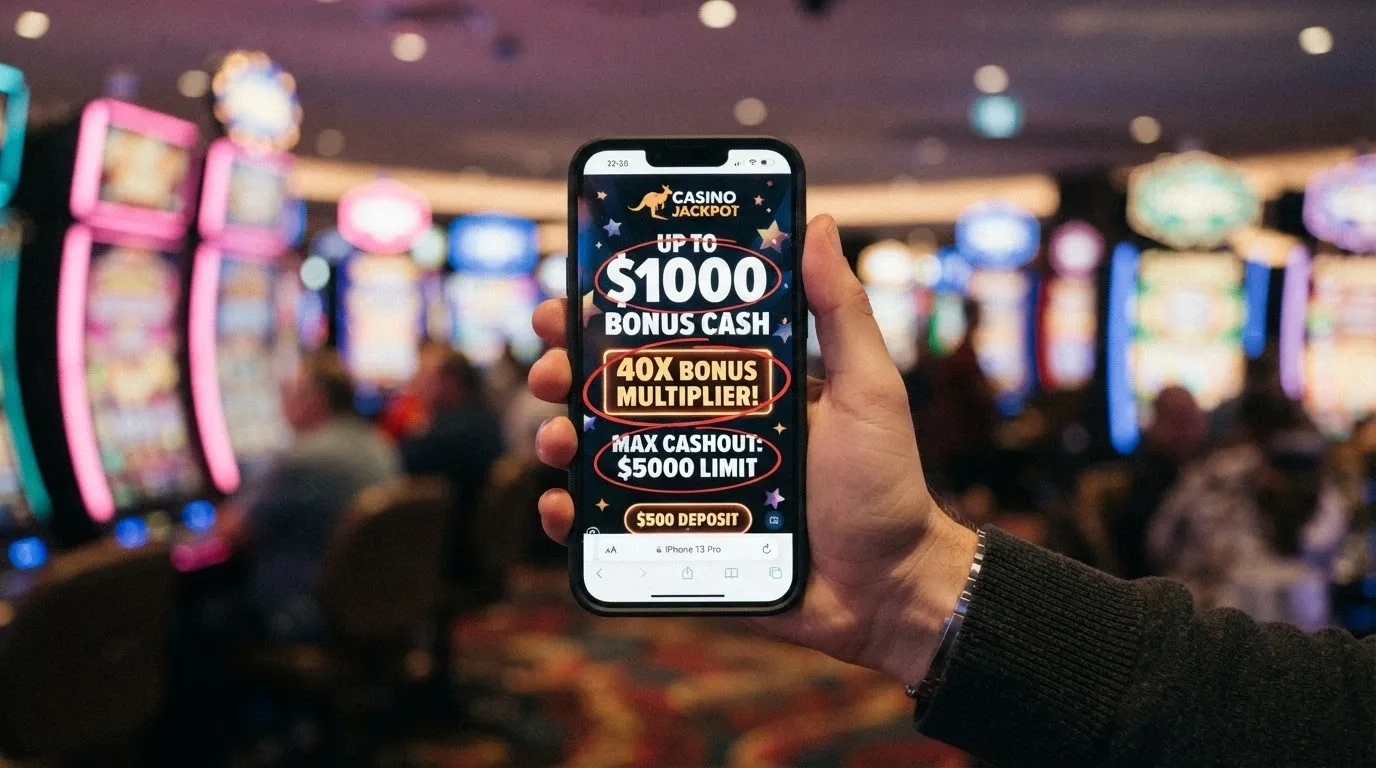
The mechanics are simple, and they always work against the player on average. A standard 40x wagering requirement on a AUD 500 bonus means AUD 20,000 in qualifying bets before any of the bonus balance converts to withdrawable cash. The casino’s edge on those bets, assuming an RTP of 96–97% across the pokies the bonus can be cleared on, is 3–4% of turnover. The expected loss on AUD 20,000 of qualifying play is therefore AUD 600 to AUD 800 — a statistical estimate over many spins, not a guaranteed outcome for any single session, and assuming only the bonus amount is wagered. That is the bonus’s real cost, and it is larger than the bonus itself.
The terms that are not in the headline are the speed limits that keep the volume up. The maximum bet during wagering — AUD 5 to AUD 8 at most of the casinos in this set — stops the player from clearing the bonus with a handful of high-stake spins and removes the variance that might let them get lucky. The validity window — five to fourteen days at the operators reviewed below — forces the player to keep playing, on the casino’s terms, before the bonus expires.
Game contribution rules are the third mechanism. Pokies contribute 100% to wagering. Table games and live casino typically contribute 0–20%, which means a bonus cleared on blackjack reduces the qualifying turnover much faster than the same volume on a pokie. The casino writes around this by excluding live games from many bonuses altogether, and by auditing for “irregular play” — patterns of low-risk wagers that, in the casino’s judgement, exploit the bonus rather than play it. Confiscation under that clause is rare but real, and the cases do not get appealed in any Australian forum.
What the headline hides, then, is the bonus’s expected loss minus its headline value. A AUD 500 bonus with 40x wagering on pokies has an expected cost of AUD 600–800 to the player who clears it. The player who does not clear it gets nothing. The casino, in either case, ends the bonus in profit. The arithmetic is statistical, not guaranteed. Any individual session can finish ahead. Across enough sessions, the house edge wins.
Free Spins — What 100 Spins Are Actually Worth
Free-spin offers at AU-facing casinos typically run 20 to 50 spins on a single named title, with up to 100 available at the larger end of the market. The headline is the spin count. The arithmetic that decides what those spins are worth is several lines further down the terms page.
A single spin at a 96% RTP, at a AU$0.20 stake, returns on average AU$0.192. A hundred such spins return on average AU$19.20 in gross play. The wagering requirement, typically 40x on the spin winnings, then requires another AU$768 in qualifying bets before any of that balance can be withdrawn. The expected loss on those qualifying bets, at the same RTP, is roughly AU$23 to AU$31. The maximum cashout cap — typically AU$50 to AU$100 on a free-spin bundle — is the next cut.
The free spin is, on this reckoning, a slightly different shape of the same trap as the no-deposit bonus. The headline figure is the spin count, which is irrelevant to the player. The relevant numbers are the stake per spin (often fixed at the casino’s choice), the wagering multiplier on winnings, the cashout cap, and the contribution rules once the spins convert to bonus cash. Game restrictions — the operator’s choice to lock spins to a single low-RTP title, often a branded or in-house game — are the third cut. A pokie at 94% RTP is materially less generous than one at 97%, and the operator chooses which one the free spins land on.
The honest read of a 100-free-spin headline at a 40x wagering requirement is: the player gets a tightly-capped coupon to one specific game, with most of the value of any win going back into qualifying turnover. A player who treats it as a free lottery ticket to a casino they were going to use anyway can clear value. Treating these spins as a free lottery ticket works, but depositing specifically to chase them turns a bonus into a liability.
VIP, Reloads and Loyalty — The Offers That Outlast the Welcome
The welcome bonus is the front door. The reload schedule, cashback offers and VIP programme are the long game. They run quietly, often by email, and they are the difference between an operator that pays back 5% of monthly play and one that pays back 15%. The difference is not advertised.
Royal Reels runs a 10-tier VIP programme that tracks the player’s monthly volume and exchanges it for cashback, exclusive bonuses, faster withdrawals and a personal account manager at the upper tiers. The casino does not publish the tier thresholds, the cashback percentages, or the speed-up on withdrawals at each level. The structure is described in general terms on the site; the specifics live behind the login. That opacity is the norm across the set. Operators prefer that VIP terms stay opaque, because they let the same nominal programme offer materially different real value to different players.
Reload bonuses — typically a 50% to 100% match on a subsequent deposit, smaller than the welcome offer — are the most visible part of the ongoing schedule. They carry the same 40x to 50x wagering as the welcome bonus, sometimes worse, and almost always with a tighter validity window (often three to seven days). Cashback offers return a percentage of net losses over a period, usually 5% to 15% weekly, and may or may not carry wagering. The cashback without wagering is the more useful offer; a 10% cashback on net losses, with no wagering, is worth more to a high-volume player than a 100% reload with 50x on top.
The loyalty economy at offshore casinos is, in sum, a smaller version of the welcome bonus’s economics. The headline is generous. The terms decide what the player actually keeps. A player who reads the small print on every reload, and who treats cashback without wagering as the only offer worth chasing, ends up paying less to the house than one who treats every promotion as a gift.
Australia’s Most-Used Offshore Casinos in 2026 — How They Really Compare
Ten brands, five columns. The table below pulls together the specifics from operator terms pages where research confirmed them, and leaves honest gaps where it did not. Two things are worth saying before the rows.
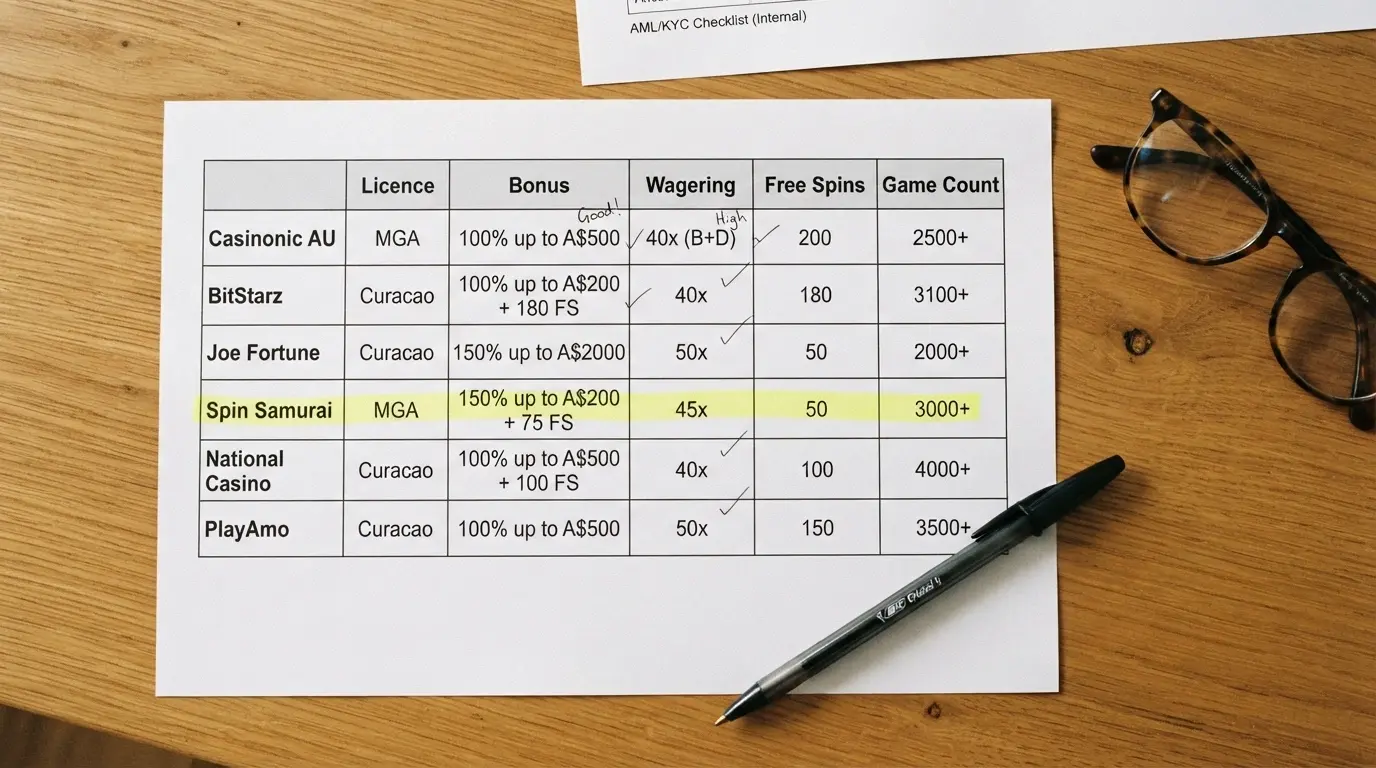
The first is the licence column. Most of the ten brands operate under a Curaçao eGaming Authority licence; one — Rainbet — operates under an Anjouan licence that explicitly restricts Australian players in its own terms; the rest carry no registered Australian credential, because none can. The Curaçao licence is the standard offshore credential for an AU-facing casino; it confers no consumer protection on an Australian customer. The Anjouan licence is newer and lighter. Neither is an Australian licence, and neither binds the operator to Australian consumer law.
The second is the wagering column. Five of the eight operators whose terms were confirmed run 40x on the bonus amount, in line with the offshore market average. Skycrown and Fair Go run lower — 30x on the bonus, or 30x on deposit-plus-bonus — the lowest figures in the set, and a material advantage on a large welcome package. Higher wagering is rarely better. The column reads from the player’s side, not the marketing side.
| Operator | Offshore Licence | Welcome Bonus | Wagering | Free Spins | Game Count |
|---|---|---|---|---|---|
| Rocket Play | Curaçao | 100% up to AUD 500 + 100 FS (1st); 200% up to AUD 500 (2nd) | 40x | 100 | 5,400+ |
| Skycrown | Curaçao | 100% up to AU$200 + FS over 3 deposits | 30x | Across 3 deposits | — |
| Royal Reels | Offshore; ACMA-blocked | AU$10 ND + deposit bonuses | 40x | — | 5,400+ |
| Bizzo Casino | Curaçao 8048/JAZ2017-067 | Up to A$4,500 + 150 FS over 4 deposits | 40x | 150 | — |
| WinSpirit | Curaçao (Complete Technologies N.V.) | 100% up to A$300 + 100 FS (1st); 200% up to A$1,000 (2nd) | 40x | 100 | 4,500+ |
| Fair Go | Offshore | 100% up to $200 × 5 ($1,000 total) | 30x (D+B) | 15 (ND on Bubble Bubble) | 280 |
| Rainbet | Anjouan ALSI-152406029-FI2 | Wager Lock: min $30, max $700 qualifying | 40x | Bundled w/ Wager Lock | — |
| Stake | Offshore | — | — | — | — |
| Wolf Winner | Curaçao | Up to AUD 5,500 + 125 FS | — | 125 | 1,800+ |
| Caswino | Offshore | — | — | — | 12,000+ |
Two of the ten — Stake and Caswino — have no confirmed welcome bonus, wagering or free-spin specifics this round. They are included because competitor coverage ranks them for AU traffic and because their platform characteristics — Stake’s global brand recognition, Caswino’s 12,000+ title library — are independently verifiable. The operator write-ups below say what is publicly known about each, and where the specifics stop.
Rocket Play
Rocket Play’s headline reads AUD 500 plus 100 free spins on the first deposit, then 200% up to AUD 500 on the second — a combined AUD 1,000 in matched bonus plus 100 spins for a minimum deposit of AUD 25. The wagering requirement is 40x on the bonus amount, which lands at AUD 20,000 in qualifying turnover on the first deposit alone. That is the offshore-market standard, and the expected loss at 96–97% RTP is AUD 600–800 — a statistical estimate across many spins, assuming only the bonus amount is wagered.
The terms that are not in the headline are tighter than the market average. Rocket Play runs a five-day bonus validity — among the shortest in this set — and a maximum bet during wagering of AUD 7.50 per spin. The maximum win from the bonus is capped at AUD 5,000, which is generous on a small bonus and irrelevant on a large one. Five days is short. A player who deposits AUD 500 on Monday and works through AUD 20,000 in qualifying bets needs roughly 4,000 spins at the AUD 7.50 cap, or close to eight hours of continuous play inside that window. The maths works only for a player who plans the bonus around their week. Casual play is rarely enough; this bonus demands a disciplined schedule.
Skycrown
Skycrown runs a smaller headline than most of the set: 100% up to AU$200 plus free spins, spread across the first three deposits rather than concentrated on one. The wagering requirement is 30x the bonus amount — the lowest figure any operator in this comparison has published. That single number decides where Skycrown sits in a shortlist.
The maths is straightforward. A player who takes the full AU$200 bonus on the first deposit and clears it at 30x has to put AU$6,000 in qualifying bets through the casino, with an expected loss of AU$180 to AU$240 at the typical 96–97% RTP band. The expected loss is roughly the bonus amount. The same arithmetic on a AUD 500 bonus at 40x produces a larger expected loss on a smaller-claimed amount. Skycrown’s lower wagering multiplier is not a marketing wrinkle; it is a meaningful reduction in the bonus’s real cost.
The remaining terms were not confirmed this round — validity windows, max-bet rules during wagering, and any maximum-cashout cap on the welcome bonus. The write-up is therefore narrower than the rest of the set. A player who is comparing wagering multipliers in isolation will find Skycrown at the top of that column. Checking the site’s full terms before confirming a deposit is always the smarter move.
Royal Reels
Royal Reels is the only operator in this set that runs a genuinely deposit-free entry point: an AU$10 no-deposit bonus after phone verification, with 40x wagering, a AU$200 maximum cashout, and a 7-day validity. The AU$10 is small. The structure is what is rare — a real chance to play a withdrawal-eligible bonus without committing AUD 20+ to an offshore account first.
The rest of the platform is built for volume. Royal Reels runs 5,400+ pokies from 40+ providers, instant crypto and PayID withdrawals, and a 10-tier VIP programme that tracks monthly play. CasinoAudit scored the brand 75/100, with Payout Speed (90), UX & Mobile (90) and Trust & Licensing (89) as strengths; Bonus Fairness (53) and Payment Options (57) as concerns. The split is honest: the casino pays fast and plays well on a phone, and the bonus terms are tighter than the headline suggests.
The catch is the ACMA block. Royal Reels is one of the 1,564 illegal gambling and affiliate sites blocked by Australian ISPs as at March 2026. A player who can reach the site is reaching it via a route the regulator has decided to close. The site’s bonuses are real. The site’s standing under Australian law is not. That is the load-bearing fact for a reader comparing it to the rest of the set, and the reason the brand’s overall CasinoAudit score sits where it does despite strong sub-scores elsewhere.
Bizzo Casino
Bizzo runs the largest headline figure on this page: up to A$4,500 in matched bonuses plus 150 free spins across four deposits. The structure is a 100% match up to A$2,500 with 125 free spins on the first deposit, then a 50% match up to A$750 with 50 free spins on the second, then a 30% match up to A$2,000 on the third and a 25% match up to A$2,000 on the fourth. The headline figure is reached only by depositing the maximum on each step.
The wagering requirement is 40x on the bonus amount, with a 14-day validity and a maximum bet with an active bonus of A$8. The Curaçao eGaming licence number 8048/JAZ2017-067 is published on the site. The licence is offshore — there is no Australian layer — but Bizzo at least names its credential.
The arithmetic on the headline is unforgiving. A player who claims the full A$4,500 over four deposits has to put A$180,000 in qualifying bets through the casino at 40x. The expected loss on that turnover, at 96–97% RTP, is A$5,400 to A$7,200. The bonus’s expected cost exceeds its headline value before the player finishes claiming it. The 14-day validity on each step is the speed limit that keeps the volume up. Claiming the full amount requires serious planning; this is a project, not a casual promotion.
WinSpirit
WinSpirit is a 2022 launch operated by Complete Technologies N.V. under a Curaçao licence, with 4,500+ slots, a live dealer suite and a sportsbook attached. The combined casino-and-sports structure is what distinguishes it from the pokies-only operators in the set.
The welcome bonus is a two-deposit package: 100% up to A$300 plus 100 free spins on the first deposit, then 200% up to A$1,000 on the second. Wagering is 40x on the bonus amount, with a A$5 maximum bet and a 7-day validity on each step. Minimum deposit on most bonuses is A$30. The combination of a sportsbook with a casino means the player is not locked into clearing the bonus on pokies; some sports wagers contribute to wagering at lower rates, and the structure appeals to players who mix casino and sports.
The 4,500+ slot library is mid-pack. The presence of a sportsbook on the same wallet is the differentiator for a player who wants both products under one account. For a casino-only player, WinSpirit is a competent mid-market option — standard wagering, a real variety of providers, and a Curaçao licence that names itself. It does not lead the set on any single dimension except the casino-plus-sports combination.
Fair Go
Fair Go is the longest-running brand in this comparison and the only one built entirely on Realtime Gaming software. The library sits at 280 games — a fraction of the multi-studio platforms — but every title is from a single provider Australians have been playing for two decades. The trade-off is intentional. Smaller library, fewer variables, more recognisable games.
The welcome package is 100% up to $200 on each of the first five deposits, for a total matched value of $1,000. The wagering requirement is 30x on the deposit plus the bonus, which makes it harder to calculate than the standard “wagering on bonus only” structure that dominates the rest of the set. The minimum deposit is $20. Fair Go also runs a deposit-free entry: 15 free spins on Bubble Bubble with 60x wagering on winnings. PayID deposits are supported, support runs 24/7, and withdrawals are processed in AUD.
The 30x on deposit-plus-bonus is the lowest wagering burden in the set on a percentage basis, but the base it applies to is larger. A player who deposits $200 and claims a $200 bonus must clear $400 × 30 = $12,000 in qualifying bets. The library size is the limiting factor. A player who likes RTG games will find the trade-off acceptable. Those seeking Evolution live dealer tables or Nolimit-style mechanics will find this platform too limited.
Rainbet
Rainbet’s terms page is the most explicit disqualification on this page. The operator restricts access from Australia, alongside a list of other jurisdictions, prohibits using a VPN, proxy or similar service to disguise a player’s real location, and runs its promotional structure on terms that assume the player has agreed to all of the above. A reader who proceeds anyway is, in Rainbet’s framing, in breach of the operator’s terms.
The licence is Anjouan, number ALSI-152406029-FI2 — a lighter credential than Curaçao, and a newer one in the offshore market. The Wager Lock Promotion requires a minimum $30 deposit and allows a maximum qualifying deposit of $700, with 40x wagering on the first-deposit promotional balance. Free spins apply to Sweet Bonanza. The promotional terms exclude Hacksaw and Nolimit games, exclude games with RTP above 97.4%, and cap the maximum bet at 2% of the deposit amount. Each exclusion is a tighter constraint than the equivalent rule at most Curaçao-licensed competitors.
Rainbet is on this page because competitor coverage ranks it for AU traffic, and because the operator’s restrictions are themselves worth a reader’s attention — they are a clearer statement of the offshore posture than most brands are willing to publish. The honest verdict is that Rainbet is not a viable option for an Australian player. The brand’s own terms say so.
Stake
Stake is a global brand with a large AU-facing footprint and no confirmed welcome-bonus, wagering or free-spin specifics in this round. The platform is offshore — not AU-licensed, like every other entry on this page — and its product mix runs across casino, sportsbook and the original Stake-branded games.
What is publicly known is the platform’s standing in the global offshore market. Stake sponsors major sporting organisations and runs a wallet-based product that combines casino, sports and original games under one balance. Its game count is materially larger than every pokies-focused competitor in this set, and its sportsbook is a serious product rather than a bolt-on. The promotional structure on the AU-facing version of the site is what this page cannot pin down.
The honest read is that a player considering Stake should treat the operator’s own terms page as the primary source. Welcome offers, wagering multipliers and free-spin bundles change frequently at the global brands; a snapshot from one quarter does not bind the next. The platform’s scale and product breadth are real. The headline figures this page lists for the rest of the set are not, in this round, available for Stake.
Wolf Winner
Wolf Winner runs a welcome package of up to AUD 5,500 plus 125 free spins, with over 1,800 games from 20+ providers and crypto withdrawals processed inside 24 hours. The Curaçao licence is published on the site. The headline is the second-largest in this comparison; the game library sits in the middle of the set.
The wagering multiplier on the welcome bonus was not confirmed this round. The bonus validity and any maximum-cashout cap were not confirmed either. The write-up is therefore narrower than the four-deposit packages elsewhere — the headline is verifiable, the fine print is not, in this snapshot. The 1,800+ library is built around the major studios; the 24-hour crypto withdrawal is faster than the standard 2–4 business days most of the set quotes for bank transfer.
The honest read of Wolf Winner is a mid-pack operator on a strong crypto-withdrawal footing, with a welcome bonus that is one of the larger headline figures in the market. A player who plans to deposit and withdraw in crypto will find the withdrawal speed a genuine advantage. A player who needs the wagering terms confirmed before depositing will need to read Wolf Winner’s terms page first.
Caswino
Caswino runs the largest game library on this page: 12,000+ titles from 70+ studios, with Evolution Gaming live casino attached. The scale is the differentiator. Every other operator in the set runs a smaller catalogue, and the difference shows up in the variety of slot mechanics, jackpot structures and live-dealer side bets available on the platform.
The welcome bonus, wagering multiplier, free-spin bundle and bonus validity were not confirmed in this round. Caswino is offshore — not AU-licensed — and operates outside the Australian regulatory perimeter in the same way as the rest of the set. The library size and the Evolution live-dealer integration are the verifiable parts; the promotional structure is what a player should check directly on the site before depositing.
The honest verdict is that a player who values game catalogue breadth above welcome-bonus size will find Caswino at the top of the shortlist. A player who is choosing on the welcome package alone will not, because the package details are not on this page in this snapshot. The 12,000+ titles is the load-bearing fact for this brand, and the gap on the bonus side is what a player should fill before depositing.
Fresh on the Scene — New Casino Brands Accepting Australians in 2026
A new casino brand is a balance between opportunity and risk. The opportunity is the welcome offer: new operators compete on the size of their sign-up package because they do not have a reputation to defend. The risk is everything else — the licence may be new, the operator may be new, the platform may be running on infrastructure that has not yet been stress-tested under real volume. There is no track record on withdrawals, complaint resolution, or how the bonus terms are interpreted when a player wins.
Competitor coverage this round flagged several recent arrivals in the AU-facing market — offshore brands launched in the past 12 to 24 months, marketing heavily on welcome bonuses and crypto deposits. None of them has yet built the kind of independent review record the older brands in this set carry. A player considering one of these brands is, in effect, betting on the licence, the terms, and the operator’s incentive to behave well while it is still building a reputation.
What the newness actually buys the player is leverage. A new operator with thin volume is more willing to pay out a disputed withdrawal than an established brand, because the reputational cost of a public complaint is higher. The newness also costs the player the things an established brand provides — a verified payout-speed record, an audit score from CasinoAudit or similar, a player-complaint trail on affiliate forums, and the accumulated operator history that tells the player how a bonus term is interpreted in practice. The due diligence checklist below is what the newness costs.
What to Check Before You Deposit at a Brand-New Casino
A brand-new casino with no track record needs to be checked in five places before the player commits AUD 20:
- The licence. A Curaçao or Anjouan licence number on the site is the start, not the end. The licence register at the issuing authority is the actual confirmation. A number that does not resolve is not a licence.
- The provider roster. A platform running 5,000+ titles from 40+ providers has integration depth; a platform running 500 titles from two providers is doing something else. The provider names tell the player whether the games are real — Evolution, Pragmatic Play, NetEnt, Play’n GO and Nolimit are not interchangeable with white-label studios operating under generic names.
- The withdrawal history. Affiliate forums, CasinoAudit’s operator pages and complaint aggregators carry the recent record. A new casino with no complaints is either too new to have any, or quietly settling them. Multiple unresolved withdrawal complaints is a reason to walk away.
- The bonus terms. The headline figure is irrelevant. The wagering multiplier, contribution rules, validity window, maximum bet during wagering and maximum cashout decide what the bonus is actually worth. A 60x bonus on AUD 5,000 is more expensive to clear than a 30x bonus on AUD 500.
- The payment-method posture. A new casino that accepts credit card or crypto from Australian customers is operating outside Australian law. That is a useful filter for the operator’s general posture, and the same posture that ignores one Australian rule tends to ignore others.
Royal Reels’ CasinoAudit profile — Payout Speed 90, UX & Mobile 90, Trust & Licensing 89, Bonus Fairness 53, Payment Options 57 — is the kind of structured read a player wants for a brand they cannot yet evaluate from track record alone. The split between the strong sub-scores and the weak ones is itself the information; a casino that scores well on payout speed and poorly on bonus fairness is telling the player where the value is.
PayID Casinos in Australia — Fast Deposits, Slower Withdrawals
PayID is the deposit method most Australian-facing casinos agree on. It clears instantly at most operators in the set. It is not, in most cases, the withdrawal method.
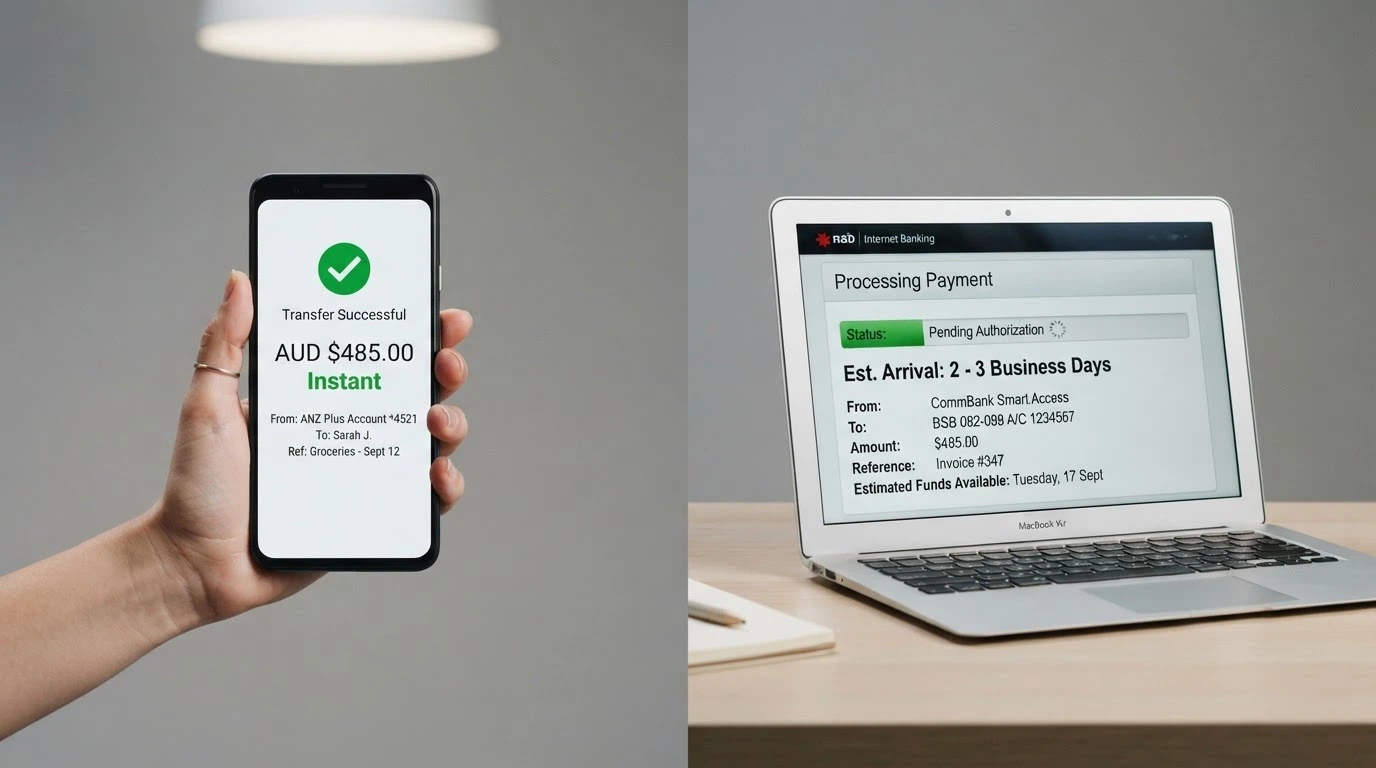
The route mismatch is the most common hidden trap on the cashier page. PayID is built on the New Payments Platform and Osko, which together allow real-time bank-to-bank transfers in Australia. A deposit via PayID arrives in the casino’s account within seconds; the player sees the balance updated, the bonus unlocked, the games ready to play. The withdrawal path, at most of the same operators, runs back through standard bank transfer rather than PayID — even when the player deposited with PayID. The reason is operational: PayID is a push-only payment rail. The casino can push a deposit confirmation to the player. It cannot, in the same way, pull a withdrawal out of the player’s account. The withdrawal therefore routes through a slower channel that supports direct debits and scheduled transfers.
The timing on the withdrawal side ranges from under an hour at the better-run casinos to 24–48 hours at the others. Once the casino approves the withdrawal, the bank transfer itself is typically near-instant. The queue sits at the casino’s end, not the bank’s. A player who deposited AUD 100 via PayID at 10pm and sees the withdrawal pending until the next business day is not waiting on the bank. They are waiting on the operator’s approval workflow.
Royal Reels advertises instant crypto and PayID withdrawals, which is the strongest claim on PayID-side speed in this set. WinSpirit, Fair Go and Wolf Winner accept PayID on the deposit side; the withdrawal side for each requires reading the specific cashier page. The published minimum withdrawal across the set is AUD 50, with a daily limit of AUD 5,000 at many of the brands; bank transfers take 2 to 4 business days once approved.
The practical read is that PayID is the right deposit method for almost any AU-facing casino, but the player should not assume the withdrawal is symmetrical. Read the cashier page before depositing, and treat any bonus that promises “instant withdrawals including PayID” as a claim worth checking against the published banking page rather than the homepage marketing.
Every Payment Method an Aussie Player Can Use — and the One You Cannot
The legal deposit routes for licensed wagering in Australia are four:
- Debit card
- Bank transfer
- PayID/Osko
- BPAY
Each of these is supported, in some form, by most AU-facing offshore casinos — even though the offshore operators are not licensed in Australia and are not subject to the legal-route rule in the same way. The credit-card, credit-related-product and crypto ban that took effect on 11 June 2024, with penalties of up to $247,500 for non-compliance, applies to operators providing online wagering to Australians. Offshore brands are not, in practice, bound by it. Many of them still accept credit cards and crypto.
That fact is itself a useful filter. If the cashier offers credit card or crypto to an Australian player, the operator is operating outside Australian rules — by choice, not by accident. The payment method on offer is a tell for the operator’s general posture toward the jurisdiction it is serving. A casino that respects one Australian rule is more likely to respect others. A casino that ignores the payment ban is signalling something broader about its willingness to comply with the IGA.
The minimum deposit at most AU-facing offshore casinos is AUD 20. The minimum withdrawal is typically AUD 50, with a daily limit of AUD 5,000 at many of the brands reviewed here. Bank transfers take 2 to 4 business days. E-wallet payouts, where supported, are faster once verified. Crypto withdrawals are typically processed inside 24 hours. PayID withdrawals, where supported at all, depend on the operator — Royal Reels is the strongest claim in the set; the rest of the brands vary.
The honest read is that the four legal methods cover almost every player’s banking preference, and that an operator offering credit card or crypto is one a player should think twice about. The payment method is the easiest check on this page; it costs nothing to look, and it tells the player more about the operator than the welcome bonus does.
Pokies in Your Pocket — Mobile Casino Play for Australians in 2026
Most Australians who play at offshore casinos do so on a phone. The desktop is a backup, not the default. The mobile experience at every operator in this set runs through the phone’s browser — there is no native app for the Australian App Store or Google Play storefront at any of the ten brands reviewed here. That absence is structural, not a design choice by the operators.

Apple and Google restrict real-money gambling apps in their Australian storefronts. A casino that wanted to ship a downloadable app would have to route through a separate approval process, which most offshore operators have not pursued. What players get instead is a mobile browser version of the desktop site — sometimes a responsive design that adapts to a phone screen, sometimes a dedicated mobile subdomain. Both work. Neither requires a download.
CasinoAudit’s UX & Mobile score of 90 for Royal Reels is one of the few structured reads on the mobile experience at an AU-facing casino. The score reflects load time, navigation, game performance and cashier flow on mobile devices. The other operators in this set were not scored on the same rubric in this round; the read across the rest is qualitative. The pattern is consistent — the larger libraries (Caswino’s 12,000+, Royal Reels’ 5,400+, WinSpirit’s 4,500+) load and run acceptably on a modern phone; smaller libraries (Fair Go’s 280 RTG games) load faster but offer less variety.
The honest read is that the mobile experience at every operator in this set is functional. The differences between them are about library size and game catalogue, not about whether the platform works on a phone. A player who has a modern smartphone and a stable internet connection will find any of these operators usable in landscape orientation.
Native Apps vs Instant Play — What You Actually Get on Each
A native app gives the player a downloadable casino on their phone’s home screen, push notifications when a bonus drops, and — sometimes — a marginally faster load time. An instant-play casino gives the player a bookmarked URL and a browser tab. The functional difference is smaller than the marketing suggests.
What the player does not get, with a native app, is a path through the App Store or Google Play for an Australian-facing offshore casino. Both storefronts restrict real-money gambling apps in Australia, and the offshore operators in this set have not pursued the separate approval route that would let them publish to Australian users. The native apps that exist at some of these brands are typically for restricted jurisdictions outside Australia, or are Android APK files distributed through the casino’s own site — installable, but with the security caveats that come from sideloading.
The instant-play experience, run through Safari, Chrome or the phone’s default browser, has closed most of the gap. Game performance on a modern phone is indistinguishable from a native app for the pokies and live dealer tables that dominate these libraries. The cashier flows work. The bonus terms surface. The withdrawal queue is the same queue. The browser bookmark is the practical equivalent of a home-screen icon, with the advantage that it does not need an update pushed through the storefront.
The honest read is that the choice is not really a choice for an Australian player. The instant-play browser version is the only one reliably available. A native app from any of these brands would, by definition, be running outside the Australian storefronts, with the security and update channels that implies.
Australia’s Online Casino Laws — What the IGA Actually Means in 2026
The Interactive Gambling Act 2001 makes it an offence to provide online casino games, online pokies and in-play sports betting to a person in Australia. There is no licence for online casino anywhere in the country — not federally, not in any state or territory. The IGA was strengthened by the Interactive Gambling Amendment Act 2017, which closed the loopholes offshore operators had used and gave the Australian Communications and Media Authority its enforcement and blocking powers.

What IS permitted and licensable is wagering on races and sport placed before the event begins, and lotteries and keno, through operators licensed by a state or territory. The Northern Territory Racing and Wagering Commission, administered through Licensing NT, is the de facto national licensor for online wagering — Sportsbet, bet365, Ladbrokes and around fifty others hold NT licences. About 190 licensed wagering providers operate in Australia. None of them offers online casino games, because they cannot.
The IGA targets the operator, not the player. Australians are not prosecuted for playing at an offshore casino. They are, however, playing outside Australian consumer law. That distinction matters more than it sounds. The prohibition prevents the operator from offering the product; it does not, and is not designed to, give the player any recourse if the operator refuses to pay out, voids a win, or closes the account. There is no Australian disputes body for offshore casino play. The ACMA can block the site. It cannot recover the balance.
The enforcement record under the IGA is concrete. As at March 2026, the ACMA has had 1,564 illegal gambling and affiliate websites blocked by Australian ISPs since the first blocking request in November 2019. More than 225 illegal services have withdrawn from the Australian market since the 2017 amendment. Blocking is DNS-level. A player who has a balance on an account when the site is blocked is not refunded; they lose access to the cashier page alongside everyone else. The blocks are effective. They are not a refund mechanism.
The table below summarises what the current rules actually say, side by side with what changes on 1 January 2027.
| Restriction | Current Rule | From 1 January 2027 |
|---|---|---|
| Wagering ad frequency | Limited; state-by-state variations | Max 3 ads per hour between 6:00 am and 8:30 pm |
| Live-sport blackout | Partial; varies by sport and broadcaster | 15 minutes before to 5 minutes after live events |
| Celebrity / influencer promotion | Allowed | Banned outright |
| Banks blocking transactions to illegal operators | No express authority | Express statutory authority granted |
| Inducement marketing to new customers | State-by-state restrictions | Banned for 14 days after signup |
| Inducement marketing after BetStop deregistration | No specific rule | Banned for 3 months |
| Inducement marketing to at-risk customers | No specific rule | Banned indefinitely |
| Radio ads during school commute | Limited | Banned during drop-off / pick-up windows |
| Online ads to logged-in users | Unrestricted | Restricted to logged-in, age-confirmed, opted-in users |
| Credit cards / crypto for online wagering | Banned since 11 June 2024 | Continued |
The two columns are the substantive change. The current rules are not weak — they prohibit the product outright, block 1,564 sites, and have driven 225+ services out of the market. What the 2026 reform does is shift the burden of compliance onto a wider net of participants: banks and payment providers, broadcasters, advertisers, athletes and influencers. The reform does not legalise online casino. It tightens the screws on the offshore operators who are already breaking the law.
The 2026 Gambling Reform — What Changes on 1 January 2027
The Interactive Gambling Amendment (Gambling Reform) Bill 2026 passed Parliament on 19 August 2026. Its measures commence on 1 January 2027. The reform is the second major tightening of the IGA since the 2017 amendment; it does not change the underlying prohibition on online casino, but it materially expands the enforcement surface around it.
The advertising restrictions are the most visible change. From 1 January 2027, no more than three wagering ads per hour may run between 6:00 am and 8:30 pm on any broadcaster. A live-sport blackout window applies from 15 minutes before a live event until 5 minutes after it ends, during which no wagering advertising may be broadcast at all. Athletes, celebrities and influencers are barred from promoting wagering products. Radio wagering ads are barred during school drop-off and pick-up times. Broadcasting sporting odds is banned outright. Online wagering ads are restricted to logged-in, age-confirmed users who have opted in. Wagering advertising inside sports venues, on player uniforms or on official apparel is also restricted.
The financial-services change is the one with the most direct impact on offshore casino players. Banks and payment providers gain express statutory authority to block transactions to illegal gambling operators. Today, an Australian bank can decline a transaction to an offshore casino, but the legal footing is uncertain and most banks do not actively screen for it. From 1 January 2027, the authority is explicit. The reform does not require banks to block — it permits them to. The practical effect is that more banks will, because the legal risk of not blocking has dropped.
The inducement marketing rules close a final gap. Direct marketing of inducements — sign-up offers, referral bonuses, free bets — is prohibited for 14 days after a customer signs up with a licensed operator, for three months after a person deregisters from BetStop, and indefinitely for any customer identified as at-risk under the operator’s harm-monitoring framework. The rules apply to licensed wagering, not offshore casinos. The offshore operators have no inducement-marketing regime to constrain. The reform matters because it limits what licensed wagering can do to compete against the offshore welcome offers, which are themselves illegal.
Offshore vs Regulated — What You Give Up Playing at an Unlicensed Casino
Playing at an offshore casino means accepting the absence of every protection that exists on the Australian-licensed side. The full list of what that absence means is covered in the responsible-gambling section below; the short version is: no BetStop, no Australian complaints body, no fund recovery, and a real risk of site blocking with a balance still on account.
There is no BetStop coverage at any offshore casino. BetStop — the National Self-Exclusion Register — binds Australian-licensed wagering providers. A person who registers with BetStop is excluded from all approximately 190 licensed wagering providers in Australia. The offshore casino, by definition, is not licensed in Australia and is not connected to the register. A player who registers with BetStop to stop gambling can keep depositing at an offshore casino the next day. Only 33.5% of Australian wagerers know BetStop exists. Of the rest, some are betting offshore and could use the protection. They are not covered by it.
There is no Australian consumer protection and no Australian complaints body for offshore play. The ACMA cannot recover a player’s money. A casino that refuses a withdrawal, voids a win, or closes an account is, in practice, the final arbiter of its own conduct. The Curaçao and Anjouan regulators handle complaints against their own licensees, but the process is slow, the outcomes are not enforceable in Australian courts, and the threshold for the regulator to intervene is high. Most disputes are resolved, when they are resolved, through affiliate forums and public complaint pressure.
There is no fund-recovery mechanism if the operator fails. The 1,564 sites the ACMA has blocked since November 2019 are blocked at the ISP level — a DNS blackhole that prevents Australian users from reaching the site. A player who has a balance on a blocked site is not refunded; the balance is locked behind a domain that no longer resolves for them. The blocks are effective for new players. They are not designed to recover existing balances.
The credit-card and crypto ban, in force since 11 June 2024, applies to operators providing online wagering to Australians. Offshore casinos are not, in practice, bound by it. The fact that an offshore casino accepts credit card or crypto from an Australian player is therefore a marker of its willingness to operate outside Australian rules — and a useful filter for the operator’s general posture.
Staying Safe at the Pokies — Responsible Gambling Tools Every Aussie Should Know
The safety net that exists for Australians is real, but it stops at the border of the offshore casino. BetStop, the National Gambling Helpline, and Gambling Help Online are all Australian services; all of them apply to licensed wagering; none of them apply to the offshore casinos reviewed on this page. A reader who is reading this section because they are worried about their own gambling — or someone else’s — needs to know that distinction before deciding what tool to use.

The National Gambling Helpline is 1800 858 858, free, confidential and staffed 24 hours a day, seven days a week, with the same number nationwide. Gambling Help Online offers 24/7 online chat with professional counsellors. Both are operated by qualified clinicians, not by the gambling industry. A single call or chat is enough to start the conversation; ongoing support is available; the services are independent of any operator or regulator.
BetStop — the National Self-Exclusion Register — launched on 21 August 2023. To the end of Q3 FY 2025–2026, 59,830 people had registered; as at 31 March 2026, 37,247 had active exclusions. The register excludes a person from all approximately 190 licensed wagering providers in Australia. It does not exclude them from offshore casinos, which are not connected. The figures are real and large — but they are also small relative to the at-risk population. An estimated five million wagerers nationwide, including 400,000 high-risk gamblers, while only about 30,000 individuals currently have active exclusions. Most people who would benefit from self-exclusion have not registered.
Awareness of BetStop is low. Only 33.5% of Australian wagerers know the register exists; around one in four Australian adults more broadly. Of those who have registered, 78% were under 40 and 38% chose lifetime exclusion. Four in five registrants experience a better overall quality of life; 79% report improved mental health; 96% had either completely stopped or decreased their betting after registering. The data is encouraging — but the data is also the data of a register that most at-risk people do not know they can use.
The Hidden Toll — Gambling Harm in Australian Numbers
The numbers behind the help line are large. An estimated 1,970,000 Australian adults are classified as having at-risk or problem gambling. Approximately 1,381,000 adults are affected by another person’s gambling — partners, family members, friends. The total reaches 3.29 million Australians aged five and over affected annually by their own or another person’s gambling. The annual health loss associated with gambling-related harm in Australian adults is estimated at over 400,000 Years Lived with Disability.
About 2.1% of Australian adults — roughly 430,000 people — experience problem gambling. High-risk gambling is estimated at 1.8%. Australians lose approximately $25 billion on legal forms of gambling each year. The legal forms are lotteries, wagering, gaming machines in clubs and pubs, and casino tables at the country’s land-based venues — Crown Melbourne, The Star Sydney and the smaller state-based casinos. Online casino is not in that figure, because the legal forms do not include it.
The at-risk populations are not evenly distributed. 27.1% of Aboriginal and Torres Strait Islander peoples are at risk of gambling harm, compared to 14.6% of non-Indigenous Australians. The disparity is large and longstanding; the underlying drivers — social, economic, geographic — sit well outside the gambling policy itself. Younger adults are also over-represented; 78% of BetStop registrants were under 40 at registration. Men are over-represented relative to women in problem-gambling prevalence; women are over-represented in the affected-others figure.
The cumulative weight of these numbers is what the marketing pages of offshore casinos do not show. A “100% up to AUD 500” headline, in this context, is not the offer of a free AUD 500. It is the offer of a session with a casino edge of 3–4% per spin, on a product whose legal status is “prohibited,” and on a platform whose player-protection regime is whatever the operator decided to put on its T&Cs page. The personal toll of the offer is borne by the player.
Practical Limits and Session Controls You Can Set Today
The session controls a player can set today depend on which side of the border they are on. On the Australian-licensed side — the wagering providers that operate under state and territory regulation — customer-set deposit limits, activity statements, take-a-break features and time-out tools are all available. The licensed operators are required to offer them; they differ in default settings and in how aggressive they are about prompting the player to set them. BetStop’s exclusion is the most powerful option, and it is the one that binds the largest number of operators — all approximately 190 licensed wagering providers in Australia.
On the offshore side, none of these controls is required, none is uniformly offered, and none is enforced by an Australian regulator. An offshore casino may offer a deposit limit in its account settings. The same operator may allow the player to raise that limit with a single click, and may not enforce it during bonus play. The take-a-break feature, where it exists, may apply to bonus eligibility rather than to the underlying deposit limit. The casino’s interest in offering these tools is real — a regulator on its own licence may require them, and a player who feels in control stays a player — but it is not aligned with the player’s interest in the same way an Australian-licensed operator’s toolset is.
The honest read is that the practical limits a player can set today are weaker on the offshore side than on the licensed side, by design. The licensed wagering operators have a regulatory obligation to offer the tools and a regulatory constraint on overriding them. The offshore operators have neither. A player who wants the strongest session controls available in Australia — customer-set deposit limits that the operator cannot lift on a phone call, take-a-break that applies to the wallet rather than the bonus, BetStop exclusion that closes the door on 190 operators at once — does not get them on this page’s shortlist.
How We Selected and Ranked the Best Aussie Online Casinos — Our Methodology
The ten operators on this page are not a personal shortlist. They are a slice of the AU-facing offshore casino market, drawn from competitor coverage and operator market-share data, filtered for brands with confirmed real-money operations and at least one verifiable specification. The ranking order is editorial; it is not generated by a weighted score across criteria, and it does not produce a single “best” casino that the reader should default to.
The criteria used to compare operators are five. Licence status — Curaçao, Anjouan, or unstated — is the first. The licence is the operator’s regulatory anchor; it determines which disputes body (if any) the player can appeal to and which compliance regime the operator runs under. Bonus fairness — wagering multiplier, contribution rules, validity window, max-bet during wagering, maximum cashout — is the second. The bonus is the headline; the terms decide its value. Game range — provider roster, library size, live-dealer presence — is the third. Payment speed — PayID support, crypto withdrawal time, bank-transfer turnaround — is the fourth. Player safeguards — the existence of a self-exclusion tool, the visibility of complaint procedures, the licensing authority’s published enforcement record — is the fifth.
The sources used to verify specifications are also five. The ACMA register is the authority on the operator’s Australian enforcement status — block history, withdrawal-from-market records. Operator terms pages are the authority on bonus conditions, payment methods and withdrawal queues. CasinoAudit’s operator profiles — Royal Reels’ 75/100 score, with Payout Speed 90, UX & Mobile 90, Trust & Licensing 89, Bonus Fairness 53, Payment Options 57 — are the authority on structured operator scoring where they exist. Affiliate forums and complaint aggregators are the authority on real-world dispute resolution. Market-share data from the operators skill and competitor comparison sites is the authority on which brands are receiving AU traffic.
Two operators in this set — Stake and Caswino — have no confirmed welcome-bonus, wagering or free-spin specifications in this snapshot. They are included because competitor coverage ranks them for AU traffic and because their platform characteristics — Stake’s global brand recognition, Caswino’s 12,000+ title library — are independently verifiable. Their absence from the comparison table is honest; the write-ups earlier in the page say what is publicly known and where the gaps sit.
Your Next Move — Choosing an Aussie Online Casino With Your Eyes Open
The frame for every choice on this page is the offshore reality. None of the ten operators is licensed in Australia. None can be. The IGA prohibits the product. The choice for an Australian player is not between a regulated option and an unregulated one — there is no regulated online casino option. The choice is between ten offshore brands, each with a different combination of bonus terms, game range, withdrawal speed and licensing rigour, and each sitting outside the Australian consumer-protection perimeter.

A shortlist from this page should start with the payment-method check. If the cashier offers credit card or crypto, the operator is operating outside Australian rules. That is a useful first cut. If the cashier accepts debit card, bank transfer, PayID or BPAY only, the operator has at least respected the payment-method side of the IGA’s framework. The remaining differences between the brands — licence type, wagering multiplier, withdrawal queue, game library — are then comparative within an offshore-only set.
A second pass should look at the bonus terms in the small print, not the headline figure. A 100% up to AUD 500 offer at 40x wagering with a 5-day validity (Rocket Play) is materially more expensive to clear than a 100% up to AU$200 offer at 30x wagering (Skycrown). A AUD 5,500 headline at 60x wagering would be even more expensive, if such an offer existed. The player who reads the wagering multiplier first, the headline second, ends up paying less.
A third pass is the licence verification. The Curaçao Gaming Control Board register and the Anjouan Gaming Authority register are public. A licence number on the operator’s site should resolve to a registered operator at the regulator. A licence number that does not resolve is not a licence.
The responsible-gambling tools above — BetStop, the National Gambling Helpline on 1800 858 858, Gambling Help Online — apply to licensed wagering only. A player who is choosing between the operators on this page and choosing to play at one of them is choosing to play outside the Australian self-exclusion perimeter. That is the honest position the page was written from, and it is the position a player should read it from. Anyone playing at any of these brands should set personal deposit limits before the first session and stick to them.
Frequently Asked Questions
Can I self-exclude from offshore online casinos in Australia through BetStop?
No. BetStop binds Australian-licensed wagering only — about 190 operators as at 31 March 2026. Offshore casinos are not licensed here and not connected to the register; they will keep taking deposits from a self-excluded person. The only path is to ask the operator directly, in writing.
Are online casino winnings taxable in Australia?
Betting and gambling winnings are not assessable income under section 6-5 of the ITAA 1997, and losses are not deductible under section 8-1 — unless the person is carrying on a business of betting or gambling. A casual punter keeps what they win. A professional punter declares it.
What happens if an offshore casino blocks my account or refuses to pay out?
The player has limited recourse. The operator’s licensing regulator (Curaçao Gaming Control Board or Anjouan Gaming Authority) can be approached, but the process is slow and outcomes are not enforceable in Australian courts. Affiliate complaint forums sometimes bring public pressure, with mixed results. The ACMA cannot recover funds.
Which online casinos accept Australian dollars (AUD)?
Most AU-facing offshore casinos accept AUD as a display and deposit currency; the ten operators reviewed here all set their cashier in AUD. Conversion to USD or EUR, where it happens, is at the casino’s own rate with no FX margin disclosed to the player.
What is the safest payment method for depositing at online casinos in Australia?
Legal deposit routes for licensed wagering are debit card, bank transfer, PayID/Osko and BPAY; credit cards and crypto have been banned since 11 June 2024. For an offshore casino, PayID is the fastest deposit method and crypto is fastest for withdrawals, but both sit outside the Australian consumer-protection net. No method is risk-free offshore.
How do I know if an online casino is trustworthy for Australian players?
Verify the licence number on the regulator’s public register. Read the bonus terms — wagering, contribution, max bet, cashout cap — not the headline figure. Check the operator’s withdrawal history on affiliate forums. Avoid any casino accepting credit card or crypto from Australians. No offshore casino has Australian consumer protection.
No-Deposit Bonuses — Free Money or a Trap?
No-deposit bonuses at AU-facing offshore casinos typically run AU$5 to AU$50 in bonus cash, or up to 100 free spins on a single named title. The wagering requirement is steep — 40x to 60x on the bonus amount — and the maximum cashout before the wagering clears is tightly capped, usually at AU$50 to AU$200. Royal Reels runs a genuinely deposit-free entry: an AU$10 bonus after phone verification, with 40x wagering, a AU$200 cashout cap, and a 7-day validity. Fair Go offers 15 free spins on Bubble Bubble as a deposit-free bonus, with 60x wagering attached. Both are real offers. Neither is what the headline figure suggests.
The expected cost to the player on a AU$10 no-deposit bonus at 40x wagering is roughly AU$16–20 in expected loss, assuming the same 96–97% RTP band as the welcome bonus analysis and stakes well below the AU$5 minimum many pokies set. That is more than the bonus itself. The reason operators run no-deposit offers is not generosity. It is conversion: a player who clears the bonus, sees a balance in their account, and deposits to chase the next promotion is worth several hundred dollars in lifetime value. The no-deposit bonus is the loss-leader for that funnel.
The cashout cap is what makes the maths work for the casino. A AU$200 maximum cashout, after 40x wagering on a AU$10 bonus, means a player would need to grind AU$400 in qualifying bets — many thousands of spins at minimum stakes — to clear the wagering and still walk away with no more than AU$200. The bonus itself pays for the player’s time only if they are lucky enough to hit a substantial win during the qualifying window. The expected value of the bonus, on an RTP-only basis, is negative from the moment it lands. The cap is what guarantees the negative value stays small.
Created by the ”PayID Casinos AU” editorial team.