
How Australian Players Actually Use Solana Casinos in 2026
Current as of 3 November 2026 and verified against the ACMA’s interactive-gambling enforcement record and the Federal Register of Legislation.
A Solana casino is, at heart, a betting site that accepts the SOL token and settles every deposit and withdrawal on a public ledger instead of inside a bank account. That single distinction is what this page is about — what it costs, where it stands under Australian law, and which operators Australian players actually land on when they search for one. Every brand on this page is an offshore operator. Online casino is prohibited in Australia under the Interactive Gambling Act 2001, and no Australian licence for online casino games exists anywhere in the country. The operators below are listed for comparison, not for use.
That caveat made, here is what the rest of this page covers: how a Solana casino actually works, which ten offshore platforms command Australian traffic in 2026, why SOL’s transaction architecture gives it a speed edge no other chain matches for gambling, what Australian law says about all of it, what games the catalogues carry, what the cashout clock really looks like, and where to turn for help if the gambling stops being fun. Each of the ten operators gets a write-up with its welcome terms, wagering requirements and the conditions attached — with no codes or working bonuses printed.
Table of Contents
- What a Solana Casino Actually Is (and Isn’t)
- Australia’s Most-Used Solana Casinos in 2026
- Why Solana Leaves Other Crypto Casinos in the Dust
- The Legal Reality for Australian Players
- The Games You’ll Actually Find at a Solana Casino
- How Fast Your Money Moves with SOL
- New Solana Casinos on the Radar in 2026
- NFT Rewards and the New Shape of Casino Bonuses
- Solana Casinos in Your Pocket
- Staying Safe When the Safety Net Isn’t There
- How We Evaluated Every Solana Casino on This List
- What Australian Players Should Actually Do About Solana Casinos
- Frequently Asked Questions
What a Solana Casino Actually Is (and Isn’t)
A “Solana casino” is a marketing phrase, not a legal category. What it means in practice is a casino website that accepts deposits in SOL — the native token of the Solana blockchain — and pays withdrawals back to the player’s wallet in SOL or another supported cryptocurrency. Some of these sites are built on Solana; most are simply online casinos that have added SOL to a list of accepted crypto deposits alongside Bitcoin, Ethereum and USDT.
The blockchain layer underneath is the same one that hosts SPL tokens, NFTs and decentralised finance applications. Solana’s design prioritises throughput over decentralisation — the network runs thousands of transactions per second at sub-cent fees, which is why crypto casinos built for speed tend to favour it over Bitcoin or Ethereum’s main chain. A bet settled on a Solana casino is, in theory, a transaction recorded on a public ledger that anyone can inspect. In practice, most “Solana casinos” are custodial sites: they hold the deposit in their own wallet, run their games on their own servers, and only touch the blockchain when the player deposits or withdraws. The “on-chain” branding usually refers to the payment rail, not the game engine.
What makes a casino a “Solana casino”
The defining feature is the deposit and withdrawal rail. A player with a Phantom wallet — the most widely used Solana wallet — sends SOL to a casino address, the casino credits the player’s account once the transaction confirms, and the player bets as if it were any other online casino. The difference shows up at two points: the deposit screen and the withdrawal screen. SLM.Games, one of the SOL-native platforms that publishes its mechanics openly, accepts 13 cryptocurrencies including SOL and credits deposits in under 30 seconds on average. That speed comes from Solana’s block times of roughly 400 milliseconds and per-transaction fees of a fraction of a US cent.
SPL tokens — Solana’s equivalent of ERC-20 tokens on Ethereum — extend the same model to other assets. A casino can support USDC, USDT or any number of meme tokens on the same rail, because every SPL token settles through the same validator network. From the casino’s perspective, accepting ten SPL tokens costs almost the same as accepting one. From the player’s perspective, switching between them costs nothing more than the wallet approval.
What the casino “knows” about the player is the wallet address — a string of letters and numbers, public by design. Some sites ask for nothing else; some ask for an email address; a few still ask for a government ID. The ones that ask for nothing call themselves “no KYC” casinos, which is a feature to some readers and a red flag to anyone who has read the section on what the Australian regulatory framework expects.
How crypto betting works on the Solana blockchain
The transaction flow looks like this on a non-custodial platform: the player visits the casino, connects a Phantom wallet, the wallet signs a transaction authorising the deposit, and the SOL moves from the player’s wallet to the casino’s wallet on the Solana network. Once the transaction confirms — usually within a second or two — the casino credits the player’s account and the player can place bets. When the player wins, the balance shows in the casino’s internal ledger until the player requests a withdrawal. The casino then signs and broadcasts a SOL transaction back to the player’s wallet address.
The whole loop, in the best case, takes seconds. The real-world figure comes from independent testing: one round of 15 offshore platforms across 127 deposits and 89 withdrawals in mid-January 2026 produced an average SOL withdrawal time of 43 seconds. That number includes the wallet authorisation, the network confirmation and the casino’s internal processing. There is no bank in the loop. There is no payment processor holding the funds for an anti-fraud review. There is no “funds credited within 1–3 business days” sentence in the terms.
That speed is also what makes the offshore casino category difficult for Australian regulators to police. Once SOL has moved from a casino to a player’s personal wallet, the funds are not in any account an Australian bank can freeze or an Australian court can seize. The casino’s domain is the only thing an Australian regulator can reach — and the ACMA has reached 1,564 of them since November 2019. That number is part of the picture on every other page of this comparison.
The ecosystem: wallets, tokens and platforms
To play at a Solana casino an Australian player needs three things: a Solana-compatible wallet, some SOL, and a site that accepts both. The first is easy. Phantom is the default Solana wallet and runs as a browser extension and a mobile app; Backpack, Solflare and a handful of others do the same job. None of them require Australian identification to install. The second step — acquiring SOL — usually means an account on a centralised exchange such as Coinbase, Binance or Kraken, an Australian dollar deposit via PayID or bank transfer, and a swap into SOL. That swap is the moment an Australian player’s funds cross from the regulated banking system into the unregulated crypto market. It is also the moment an Australian bank, from 1 January 2027 under the new federal amendments, gains explicit authority to block the transaction if the receiving merchant is identified as an illegal gambling operator.
The third piece is the casino itself. The platforms that accept SOL range from large multi-provider brands that happen to take crypto to small crypto-native operations built specifically for the Solana audience. The crypto-native end is where the SOL branding is most visible — provably fair games, on-chain verification, no sign-up required to play — but it is also the smallest slice of the traffic. The bigger Australian-facing traffic flows to the multi-provider offshore brands, the same names that have been accepting credit cards and e-wallets for a decade and have added SOL to their cashier list.
Solana itself is reliable, but not perfectly so. The network recorded two brief outages in 2025 with an average duration of around four hours. For a casino player, an outage means deposits and withdrawals stall — not catastrophic, but a reminder that the speed story has a tail.
Solana casinos vs traditional online casinos at a glance
A traditional online casino, of the kind licensed in Malta or the UK, holds player funds in a bank account segregated from operating capital, runs games on servers it owns and audits, displays a gambling licence number in its footer, and submits to a national complaints body that can force a payout. A Solana casino holds funds in a custodial wallet, runs games on servers it owns and audits only if it chooses to, displays a Curaçao licence number in its footer, and submits to no complaints body the player can actually reach from Australia. The interface looks similar; the plumbing underneath is not.
The deeper difference is what happens when something goes wrong. A licensed operator is bound by rules about handling complaints, segregating player funds, and verifying the identity of its customers. A Curaçao-licensed crypto casino is bound by whatever its terms of service say, enforced by whatever court has jurisdiction over its registered entity. For an Australian player, that court is effectively unreachable. The site can refuse a withdrawal for almost any reason the terms allow; the player has no Australian consumer protection, no Australian complaints body, and no recourse if the operator voids a win. The site itself can also be blocked by Australian ISPs at any time — and 1,564 of them have been since 2019 — with a player balance still sitting in the account.
This is not a comparison between “good” and “bad” operators. Every casino on this page is offshore; every one of them operates outside Australian law; every one of them offers games that no Australian bookmaker is licensed to provide. The comparison that matters is between what is licensed and what is not — and what a player gains, and gives up, by stepping outside the system that exists.
Australia’s Most-Used Solana Casinos in 2026
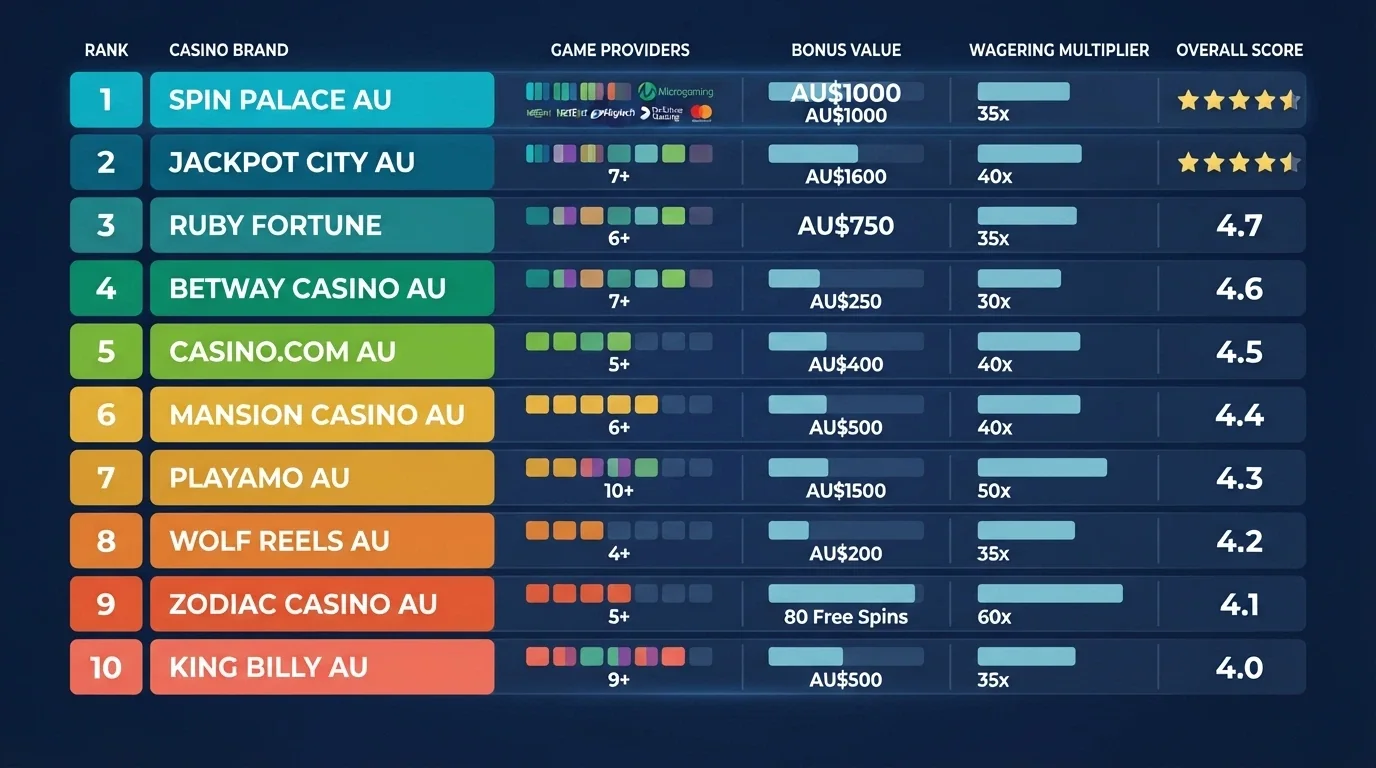
The ten operators below are ranked by the criteria laid out in the section on evaluation: market share, bonus value, game-provider breadth and licence transparency, in that order. Every row in the table should be read with the same caveat: all ten are offshore brands prohibited from serving Australian customers under the IGA. The licence column shows the regulatory home each operator has chosen for itself; it does not show an Australian licence, because none exists.
| Casino | Licence | Game Providers | Welcome Bonus | Free Spins | Wagering |
|---|---|---|---|---|---|
| Stake | Curaçao | Pragmatic Play, Evolution, Hacksaw, Push Gaming, Nolimit City, Relax Gaming | 200% up to $3,000 | 50 FS on Dead or a Wild | 40x |
| Skycrown | Curaçao | Pragmatic Play, BGaming, Evolution, NetEnt, Play’n GO, Yggdrasil | Up to A$4,000 + 400 FS across 5 deposits | 400 FS across deposits | 40x |
| Rocket Play | Curaçao | Pragmatic Play, Evolution, BGaming, Betsoft, Quickspin | 100% up to A$1,000 + 100 FS | 100 FS | 40x |
| FairGO | Curaçao | RealTime Gaming (RTG) | 100% up to A$1,000 per deposit (5 deposits = A$5,000 total) | 25 FS on first deposit | 30x |
| Royal Reels | Curaçao | Pragmatic Play, Evolution, BGaming, Betsoft | Up to A$5,000 + 200 FS across multiple deposits | 200 FS across deposits | 35x–40x |
| Bizzo Casino | Curaçao | Pragmatic Play, Evolution, NetEnt, Playtech, Yggdrasil | Up to A$1,000 + 150 FS across 2 deposits | 150 FS across deposits | 40x |
| Rainbet | Curaçao | Pragmatic Play, Evolution, Hacksaw, Nolimit City | 100% up to $2,000 | — | 30x–40x |
| BC.Game | Curaçao | Pragmatic Play, Evolution, Hacksaw, BGaming, Red Tiger | Up to 360% across 4 deposits (in crypto) | — | 40x |
| Betplay | Curaçao | Pragmatic Play, Evolution, Hacksaw, Red Tiger | 100% up to $5,000 | — | — |
| ShakeBet | — | — | 300% up to A$7,000 + 350 FS | 350 FS | — |
A bonus-cap number is the smallest part of the offer. The wagering multiplier is the part that determines what the bonus costs. Take Stake’s headline — 200% up to A$3,000 at 40x. That requires A$120,000 of qualifying turnover before the bonus funds can be withdrawn, which is forty times the bonus amount on top of the deposit itself. At the smallest minimum-stake slots documented on a SOL-native platform, 0.1 SOL per spin, the spin count runs into the thousands; at a five-second-per-spin pace, clearing the bonus takes dozens of hours of continuous play. The bonus funds are not the prize — clearing the turnover is the work. The fair comparison across this table is therefore not “which has the biggest dollar cap” but “which has the smallest multiplier combined with the longest validity window” — and by that measure, the gap between FairGO’s 30x and Bizzo’s 40x-over-seven-days is wider than any dollar amount in the table.
Stake
Stake is the highest-volume crypto casino in the offshore set and the brand most Australian crypto-curious players will have heard of. The welcome package is a 200% match up to A$3,000 plus 50 free spins on Dead or a Wild, with a 40x wagering requirement on the bonus and 30 days to clear it. The game catalogue is the deepest in the comparison — Pragmatic Play and Evolution sit at the top, with Hacksaw, Push Gaming, Nolimit City and Relax Gaming rounding out a roster that covers slots, live dealer, crash games and the high-volatility Bonus Buy titles that have driven crypto casino traffic for the last two years.
Stake operates under a Curaçao licence and accepts SOL alongside a long list of other cryptocurrencies. The terms attached to the welcome bonus are not unusual for the offshore category, but they are stricter than the marketing makes them sound. The 40x multiplier applies to the bonus amount, the 30-day window starts the moment the bonus is credited, and the free-spin winnings are subject to their own conversion cap. None of that is hidden, but none of it is on the landing page either.
Stake is the obvious first stop for high-volume slot players who already bet at crypto casinos and value the largest game catalogue in the offshore market. The A$120,000 turnover requirement is the number that ends the conversation for a player chasing the bonus funds in cash — clearing it inside 30 days is heavy work.
Skycrown
Skycrown’s headline is the biggest total package in the table: up to A$4,000 in bonus funds plus 400 free spins, spread across the first five deposits. The per-deposit bonus structure — a smaller match on each of deposits one through five — is the standard “extended welcome” pattern in the offshore category and is designed to keep a player depositing rather than walking away after the first match. The wagering requirement is 40x on the bonus, the validity window is 14 days from credit, and the game catalogue runs through Pragmatic Play, BGaming, Evolution, NetEnt, Play’n GO and Yggdrasil.
Spread across five deposits, the package amortises. The 14-day window per credit makes it punishing for a player who treats the welcome as a single weekend. The provider mix is the second-deepest in the table behind Stake. The combination is generous on paper and tight on the clock.
Rocket Play
Rocket Play is a cleaner offer than most of the table: a single 100% match up to A$1,000 plus 100 free spins, 40x wagering, 14 days to clear. The provider mix — Pragmatic Play, Evolution, BGaming, Betsoft and Quickspin — covers the mainstream slot catalogue and a credible live dealer suite. There is no multi-deposit gimmick, no tiered package, no sliding wagering scale. What you see on the landing page is what the bonus terms say.
The 14-day window applies to the full A$1,000 + 100 FS as a single credit, not spread over multiple deposits. A player who deposits, plays through the bonus once and stops is the use case the offer was built for. A player who wants to deposit across several sessions will find the validity clock running on the same 14 days regardless.
The 100% match with 100 free spins is a clean mid-table offer — no multi-deposit gimmick, no tiered package. The 40x wagering is the market standard; the 14-day window is on the short end; the provider mix covers the mainstream slots and live dealer. A reasonable middle-of-the-table pick for a player who values clarity over a larger cap.
FairGO
FairGO is the most Australian-facing brand in the table — the name reads local, the deposit page accepts AUD directly, and the entire game catalogue runs on RealTime Gaming (RTG), one of the older online casino software studios. The welcome package is the most generous by total dollar value: 100% up to A$1,000 per deposit across the first five deposits, totalling A$5,000, plus 25 free spins on the first deposit. The wagering requirement is 30x — the lowest in the table.
The RTG-only catalogue is the trade-off. Pragmatic Play, Evolution and Hacksaw are not in the mix; the slots are an older generation, with the characteristic RTG visual style and a smaller live dealer presence. A player who values the breadth of the modern crypto slot catalogue will not find it here. A player who values the lowest wagering multiple in the comparison and an AUD-denominated cashier will.
At 30x wagering — the lowest multiplier in the comparison — and a total cap of A$5,000 across five deposits, FairGO is the cheapest bonus to clear in the offshore set. The RTG-only catalogue is the trade, and the trade is the point.
Royal Reels
Royal Reels carries the highest dollar cap of any single bonus in the table: up to A$5,000 plus 200 free spins, spread across multiple deposits, with a wagering requirement quoted at 35x to 40x. The range is the unusual detail — most operators commit to a single multiplier, and the bracket here suggests the multiplier varies by deposit tier or game contribution. The provider mix — Pragmatic Play, Evolution, BGaming and Betsoft — covers the mainstream slot catalogue.
The wagering range is the point to read carefully. A 35x multiplier is materially cheaper to clear than 40x; a 40x multiplier is the market standard. Without knowing which tier applies to which deposit, a player cannot compute the turnover cost upfront. The terms page is the only place to find out, and the standard advice on this comparison is to read that page before claiming.
Royal Reels offers the highest dollar cap in the table, and a wagering range that makes the actual cost something a player should work out on the operator’s terms page before claiming.
Bizzo Casino
Bizzo’s offer is the tightest window in the table: up to A$1,000 plus 150 free spins across the first two deposits, 40x wagering, seven days from credit. The provider mix — Pragmatic Play, Evolution, NetEnt, Playtech and Yggdrasil — is the most varied of any operator carrying a Playtech licence in the comparison.
Seven days is the constraint. A$1,000 at 40x is A$40,000 in qualifying turnover, twice if both deposit bonuses are claimed, and the clock starts running the moment the first deposit bonus is credited. Most players will not clear that in a week; the offer is built for the player who plans to play through the bonus quickly and is comfortable with the risk of forfeiture.
The provider mix — Pragmatic Play, Evolution, NetEnt, Playtech and Yggdrasil — is the most varied of any operator carrying a Playtech licence in the comparison. Seven days is the constraint, and seven days is the reason this offer sits where it does on the ranking rather than higher up.
Rainbet
Rainbet’s welcome is a clean 100% match up to A$2,000 with a 30x to 40x wagering requirement and no published free-spin component. The provider mix is narrower than most of the table — Pragmatic Play, Evolution, Hacksaw and Nolimit City — but the four studios cover the bulk of the high-volatility slots and crash games that drive crypto casino traffic.
The sliding wagering multiplier is the same kind of uncertainty that Royal Reels carries, though the 30x lower bound is friendlier. A 30x turnover on a A$2,000 bonus is A$60,000 in qualifying turnover, materially cheaper to clear than the 40x standard; a 40x tier is the market standard. Without per-game contribution rules published on the landing page, the lower bound is the figure to budget around.
The Hacksaw and Nolimit City focus makes Rainbet the pick for a player who values those studios specifically. The provider roster is narrower than the rest of the table; the wagering floor at 30x is the friendliest in the comparison outside FairGO.
BC.Game
BC.Game is the most crypto-native operator in the table — the brand was built around crypto deposits and the welcome package is paid in cryptocurrency rather than AUD. The headline is a tiered 360% across the first four deposits, with a 40x wagering requirement. The provider mix — Pragmatic Play, Evolution, Hacksaw, BGaming and Red Tiger — is the broadest in the comparison and includes BGaming, which is a notable addition for the crash and dice game categories.
The 360% figure is the largest headline multiplier in the table and the easiest to misread. A 360% match on the first deposit means the casino adds 3.6 times the deposit as bonus funds; across four deposits, the cumulative package is large, but each deposit’s wagering still runs at 40x on its own bonus amount. The bonus is paid in the crypto the player deposits in, which means the dollar value of the package moves with the market.
The 360% headline is the largest in the table — the easy figure to misread. The bonus is paid in the crypto the player deposits in, so the AUD value moves with the market. For a player who already holds crypto and is comfortable with that exposure, the package is the biggest cumulative offer in the comparison.
Betplay
Betplay carries a 100% match up to A$5,000 — the highest dollar cap of any 100% match in the table — under a Curaçao licence with Pragmatic Play, Evolution, Hacksaw and Red Tiger in the catalogue. Wagering terms, validity window and free-spin component were not surfaced from the operator’s own imprint page this round and have not been independently verified.
The bonus cap is the figure to anchor on; the wagering terms are the figure that determines whether the offer is worth taking, and that figure is not on this page. A player considering Betplay should read the operator’s bonus terms directly before depositing — not because the offer is suspect, but because the comparison table cannot speak to what it has not verified.
Betplay carries the highest single-deposit 100% cap in the comparison, but the wagering terms have not surfaced in this research pass — a player drawn to the offer should check them at the source before deciding.
ShakeBet
ShakeBet’s headline is the largest single number in the table: 300% up to A$7,000 plus 350 free spins. The licence, the provider mix and the wagering terms were not surfaced this round; the only verified figure is the welcome package itself, drawn from Slotozilla’s Australian Solana casino ranking.
A 300% match is unusual even by offshore standards. The dollar cap of A$7,000 is the largest in the table. Neither number tells a player what the wagering requirement is, how long the bonus is valid for, or which providers the site actually carries. The comparison table here reports only what is verifiable; the rest has to be checked at the source.
300% up to A$7,000 plus 350 free spins is the largest single headline in the table. The licence, providers and wagering terms were not surfaced this round. The brand is on the ranking because Australian traffic lands there; the rest is the player’s responsibility to verify.
Why Solana Leaves Other Crypto Casinos in the Dust
Solana’s design choices — high throughput, sub-second finality, near-zero per-transaction fees — were not made with casinos in mind. They were made for decentralised finance and NFT trading. But for a casino player, those design choices produce exactly the property the offshore gambling industry has spent a decade trying to fake: deposits that confirm in seconds, withdrawals that settle in seconds, and fees that do not eat a meaningful fraction of a small bet. The independent test of 15 platforms in mid-January 2026 produced an average SOL withdrawal time of 43 seconds across 89 separate withdrawals. No Bitcoin casino, no Ethereum main-chain casino, no fiat-rail casino of any kind publishes a number close to that.
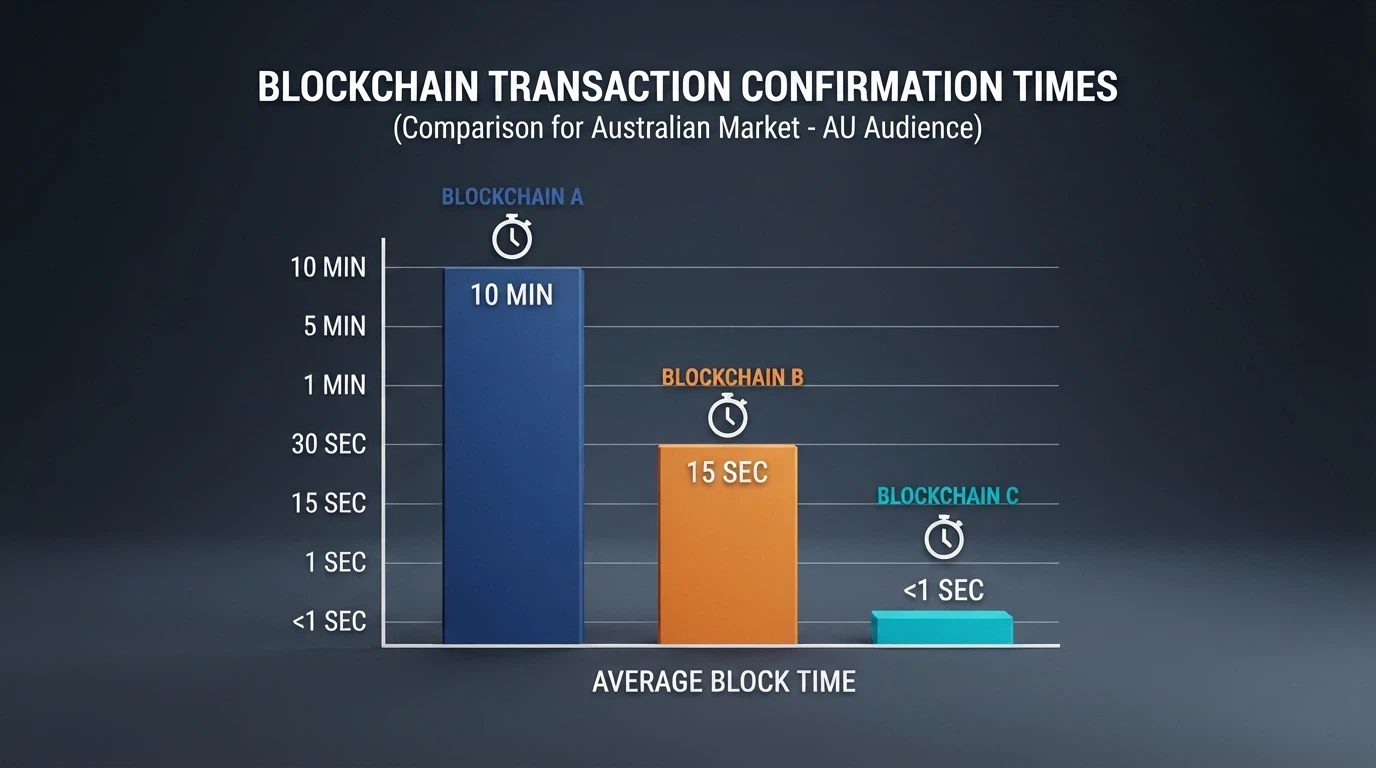
That speed is not magic. It is the consequence of running a blockchain that prioritises transaction throughput over decentralisation — fewer validators, faster block times, hardware requirements that exclude hobbyists but let the network settle tens of thousands of transactions per second. The trade-off is well known in the crypto world: Solana is faster and cheaper than Ethereum’s main chain, but the validator set is smaller and the network has experienced outages that Bitcoin and Ethereum have not. For a casino player, the trade-off looks like a casino cashier screen that works like a stock exchange one — until it doesn’t, in which case deposits and withdrawals stall for the duration of the outage.
SOL as your betting currency: what changes
When a casino never touches fiat, every step from deposit to cashout runs on-chain. SOL leaves the player’s wallet, arrives at the casino’s wallet, and the casino credits the player’s internal account. There is no bank transfer to clear, no PayID to reconcile, no BPAY reference number, no card processor holding the funds for an anti-fraud review. The deposit confirmation at SOL-native platforms runs under 30 seconds on average; the withdrawal runs in roughly 43 seconds. Both numbers are fractions of the time a licensed Australian wagering operator takes to clear a debit-card withdrawal, which the licensed operators measure in hours at best and business days at worst.
The licensed Australian alternative is the opposite of this. Licensed wagering operators in Australia accept deposits via debit card, bank transfer, PayID/Osko and BPAY. Crypto is explicitly banned as a deposit method for licensed wagering under section 15C of the IGA, in force since 11 June 2024. An Australian player who wants to bet with crypto is, by definition, betting with an operator outside the licensed system. The cashier speed is what they are buying; the regulatory safety net is what they are giving up.
There are also practical consequences on the casino side. SPL tokens — Solana’s token standard — let a casino support USDC, USDT and a long list of other tokens on the same rail. A casino that accepts ten SPL tokens pays roughly the same in network fees as a casino that accepts one. From the player’s perspective, switching between USDC and SOL is a wallet change, not a new payment processor. That flexibility is part of why the crypto casino cashier has converged on Solana over the last two years.
The crypto-native casino experience
A non-custodial casino is one where the player retains custody of the funds until the moment of betting — the bet is settled on-chain, the result is verified on-chain, and the winnings return to the player’s wallet without ever sitting in the casino’s account for longer than the bet itself. SLM.Games operates on this model, publishes its mechanics openly, and runs on-chain withdrawals with no manual review queue. BLITZ99 does the same — every result verified on-chain, no sign-up required, instant payouts to the player’s wallet. These are the casinos that most credibly use the “on-chain” label.
A custodial casino is one where the deposit is held by the casino in its own wallet, the games run on the casino’s servers, and the “blockchain” piece is only the deposit and the withdrawal. Most of the operators in the comparison table — Stake, Skycrown, Rocket Play, the rest — are custodial sites with crypto cashiers. The brand is the casino; the chain is the rail; the games are the same proprietary-RNG slots that any online casino runs.
The difference matters when something goes wrong. A non-custodial platform can verify the result of a bet independently, because the random seed was committed before the bet and can be re-derived afterwards. A custodial platform can void a winning bet for any reason its terms of service allow, and the player has no on-chain evidence to contradict it. The “provably fair” label, which the next section covers in detail, is meaningful only at the non-custodial end.
Solana vs Ethereum and Bitcoin for casino play
Three properties decide which blockchain wins at the casino deposit screen: speed, cost and reliability. On speed, Solana’s block times of roughly 400 milliseconds put a SOL transaction on-chain before Bitcoin has mined a single block — Bitcoin’s average block time of ten minutes means a Bitcoin deposit confirmation can take an hour in adversarial conditions. On cost, Solana’s per-transaction fees of a fraction of a US cent make small bets viable; Ethereum’s main-chain fees, while lower than they were in 2021, still run several dollars during congested periods and make micro-betting uneconomic. On reliability, Bitcoin has the longest unbroken uptime record of any major chain; Solana has had two brief outages in 2025 with an average duration of around four hours. Neither outage was catastrophic, but a casino player whose withdrawal stalls for four hours notices.
For a player funding a session with $100 worth of SOL, the practical effect is that a Solana deposit lands in the casino balance within seconds, costs nothing in fees, and can be withdrawn back to the wallet in under a minute when the session ends. A Bitcoin deposit of the same nominal value lands after one confirmation in roughly ten minutes, costs a few dollars in fees that vary with network conditions, and can take much longer if the casino’s policy is to wait for multiple confirmations. The numbers make Solana the better rail for casino play by every measure except the longest-running uptime record.
The Legal Reality for Australian Players
Online casino games are prohibited in Australia. There is no licence for them, no state or territory that issues one, no path to legalising the product under current federal law. The Interactive Gambling Act 2001, strengthened by the Interactive Gambling Amendment Act 2017, makes it an offence to provide an online casino, online pokies or in-play sports betting to a person in Australia. The Interactive Gambling Amendment (Credit and Other Measures) Act 2023 extended the prohibition to payment: since 11 June 2024, crypto and credit cards are banned for licensed wagering, and an operator that fails to enforce the ban faces penalties of up to A$247,500. This is not grey area; it is the federal framework.
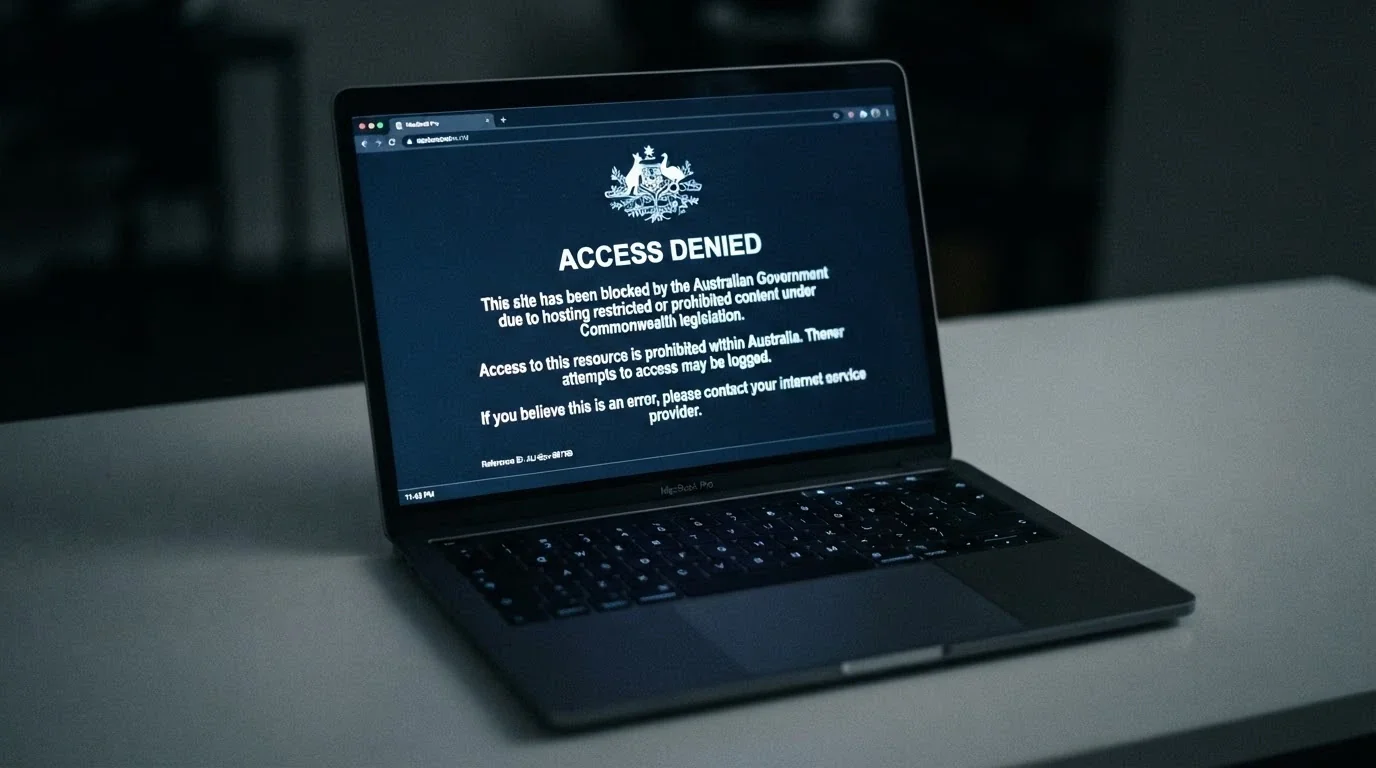
The regulator is the Australian Communications and Media Authority (ACMA), which investigates complaints, issues formal warnings, brings civil penalty proceedings and directs Australian ISPs to block illegal gambling websites. The legal status by activity, the regulator and a licensed AU operator example line up like this:
| Activity | Legal Status Under IGA | Regulator | Licensed AU Operator Example |
|---|---|---|---|
| Online casino games (slots, table games, live dealer) | Prohibited | ACMA | None — no licence exists |
| Online pokies | Prohibited | ACMA | None — no licence exists |
| In-play sports betting | Prohibited | ACMA | None — no licence exists |
| Pre-event sports and racing wagering | Licensed | State/Territory regulators (NTRWC for online) | Sportsbet, bet365 AU, Ladbrokes |
| Lotteries and keno | Licensed | State/Territory regulators | The Lott, Tatts |
| Crypto payment for any licensed wagering | Prohibited since 11 June 2024 | ACMA | None — banned at the payment-method level |
The clearest column to read in that table is the last one. Licensed AU wagering operators exist for sport, racing, lotteries and keno. None exists for online casino games, online pokies or in-play sports betting. The licence column for those rows is empty because there is no licence to fill it with.
The Interactive Gambling Act and what it actually bans
The IGA draws the line at the product, not the operator. Online casino games, online pokies and in-play sports betting are prohibited services: a person in Australia cannot be supplied with any of them, and the supplier commits an offence by doing so. Pre-event wagering on racing and sport is licensed through state and territory regulators, with the Northern Territory Racing and Wagering Commission acting as the de facto national licensor for the biggest online operators. Lotteries and keno are licensed through state regulators. The product line is what the law reads; the operator line is what it doesn’t.
The crypto payment prohibition sits on top of the product prohibition. Since 11 June 2024, credit cards and digital currency have been banned as payment for any licensed wagering service. The penalty for an operator that fails to enforce the ban is up to A$247,500 per offence. The reason that penalty is rarely levied is that the operators most likely to take crypto — offshore casinos — are already outside the Australian regime. The penalty is for the licensed operator who slips up; the offshore operator doesn’t need to slip.
The 2026 reform changes the advertising and inducement framework without changing the underlying prohibition. The Interactive Gambling Amendment (Gambling Reform) Bill 2026, passed on 19 August 2026 and commencing 1 January 2027, caps wagering advertising at three ads per hour between 6:00 am and 8:30 pm, imposes a live-sport blackout from 15 minutes before until 5 minutes after a live event, and gives banks and payment providers express authority to block transactions to illegal gambling operators. The reform tightens what licensed operators can say, and tightens what banks can do — but it does not legalise online casino, because that is not what the bill is about.
No KYC: what you gain, what you lose
“No KYC” is marketed as freedom. For an Australian player it means the absence of every safeguard the regulated system built around online gambling:
- No identity verification. A licensed Australian wagering operator must verify a customer’s identity before accepting a deposit. An offshore Solana casino that asks for no ID has no way to enforce age verification, no way to connect a self-excluded player to BetStop, and no Australian complaints body that can mediate a dispute. The lack of friction is the feature; the lack of friction is also the absence of protection.
- No Australian complaints body. The Australian Financial Complaints Authority and state gambling regulators handle disputes with licensed operators. Neither has jurisdiction over an offshore Curaçao-licensed casino. A dispute is handled by whatever the operator’s own terms allow, and the player’s only remedy is whatever court can hear the case where the operator is registered.
- No recourse on refused withdrawals. If a Curaçao-licensed casino refuses a withdrawal for any reason its terms allow, the player cannot escalate the dispute to an Australian body. The casino’s decision is the final word.
- The site can be blocked with the balance still on it. The ACMA has had 1,564 illegal gambling websites blocked by Australian ISPs since November 2019. A blocked site is still running offshore; a player who has SOL deposited at the casino can still log in from a non-Australian IP. But the moment an Australian player cannot reach the site, any balance sitting in the account becomes harder to retrieve.
- No BetStop coverage. The National Self-Exclusion Register binds Australian-licensed wagering operators only. A self-excluded Australian who opens an account at an offshore Solana casino will not be detected by the register, will not be flagged by the casino, and will not be refused service. The most concrete harm of the offshore route is the gap it creates in the safety net the rest of the Australian system has built.
The player is not prosecuted under the IGA — the Act targets the provider, not the person using the service. That is the legal position. The practical position is that using an offshore casino means stepping outside every system that exists to protect Australian players from the harm online gambling can cause.
The Games You’ll Actually Find at a Solana Casino
The catalogue at the offshore end of the comparison is enormous by the standards of any single physical casino or any single Australian licensed operator. Moonbet, one of the crypto-native platforms that publishes its slot library, displays over 4,000 slot games with RTP and volatility shown before each game opens, filterable by provider, RTP range, volatility and game type — Megaways, Bonus Buy, Jackpot and Classic slots all sit in the same lobby. By comparison, a typical land-based Australian casino floor carries a few hundred machines, and a Crown or The Star online product is a smaller subset still. The crypto casino catalogue is the product advantage of operating outside the licensed system, and it is the reason Australian players land on these sites in the first place.

The native Solana casinos — the platforms built specifically for the SOL audience — add another layer underneath the slot library: provably fair games, dice mechanics and table-style RNG games that exist only because the casino can settle on-chain. The most credible of these publish their house edge per game, commit to the random seed before each bet, and let the player verify the result after the roll.
The slot catalogue on Solana casinos
Four thousand slots is the upper end of what the bigger Solana-accepting platforms list. The slot machine on the floor of a Crown Melbourne is one of a few hundred distinct titles; the slot catalogue at Moonbet is closer to four thousand, with new releases added weekly. The catalogue depth is the single biggest advantage offshore Solana casinos have over their land-based Australian counterparts.
The filtering tools are the second advantage. Moonbet shows RTP and volatility before the player opens a game, which is the kind of disclosure Australian licensed operators do not always provide. Pragmatic Play, Hacksaw, Nolimit City, Push Gaming and BGaming are the studios driving the high-volatility Bonus Buy and Megaways segment that has defined crypto casino traffic for the last two years. Evolution carries the live dealer catalogue. NetEnt, Playtech and Yggdrasil round out the mainstream. A player who wants to know what they are betting on — RTP, volatility, mechanics — gets more information at a crypto casino than at most licensed Australian operators.
The trade-off is that the RTP and volatility figures are usually the studio’s published figures, not the casino’s audited figures. A platform like Moonbet that displays them prominently is closer to the regulated end of the spectrum; a platform that doesn’t is at the mercy of whatever its game providers publish. Provably fair RNG games are the only category where the player can verify the outcome after the fact — covered in detail below.
Dice, crash and table-style RNG games
Beyond the reels, the native Solana game types are the products traditional casinos cannot replicate. Dice with customisable odds, coin flip at a fixed multiplier, plinko at 99% RTP, crash games where the line goes up until it doesn’t — these are the games built specifically for the SOL audience.
A few open-source projects publish their mechanics. cyberloomTech’s casino_platform_solana, an open-source casino engine on GitHub, features Coin Flip at a 1.95x multiplier, Dice Roll with customisable odds, Slots paying up to 25x the bet, and a uniform 5% house edge across all games with a 0.1 SOL minimum bet. 8BET.io offers Plinko XY, a Solana slot at 99% RTP — the highest transparent RTP among the games verified on this page. The jett-game project runs 11 games with a ProvablyFairRNG built on xoroshiro128+, ready for integration with Solana’s Verifiable Random Function, and is documented at 96% RTP across a 100,000-round Monte Carlo simulation.
These are the games the rest of the catalogue cannot be: the math is published, the house edge is published, the random seed is committed before the bet. A player who understands the underlying mechanism can verify every result after the fact. That is what the next section is about.
Provably fair: the mechanic that changes everything
Provably fair is the property of a game where the player can verify, after the fact, that the outcome was not manipulated by the casino. The mechanism is well-defined: the casino commits to a hashed version of a server seed before the bet, the player supplies a client seed, and a sequential nonce increments with every bet. After the bet settles, the casino reveals the unhashed server seed; the player hashes it themselves and confirms it matches the pre-bet commitment. If the hashes match, the seed was not changed mid-bet, and the result was not rigged.
SLM.Games uses the SHA-256 hashing standard for this commitment, with the three-part server seed, client seed and nonce sequence documented on its platform page. BLITZ99 runs a Solana-native implementation where every result is verified on-chain, no sign-up is required to play, and payouts return to the player’s wallet instantly. The jett-game project documents the xoroshiro128+ random number generator and its integration with Solana’s VRF (Verifiable Random Function), the on-chain randomness primitive that lets a smart contract consume a publicly verifiable random value.
The mechanism is not universal. Most of the slots in a 4,000-game lobby are produced by third-party studios using their own RNG, audited or not. The provably fair label applies to the games the casino itself builds or sources from a provably fair vendor — Dice, Crash, Coin Flip, Plinko and the smaller catalogue of native crypto games. For those games, the player can check the math; for the rest, the player has to trust the studio.
SLM.Games publishes a transparent house edge on every original game, ranging from 1% on Dice to 4% on Wheel segments. That number is the closest thing to a fair disclosure in the crypto casino category: a flat percentage of every bet that the casino expects to keep, on average, over time. Compare that with the typical slot RTP of 94%–96% — which is a house edge of 4%–6% — and the dice and crash games at the provably fair end sit at the friendlier end of the published house-edge spectrum.
How Fast Your Money Moves with SOL
Forty-three seconds. That is the figure from the independent test of 15 offshore platforms across 89 SOL withdrawals in mid-January 2026, and it is the number that resets what a player expects from a cashout. The same test covered 127 deposits, with average deposit confirmation times under 30 seconds at SOL-native platforms. No licensed Australian wagering operator clears a withdrawal in 43 seconds. The licensed operators measure withdrawal times in hours at best and business days at worst, because their cashier is a bank transfer rather than a blockchain transaction.
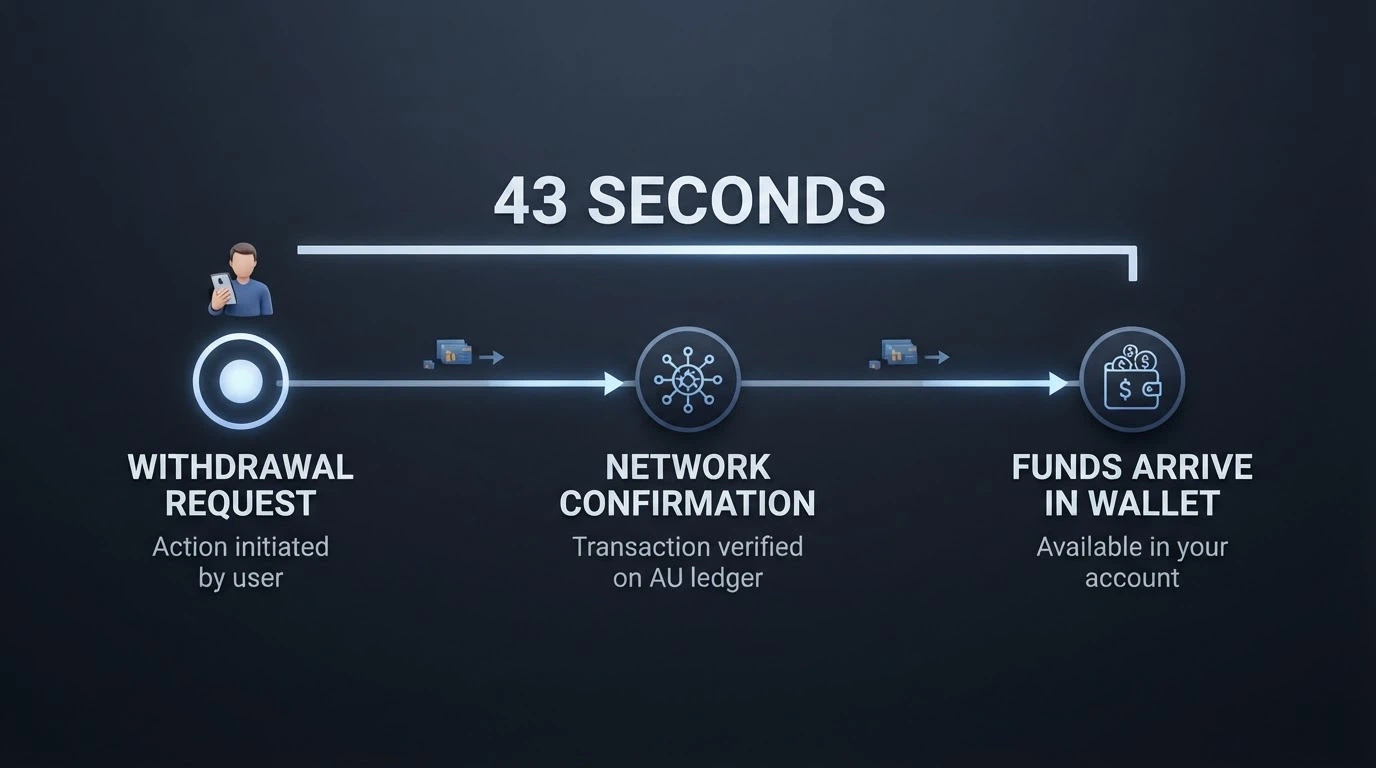
That speed is the structural advantage of the SOL payment rail, and it is the property that drives most of the marketing the offshore Solana casinos publish. It is also the property that makes the offshore casino category hard for Australian regulators to police — once the SOL has moved from the casino’s wallet to the player’s, it is no longer in any account an Australian bank can freeze or an Australian court can seize.
SOL deposits and withdrawals: how they work
The deposit flow on a SOL-native platform: the player opens the casino cashier, the casino generates a deposit address, the player sends SOL from their Phantom wallet to that address, the transaction confirms on the Solana network in roughly 400 milliseconds, and the casino credits the player’s account once it detects the incoming transaction. SLM.Games reports average deposit confirmation times under 30 seconds — a figure that includes the wallet authorisation, the network confirmation and the casino’s internal crediting.
The withdrawal flow is the mirror image: the player requests a withdrawal, the casino signs and broadcasts a SOL transaction from its hot wallet to the player’s wallet address, the transaction confirms on the network, and the SOL lands in the player’s wallet. At a non-custodial platform like SLM.Games, there is no manual review queue and no waiting period — the withdrawal is signed and broadcast within seconds of the request. At a custodial platform like the larger multi-provider brands, there may be a manual review for the first withdrawal or for any withdrawal above a threshold, and the SOL sits in the casino’s internal ledger until the review completes.
The Solana network’s reliability is the only real downside. The two brief outages in 2025, averaging around four hours each, are the kind of event where a player’s deposit or withdrawal stalls mid-flight. The funds are not lost — Solana transactions either confirm or they don’t, and an unconfirmed transaction eventually confirms when the network resumes — but a player whose withdrawal stalls for four hours notices. The speed advantage is real; the speed advantage is not absolute.
The real speed of crypto payouts: what 127 deposits and 89 withdrawals tell us
Casipto’s January 2026 test is the only independent timing data set for Solana casino withdrawals that this page has surfaced. The methodology was straightforward: 15 offshore platforms, 127 deposits processed, 89 withdrawals processed, every timing recorded. The headline figure is an average SOL withdrawal time of 43 seconds across the full sample.
That figure is the median experience, not the guaranteed experience. Individual platforms will run faster — a non-custodial site with an automated hot wallet can complete a withdrawal in under 10 seconds — and individual platforms will run slower — a custodial site with a manual review queue can stretch a withdrawal to hours. The 43-second average is what a player should budget around, not what they should expect from any single operator on any single withdrawal.
What the figure does not compare against is Bitcoin or Ethereum. No equivalent independent test of 127 Bitcoin deposits and 89 Bitcoin withdrawals across 15 platforms was surfaced in this research pass, so the cross-chain comparison has to be drawn from the on-chain properties of each network rather than from a like-for-like casino test. Solana’s 400-millisecond block times, sub-cent fees and 43-second average casino withdrawal give it a structural speed advantage that Bitcoin’s 10-minute blocks and Ethereum’s main-chain gas cannot match. The casino-level comparison would refine that advantage; the network-level comparison already makes the case.
New Solana Casinos on the Radar in 2026
The Solana casino landscape is not static. Betplay is one of the newer entries commanding Australian traffic, with a 100% match up to A$5,000 under a Curaçao licence and a Pragmatic Play, Evolution, Hacksaw and Red Tiger catalogue — though its wagering terms were not surfaced this round. ShakeBet is another newer entrant, with the largest headline figure in the comparison (300% up to A$7,000 plus 350 free spins) but no confirmed licence, provider mix or wagering terms. Both sit on this ranking because Australian traffic lands there, and because the comparison table cannot speak to what it has not verified — but both are operators a player should check at the source before depositing.
The pattern across newer entrants is competition on bonus size. Established offshore brands settled at 100% matches with 100 free spins and 40x wagering; the newer entrants push the headline numbers higher. A 360% package across four deposits, or a 300% match with 350 free spins, is the kind of headline a newer brand uses to break through an established competitor’s search ranking. The wagering requirements on those larger headlines usually match the market standard of 40x; the bonus validity windows are often shorter; the conversion caps on free-spin winnings are usually tighter. The dollar figure is the marketing; the conditions are the cost.
NFT Rewards and the New Shape of Casino Bonuses
Some Solana casinos have begun using NFTs — non-fungible tokens on the Solana blockchain — as part of their promotional structures. A deposit bonus paid in a tradable NFT is a different product from a locked bonus balance: the NFT sits in the player’s wallet, can be sold on a secondary marketplace, and has a market value determined by what other buyers will pay for it. The wagering obligation that would normally apply to a bonus balance can be structured as a hold period before the NFT becomes transferable, or as a multiplier on the NFT’s value rather than the deposit amount.
The wagering obligation on an NFT drop is the piece to read carefully. A casino that gives away a free NFT with no strings attached is giving the player an asset; a casino that gives away an NFT subject to a 40x turnover on the NFT’s floor price has built a bonus with a slightly different label and the same cost. The mechanism is newer than the standard deposit match; the marketing is fresher; the underlying obligation is usually the same.
The value proposition is different in one specific way: a tradable NFT can be sold before the wagering obligation is cleared, which means the player can recover the floor-price value of the bonus immediately rather than waiting for the turnover to complete. Whether the casino’s terms allow that resale is the detail that determines whether the NFT is genuinely different from a locked bonus or a relabelled version of one.
Solana Casinos in Your Pocket
Every Solana casino runs in a browser, which means a phone is all a player needs. Phantom’s mobile wallet integrates with the same Solana dApps that the desktop browser extension does, and the deposit-and-bet flow on mobile is the same flow as on desktop. The difference is the form factor: smaller screen, touch controls, and a wallet confirmation step that requires a fingerprint or face scan rather than a browser extension click.
App-store casino apps are essentially absent from this category. Apple and Google have policies against real-money gambling apps in most jurisdictions, and the offshore Solana casinos do not appear in the Australian App Store or Google Play storefront. The browser-based delivery is also why the category has no install friction for an Australian player — no download, no store approval, no age gate enforced by the platform holder.
The trade-off is the same trade-off the desktop experience carries: no native app means no push notifications, no biometric login, no platform-level age verification. The wallet holds the player’s funds; the browser holds the casino’s interface. A player who loses their phone loses the browser session but not the wallet — and the funds in the wallet are not in the casino’s balance.
Staying Safe When the Safety Net Isn’t There
An Australian player at an offshore Solana casino stands outside BetStop, outside the Australian complaints system, and outside every consumer protection the regulated market built. The page does not soften that. It also does not leave the player without recourse — because the responsible-gambling infrastructure that exists at the federal level applies regardless of where the player bets.

What self-exclusion and deposit limits look like at a crypto casino
BetStop does not cover offshore casinos. The National Self-Exclusion Register, live since August 2023, had 67,480 registrations by 31 July 2026 with 41,290 exclusions still active — and every one of those exclusions binds Australian-licensed wagering services only. The 78% of registrants under 40, and the 38% who chose lifetime exclusion, are excluded from licensed bookmakers and licensed wagering sites — not from offshore Solana casinos. An offshore casino is not connected to the register, will keep accepting a self-excluded person’s money, and has no obligation to check.
Platform-level responsible-gambling tools are the next layer down. Some offshore casinos offer deposit limits, cooling-off periods and self-exclusion options inside the player’s account — but the tools are optional, the operator chooses whether to enforce them, and there is no Australian body that audits the operator’s compliance. The 2027 inducement marketing ban — which prohibits direct marketing for 14 days after sign-up, three months after a BetStop deregistration and indefinitely for at-risk customers — binds Australian-licensed operators only. An offshore casino is not subject to it.
The most concrete harm of the offshore route is the gap it creates in the safety net the rest of the Australian system has built. A self-excluded Australian who decides to play again has no system to detect that decision at an offshore casino. The decision is the player’s alone.
The help that is there: Australian resources that work no matter where you play
The National Gambling Helpline is 1800 858 858. It is free, confidential and staffed 24 hours a day, 7 days a week. Gambling Help Online, at gamblinghelponline.org.au, provides online chat and counselling for the same service. Neither line is jurisdiction-limited; neither asks where the player has been betting; both are funded to support any Australian affected by gambling harm regardless of whether the gambling took place at a licensed venue, a licensed wagering site or an offshore casino.
The data on problem gambling in Australia is the reason the helpline exists. About 2.1% of Australian adults — roughly 430,000 people — experience problem gambling, with the Australian Institute of Health and Welfare putting high-risk gambling at 1.8% in 2022. Those numbers include players at licensed venues and licensed wagering sites; the offshore casino contribution is harder to measure but unlikely to be zero. A player who feels the gambling has stopped being fun can call the helpline at any hour; the call is confidential and the service is free.
How We Evaluated Every Solana Casino on This List
This page is a comparison, and the comparison has a basis. The sources consulted include the ACMA’s interactive-gambling enforcement record (for the legality and enforcement sections), the Federal Register of Legislation (for the IGA and the 2024 crypto payment ban), independent transaction-speed testing from Casipto (for the 43-second SOL withdrawal figure), comparison-page synthesis from Slotozilla, AussieOnlineCasino and CryptoCodex (for the per-operator bonus and provider figures), and operator imprint pages where accessible.
The criteria that ordered the ranking are, in order: market share among Australian-facing traffic, bonus value adjusted for wagering multiplier, game-provider breadth, and licence transparency. Where a licence was not individually verified from the operator’s own imprint page this run, the licence field is reported as the Curaçao licence the comparison pages attribute to the brand — not as an independently verified regulatory registration. The wagering terms marked with an em dash were not surfaced from the operator’s own imprint page this round.
This is not a black-box ranking. The criteria are listed, the sources are named, and the gaps in the data are flagged where they appear. A reader who wants to verify a specific operator can check it against the comparison pages and against the ACMA’s register; a reader who wants to challenge a ranking position can work backwards from the criteria and the data.
What Australian Players Should Actually Do About Solana Casinos
The trade-off this page has been laying out is the trade-off every Australian player faces when they consider an offshore Solana casino. The licensed Australian wagering market offers safety — BetStop, an Australian complaints body, segregated player funds, no site blocking risk, banks that are about to gain authority to refuse deposits to illegal operators. The licensed market also offers no online casino games, no online pokies, no in-play sports betting — because the Interactive Gambling Act prohibits all three. The offshore Solana casino market offers every game the licensed market does not — slots, live dealer, dice, crash, provably fair table games, 4,000-title slot libraries, deposits that confirm in seconds, withdrawals that settle in 43 seconds. It also offers no Australian consumer protection, no Australian complaints body, no BetStop coverage, and a 1,564-site history of ACMA-initiated ISP blocking — any one of which could happen to the site the player is using.
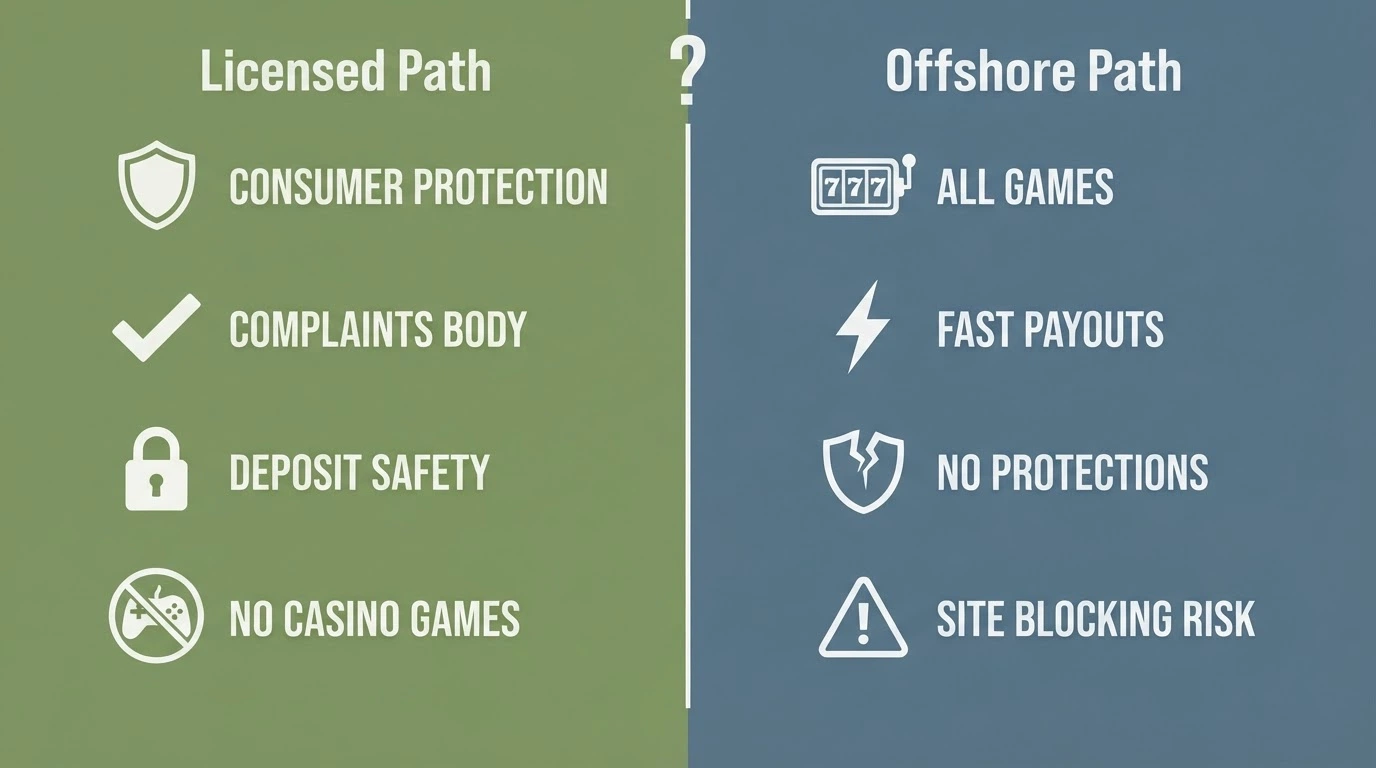
The bonus arithmetic is the cleanest way to see the trade. Take Stake’s welcome — 200% up to A$3,000 at 40x wagering, 30 days to clear. The bonus funds are A$3,000, the wagering multiple is 40, the turnover required is A$120,000, and at a 5-second-per-spin pace on a 0.1 SOL minimum bet slot, clearing the bonus takes dozens of hours of continuous play. The “free” money is not free; the play time is the cost; the house edge is what the player pays whether or not they clear the bonus.
The final judgement is not a recommendation to play. The legal position is that online casino is prohibited in Australia and that no offshore operator can change that. The practical position is that an Australian player who chooses to play at one of these operators does so without the safety net the rest of the Australian gambling system has built — and that 1,564 sites have already lost their Australian reach for the same reason. The helpline at 1800 858 858 applies regardless. The decision is the player’s; the consequences are theirs as well.
Frequently Asked Questions
Are Solana casinos legal for Australian players?
No. Online casino games are prohibited in Australia under the Interactive Gambling Act 2001, strengthened by the 2017 amendments, and no licence for online casino exists anywhere in the country. Crypto payments for licensed wagering have been banned since 11 June 2024 under section 15C of the IGA. Every Solana casino accepting Australian players is an offshore operator offering a prohibited service; the player is not prosecuted, but has no Australian consumer protection, no complaints body and no BetStop coverage.
Can I use BetStop to self-exclude from Solana casinos in Australia?
No. BetStop, the National Self-Exclusion Register, binds Australian-licensed wagering services only. By 31 July 2026 the register had 67,480 registrations with 41,290 still active — but those exclusions do not extend to offshore casinos. An offshore Solana casino is not connected to the register, will not detect a self-excluded Australian, and is not obligated to refuse service. The most concrete harm of the offshore route is the gap it creates in BetStop.
What does “provably fair” mean at a Solana casino?
Provably fair is the property of a game where the player can verify after the fact that the result was not rigged. The mechanism: the casino commits a hashed server seed before the bet, the player supplies a client seed, a sequential nonce increments per bet, and after settlement the player hashes the revealed server seed and confirms it matches the pre-bet commitment. SLM.Games uses SHA-256; BLITZ99 verifies every result on-chain; the jett-game project uses xoroshiro128+ ready for Solana VRF. The label applies to the casino’s own games, not to slots from third-party studios.
How fast are Solana casino deposits and withdrawals compared to Bitcoin?
Independent testing of 15 offshore platforms in mid-January 2026 produced an average SOL withdrawal time of 43 seconds across 89 withdrawals, with deposits confirming in under 30 seconds on average. No equivalent independent test of Bitcoin casino withdrawals was surfaced this run. On network properties alone, Solana’s 400-millisecond block times and sub-cent fees give it a structural speed advantage over Bitcoin’s 10-minute blocks and Ethereum main-chain gas fees; the casino-level difference is in the same direction.
What is the house edge on provably fair Solana casino games?
SLM.Games publishes a transparent house edge on every original game page, ranging from 1% on Dice to 4% on Wheel segments. The cyberloomTech open-source casino engine applies a uniform 5% house edge across Coin Flip, Dice Roll and Slots. Most slot games at the offshore end run at 94%–96% RTP, which is a 4%–6% house edge — slightly higher than the provably fair dice and crash end. The house always has an edge; the question is how much, and whether the casino publishes it.
How does the ACMA enforce the online casino ban against crypto gambling sites?
The ACMA investigates complaints, issues formal warnings, brings civil penalty proceedings and directs Australian ISPs to block illegal gambling websites. In Q2 2024 alone, the ACMA completed 14 investigations, found 17 IGA breaches, issued 15 formal warnings and referred 50 websites for ISP blocking. Since November 2019, 1,564 illegal gambling and affiliate websites have been blocked. From 1 January 2027, banks and payment providers gain express authority to block transactions to illegal gambling operators.