
Easy Withdrawal Casinos in Australia: The Real Numbers Behind Fast Payouts
Data current as of 22 November 2026 and verified against the ACMA register and Curaçao eGaming licensing records.

The phrase “easy withdrawal casino” gets thrown around the way “fast” gets thrown around at fast-food counters — it means whatever the operator wants it to mean. For a player who has just hit a win and wants the money in their bank account, the gap between tapping “withdraw” and seeing the balance settle is the only number that matters. Everything else — the bonus, the welcome package, the loyalty scheme — sits in front of that moment like a queue.
This page is about that moment. It covers the offshore casinos that serve Australian players in 2026, what their published withdrawal terms actually look like, what real tests have shown when an Australian player tries to cash out, and the regulatory reality that shapes every choice on the list. None of the operators covered here holds an Australian licence for online casino games — that product is prohibited under the Interactive Gambling Act 2001. What this guide does is give a player the information to compare them honestly, in the language they will meet at the cashier, and to decide which trade-offs are worth accepting.
Table of Contents
- What an “Easy Withdrawal” Casino Actually Means for Australian Players
- Why Your Withdrawal Speed Depends on How You Pay
- The Fastest-Paying Casinos for Australian Players in 2026
- Which Casino Games Pay Out Fastest in Australia
- Why Australia’s Gambling Laws Change Everything About Fast Payouts
- Staying in Control: Responsible Gambling and Fast-Payout Casinos
- How We Evaluated Fast-Payout Casinos for This Guide
- What Fast Withdrawals Actually Mean for Your Play
- Frequently Asked Questions
What an “Easy Withdrawal” Casino Actually Means for Australian Players
For an Australian player, “easy withdrawal” is a bundle of three things: a published cashout time that does not require reading between the lines, a payment method the player can actually fund in AUD without jumping through hoops, and an operator who processes what the rail promises. Get one of those wrong and the others stop mattering.
The first thing to clear up is who is offering this. No Australian-licensed operator offers online casino games. Sportsbet, bet365, Ladbrokes and the licensed Australian wagering market cover sport and racing only — no pokies, no blackjack, no live casino. Anyone searching for an “easy withdrawal casino” in Australia is, by definition, looking at offshore brands. That is not a secret. The ACMA has had 1,564 illegal gambling sites blocked at the DNS level since November 2019, and more than 225 services have withdrawn from the Australian market since 2017. The category exists; it just sits outside Australian law.
That does not make the operators illegitimate. Curaçao-licensed brands dominate the AU-facing market, with a smaller cluster licensed in Anjouan and a few elsewhere. The framework is different: the player is not prosecuted under Australian law (the Interactive Gambling Act 2001 targets the provider, not the customer), but the player also gets none of the Australian consumer protections. No ACMA dispute resolution, no BetStop coverage, no Australian complaints body. The faster a payout is, the less likely any of that matters. The slower it is, the more it does.
What Separates a Fast-Payout Casino from the Rest
The fastest verified cashout across the AU-facing market was 10 minutes — a Solana withdrawal tested at Rolling Slots with automated ID verification, where the average KYC turnaround came in at 2.4 hours. That figure is real. It was achieved on a real AUD deposit, with automated verification, on a single specific brand. Pull the same test on a slower operator and the number stretches to days, not minutes.
The structural differences are three. Internal processing time — how long the operator takes to approve a withdrawal request — sits at one end. SkyCrown advertises a 10-minute average and, for verified accounts on crypto, the realistic figure is under one hour. Royal Reels has been tested at 4 hours 12 minutes on PayID after KYC. The two ends of that spectrum are a hundredfold apart.
Payment rail speed sits at the other end. Crypto over a fast network (Solana, Litecoin, sometimes Tron) confirms in minutes. PayID runs on the New Payments Platform and clears within the same business day for participating banks. MiFinity and other e-wallets settle in 24–48 hours. Bank transfers, where the operator supports them at all, run 3–7 business days through intermediary banks.
KYC is the bottleneck most players do not see coming. An account that has not been verified before its first withdrawal request sits in a queue while the operator reviews documents. SkyCrown’s average is reportedly within 4 hours for an automated review, which is unusually fast. The fastest cashout in the world is no use if the operator holds the funds for 48 hours waiting on a driver’s licence scan.
Operator policy sits underneath all of this. Some operators apply a 3x deposit turnover requirement before they will process a withdrawal free of charge — that is, you must have wagered three times your deposit before the funds become withdrawable. SkyCrown and Royal Reels both publish this rule. It is the kind of policy that turns a “fast withdrawal” promise into a multi-day grinding session for any player who tries to deposit and immediately cash out.
The Checklist Every Player Should Run Before Depositing
Five things to check, in this order, before any player sends a dollar to an AU-facing offshore casino.
Withdrawal method availability. The deposit page and the withdrawal page are not always the same list. Royal Reels accepts PayID and crypto for deposits but processes withdrawals through bank transfer only — a 3–7 business day rail, not the 10–30 minute crypto that funded the account. Check the cashier’s withdrawal tab, not the deposit one, before signing up.
Minimum and maximum cashout limits. SkyCrown publishes A$30 minimums for MiFinity and crypto, A$100 for bank transfer, with daily caps of A$5,000 (some sources say A$7,500), weekly A$10,000–A$15,000, and a monthly ceiling of A$45,000. Royal Reels publishes a A$50–A$75 minimum and a A$9,000-per-day maximum. A player with a five-figure balance should think about whether the monthly ceiling forces them to split withdrawals across calendar months.
KYC turnaround time. Look for any operator-published estimate. Where one is not published — and most do not publish one — player reviews on Trustpilot or independent sites are the next-best signal. SkyCrown sits at 3.6 out of 5 on Trustpilot; Royal Reels carries 173 reviews that skew heavily negative, mostly around cashout friction.
Turnover requirement on deposits. The 3x figure at SkyCrown and Royal Reels is the norm for Curaçao-licensed brands. It means a A$1,000 deposit needs A$3,000 of wagering before the operator will process a “free” withdrawal. Some operators will process withdrawals before that threshold but charge a fee.
Real player review signals. Trustpilot, the casino review aggregators, and Reddit threads all surface the same picture at different speeds: cashout delays, account closures during withdrawal, and bonus term disputes. A brand with a 3.6 score is not a brand with no complaints. A brand with 173 reviews, mostly negative, is a brand a careful player investigates before depositing.
Why Your Withdrawal Speed Depends on How You Pay
Of everything a player controls at an offshore casino, the payment method is the lever that moves the timeline the most. The operator can publish whatever it likes; the rail itself sets the floor. Crypto networks confirm in minutes. PayID clears on NPP during business hours. Bank transfers crawl through intermediary correspondent banks. The same A$1,000 win can arrive in ten minutes or seven business days depending on which button the player pressed at the cashier.
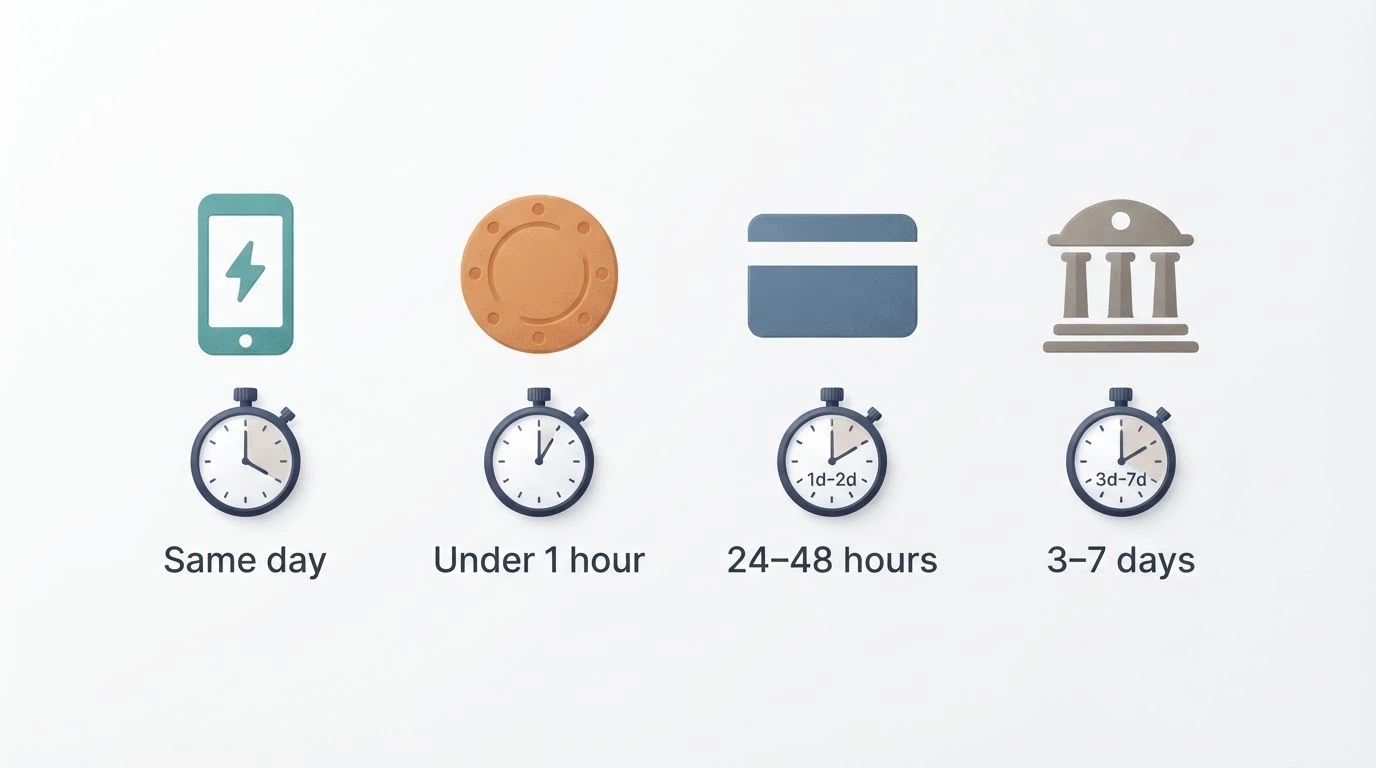
This is also the section of the page where the offshore status shows through. Australian-licensed wagering operators are banned from accepting credit cards or crypto since 11 June 2024; penalties for non-enforcement reach A$247,500. If a casino is offering either payment method to an Australian player, the operator is outside Australian rules by definition. The payment method is itself a tell.
Instant vs Same-Day vs Multi-Day: What the Speed Labels Actually Mean
“Instant withdrawal” in casino marketing almost always means the internal processing is fast, not that the money lands instantly. Crypto on a fast network with no network congestion gets close — Solana and Litecoin confirmations run under a minute, and the operator’s automated approval can put funds in the player’s wallet within the hour. The chain has to be settled before the cash is spendable, the player still needs a wallet, and converting to AUD costs a spread on the exchange.
“Same-day” usually describes a processing service-level agreement — the operator commits to releasing the funds on the day the request is made. Royal Reels has been tested at 4 hours 12 minutes on PayID on a weekday, which is faster than the published target. PayID on SkyCrown is described as same-day, with realistic figures inside a business day.
“Multi-day” describes the bank transfer default. Royal Reels processes withdrawals through bank transfer only, with a published 3–7 business day window. SkyCrown supports bank transfers at A$100 minimum, with the same kind of window. Intermediary correspondent banks in some corridors add their own delays; there is nothing the player can do about that.
No Australian-facing casino offers true instant AUD cashouts — that is, no operator accepts a deposit method, credits a win, and pushes AUD to a player’s Australian bank account in seconds. The closest any brand gets is crypto to a wallet the player holds, which then needs a separate AUD conversion step.
PayID, Crypto and E-Wallets: The Fastest Ways to Get Your Money
| Payment Method | Typical Withdrawal Speed | Minimum Withdrawal (A$) | Operator Availability | KYC Required |
|---|---|---|---|---|
| Crypto (BTC, ETH, USDT, etc.) | <1 hour (verified) | A$30 | SkyCrown; Royal Reels (deposits only); Stake | Yes |
| PayID | Same day; ~4h on tested Royal Reels | A$20 | SkyCrown; Royal Reels (deposits only) | Yes |
| MiFinity (e-wallet) | 24–48 hours | A$30 | SkyCrown | Yes |
| Bank Transfer | 3–7 business days | A$100 (SkyCrown); A$50–A$75 (Royal Reels) | SkyCrown; Royal Reels (withdrawal only) | Yes |
| Card (Visa, Mastercard) | 3–5 business days | — | SkyCrown | Yes |
PayID is the closest thing the Australian player has to a domestic fast rail. The New Payments Platform settles in near-real-time during banking hours, and participating banks credit the funds within the same day. The operator side has to do its part — Royal Reels was tested at 4 hours 12 minutes on a weekday, SkyCrown advertises same-day. Both are fast. Neither is “instant”.
Crypto is faster on the rail but slower on the conversion. A Bitcoin or USDT withdrawal confirms in 10–30 minutes for the brands that publish a number (Royal Reels averages that range; SkyCrown aims for under an hour). The win does not land as AUD in a bank account — it lands as a coin in a wallet the player controls, then has to be sold for AUD on an exchange, with a spread, a network fee, and possibly a tax reporting step. That friction is invisible at the casino but real at the wallet.
E-wallets — MiFinity is the common one at AU-facing brands — sit between crypto and bank transfer. They settle in 24–48 hours at SkyCrown with a A$30 minimum. The advantage is that the funds land in AUD, not in coin. The disadvantage is the rail is not faster than PayID in any meaningful sense, and the wallet has its own onboarding.
Bank Transfers and Card Withdrawals: Why They Take Days
Two structural reasons and one operator-side reason. Banks process transfers in batched windows — same-day for same-bank transfers, next-day for NPP instant, and 2–3 business days for transfers that cross intermediary banks. An AUD transfer leaving a Curaçao-licensed operator typically routes through a correspondent bank chain before it reaches an Australian account, and each link in that chain has its own cut-off time.
Card network settlement cycles sit on a different timeline. Visa and Mastercard authorisations happen in seconds; the actual movement of funds, called clearing and settlement, takes 1–3 business days for domestic rails and 3–5 for cross-border. SkyCrown publishes a 3–5 business day window for card withdrawals, which matches the network floor.
The operator-side reason is that some operators default to bank transfer despite the slower timeline. Royal Reels runs withdrawals through bank transfer only — there is no card withdrawal option, no PayID withdrawal option, and crypto withdrawals are limited to deposits at some domains. The player who funded an account with USDT may still wait seven business days for a bank transfer to clear. SkyCrown supports more methods on the withdrawal side, but a player who only deposited by card and is now trying to withdraw to the same card may still see the 3–5 day window.
Real-Money Play vs Restricted Payouts: What Blocks Your Cashout
Three things can freeze a withdrawal that have nothing to do with the rail.
The deposit turnover rule. Both SkyCrown and Royal Reels apply a 3x turnover requirement on the deposit amount before withdrawal is free — a A$1,000 deposit becomes A$3,000 of wagering. Some operators will process the withdrawal before the threshold is met, but charge a fee for the privilege. The rule is not hidden, but it is rarely mentioned in the welcome bonus pitch.
The bonus lock. If a player has accepted a welcome bonus with wagering requirements, the bonus funds (and sometimes the deposit funds as well, depending on the terms) sit locked until the requirements are met. Until that point, the cashier’s withdrawal button may not even appear. The bonus-to-cash pipeline is where most “I can’t withdraw” complaints originate.
The account verification hold. KYC is most often triggered by the first withdrawal request. A player who has been depositing and playing for a week without verifying their account will hit a verification wall the first time they try to cash out — and the wall’s height is unpredictable without checking the operator’s published turnaround time. Where one is not published, it usually means the operator prefers to keep that number vague.
Withdrawal limits are the fourth factor, more often than players expect. Royal Reels caps at A$9,000 per day. A player with a A$50,000 balance cannot withdraw in a single request — they are looking at six business days at minimum, and possibly longer if the operator’s internal processing drags. SkyCrown’s monthly ceiling of A$45,000 is a similar constraint on the larger-balance player.
How Bonus Terms Slow Down Your Withdrawal
A welcome bonus is sold as free money. It is structured as a withdrawal gate. SkyCrown’s welcome package for AU players is up to A$8,000 plus 400 free spins, with a 40x wagering requirement on the bonus funds. The wagering applies to the bonus, not the deposit — but the bonus is what extends the playable balance, and the wagering is what has to be cleared before anything is withdrawable.
Worked through, the bonus of A$8,000 at 40x wagering means A$320,000 of turnover before the bonus-related lock releases. At a typical A$1 per spin and 5 seconds per spin — the kind of pace a real player sets on a standard pokie — that is 320,000 spins, or about 445 hours of continuous play. Spread across evening sessions, that runs into weeks for any player who is not grinding a single title eight hours a day. The math matters because it is the answer to “how long until I can withdraw” that no cashier screen displays.
A player who accepts the full A$8,000 bonus has committed to a multi-week playthrough before the bonus side clears. A player who skips the bonus and plays only with their A$1,000 deposit clears the 3x turnover rule at A$3,000 of wagering — half an hour at standard stakes — and can withdraw freely.
Game weighting is the second-order effect. Pokies typically contribute 100% of each spin’s stake to the wagering requirement. Live casino games contribute less — 10% is common, sometimes zero. A player who clears the bonus on blackjack will be there much longer than the headline figure suggests. The bonus terms page is the place to check, and most players do not.
The Fastest-Paying Casinos for Australian Players in 2026
The featured set is ten operators that serve Australian players from offshore licences. The ranking runs from the most data-rich brands — SkyCrown and Royal Reels, both with verified withdrawal tests in the public record — down to brands that appear in the AU-facing market but for which no comparable data could be confirmed. Every brand listed is offshore; none holds an Australian licence for online casino. That is the structural fact the rest of the page works around.
| Operator | Regulatory Status |
|---|---|
| SkyCrown | Offshore — Curaçao (OGL/2023/176/0095), not licensed in Australia |
| Royal Reels | Offshore — Curaçao (1668/JAZ), not licensed in Australia |
| Rocket Play | Offshore, not licensed in Australia |
| Stake | Offshore — Curaçao, not licensed in Australia |
| FairGO | Offshore, not licensed in Australia |
| Bizzo Casino | Offshore — Curaçao, not licensed in Australia |
| WinSpirit | Offshore, not licensed in Australia |
| Scream Casino | Offshore, not licensed in Australia |
| Rainbet | Offshore, not licensed in Australia |
| Rocket Casino | Offshore, not licensed in Australia |
The market-share picture tells its own story. Rocket Play holds 9.4% of the AU-facing market with US$632.69M in revenue; SkyCrown holds 8.55% with US$436.07M; Royal Reels holds 2.51% with US$243.99M. These three brands sit at the top of the offshore AU market by traffic, and they are the three with the most public data attached. The other seven on the list have either thinner published terms, no recent withdrawal tests in the public record, or both.
How We Ranked These Operators: Speed, Data and Real Tests
The primary sort is verified withdrawal speed. A brand with a real AUD-deposit test showing a PayID withdrawal in 4 hours ranks ahead of a brand with a published “1–3 business days” window and no test. The secondary sort is operator transparency — published withdrawal limits, published KYC turnaround, a public licence ID. The tertiary sort is player review signal at scale — a Trustpilot score built on 100+ reviews carries more weight than one built on 12.

Where verified data is absent, the brand is not dropped — it is ranked lower, and the data gap is named in the operator’s write-up. A player who wants to deposit at one of those brands should verify the cashout terms directly with the operator before sending money.
The AU-specific lens is two-fold. Does the operator support AUD natively, or does the player have to convert at deposit and again at withdrawal? And does the operator offer PayID, which is the rail that gives the closest thing to a domestic fast withdrawal? SkyCrown checks both. Royal Reels checks the AUD box but routes withdrawals through bank transfer only. Brands further down the ranking check neither consistently.
Where These Casinos Sit in the Australian Legal Picture
Every casino on this list is offshore. Every one of them is offering a service that is prohibited under the Interactive Gambling Act 2001 to be provided to a person in Australia. The IGA makes it an offence to provide online casino games, online pokies, and in-play sports betting to Australian customers. The ACMA enforces this by directing ISPs to block illegal sites and by issuing warnings and civil penalty proceedings against providers.
The individual player is not prosecuted. The Act targets the provider, not the customer. That has been the consistent position of the ACMA since the IGA was passed in 2001. It does not mean the player’s money is protected by Australian law — it is not, and no ACMA dispute resolution process will recover funds from an offshore operator. The legal position is “not illegal for you, not safe for you either.”
This page covers these operators because Australian players are using them, the search demand is real, and the comparison is what the reader is looking for. It does not cover them because they are a recommended choice. The honest framing is: these are the operators serving the AU market from offshore, here is what they publish, here is what real tests have shown, and here is what offshore status costs the player in terms of consumer protection.
SkyCrown: Crypto Withdrawals Under an Hour, Thousands of Pokies
SkyCrown operates under a Curaçao eGaming licence, number OGL/2023/176/0095, issued to Hollycorn N.V. The brand has been accepting Australian players since 2022. It is not licensed in Australia; no online casino is. The Curaçao licence is the framework SkyCrown operates under.
The withdrawal data is the most complete in the set. SkyCrown advertises a 10-minute average processing time. Realistic figures, drawn from published reviews and player reports, are under one hour for verified crypto accounts, same-day for PayID, 24–48 hours for MiFinity e-wallet, and 3–5 business days for card withdrawals. The crypto figure is the headline number; the PayID figure is the one most relevant for an Australian player who does not want to hold a wallet.
The limits are published and consistent across sources. Minimum withdrawals are A$30 for MiFinity and crypto, A$100 for bank transfer. Daily limits sit at A$5,000 (some sources say A$7,500), weekly at A$10,000–A$15,000, and monthly at A$45,000. A player withdrawing A$45,000 a month has reached the ceiling — anything above that waits for the next calendar month.
The 3x deposit turnover rule applies. A deposit of A$500 needs A$1,500 of wagering before free withdrawal. Welcome bonus terms carry a 40x wagering requirement on bonus funds, with up to A$8,000 plus 400 free spins across the multi-stage package. The bonus extends the playable balance considerably; the wagering extends the time-to-withdrawal by much more.
Payment coverage is the broadest in the AU-facing set: Visa, Mastercard (A$30 minimum), Neosurf (A$20 minimum), CashtoCode (A$25 minimum), MiFinity (A$30 minimum), PayID (A$20 minimum), and crypto across nine coins — BTC, ETH, LTC, USDT, DOGE, XRP, BCH, TRX, BNB. Pokies run into the thousands from providers including Pragmatic Play, Relax Gaming, Yggdrasil and Betsoft.
KYC turnaround has been recorded at within 4 hours per a third-party review. That is fast. Trustpilot sits at 3.6 out of 5, with verified-withdrawal reviews supporting the speed claim and slow-withdrawal reviews clustering around larger sums or incomplete KYC.
The verdict. SkyCrown is the data-rich choice for a player who wants to verify speed, method, and limits before depositing. The crypto rail is the fastest path; PayID is the closest AUD-native alternative. The bonus is large, and the wagering is what makes it slow.
Royal Reels: Fast PayID Cashouts, but Withdrawal Complaints Mount
Royal Reels runs on a Curaçao eGaming licence, 1668/JAZ, and actively targets Australian players with AUD support and a pokies-heavy lobby. Like every other brand in this set, it is not licensed in Australia. The targeting is what makes the AUD support deep — minimum deposits of A$10–A$30 depending on method, a pokies library drawn from the same providers as SkyCrown.
The withdrawal numbers look competitive on paper. A PayID withdrawal after KYC was tested at 4 hours 12 minutes on a weekday. Crypto withdrawals (BTC, ETH, USDT, USDC) average 10–30 minutes. Those figures are the fastest published in the Royal Reels record and would put the brand near the top of the speed ranking.
The friction sits on the method-availability side. Royal Reels supports deposits via PayID and crypto, but the withdrawal tab is bank transfer only for most players — a 3–7 business day rail. A player who funded their account with USDT may still wait the full bank window to receive AUD. The withdrawal minimum is A$50–A$75 depending on method, the daily maximum A$9,000, and there is no published win cap.
The 3x deposit turnover rule applies, the same as SkyCrown. Credit card deposits incur a fee of up to 3% and are limited to A$30–A$1,000; crypto deposits carry no published limit. Welcome bonus terms vary by domain and period — the brand runs rotating offers — and a current published figure did not surface in this round of research.
Trustpilot is where the picture sharpens. Royal Reels carries 173 reviews, predominantly negative, with most complaints clustering around withdrawal delays and account closures during cashout. A 3.6 score with a handful of complaints is one thing; 173 reviews skewed negative is a pattern.
The verdict. Royal Reels is fast when the rail cooperates — PayID and crypto on the deposit side, bank transfer on the withdrawal side. The published limits are player-friendly. The player-review signal is the part that gives a careful reader pause, and a player considering this brand should weigh the speed promise against the complaint volume before depositing.
Rocket Play: Australia’s Highest-Traffic Offshore Casino
Rocket Play leads the AU-facing offshore market by traffic — 9.4% market share, US$632.69M in revenue. The numbers come from the BLASK market-share dataset and represent the largest share held by any offshore brand serving Australian players. That is the public picture.
The withdrawal picture is thin. No verified AUD-deposit test surfaced this round. No published withdrawal limits, KYC turnaround, or rail-specific speed data appeared in the research record. The brand is real, the traffic is real, and the rest of the data is the part a player has to find for themselves.
Rocket Play is offshore and not licensed in Australia. No specific Curaçao or Anjouan licence number surfaced in the research. The brand is on the list because of the AU market position, not because the withdrawal terms have been independently verified. A player choosing Rocket Play on the strength of the market-share data should check the cashier’s withdrawal tab before depositing, and should treat the speed claim as unconfirmed until the operator’s terms say otherwise.
The verdict. Rocket Play is the brand with the AU traffic lead and the thinnest withdrawal data in the top three. The market position is genuine; the cashout experience is the question a player needs answered before sending money.
Stake: Crypto-Native Platform With No Traditional Welcome Bonus
Stake runs from Curaçao and is built around crypto deposits and withdrawals — Bitcoin, Ethereum, Litecoin, USDT and the rest. The brand is not licensed in Australia; it operates outside the AU regulatory perimeter by design. Australian players have always accessed Stake via crypto rails, and the credit-card ban introduced on 11 June 2024 simply confirmed that Stake sits in the offshore camp.
The withdrawal figure for Stake is the general crypto-native one — minutes to hours for a verified account on a fast network. The brand does not publish a specific number in the public record this round, but the architecture is built for speed. Crypto in, crypto out, with no bank intermediary.
The model is what sets Stake apart from the rest of the list. There is no traditional welcome bonus with a wagering requirement. Stake runs a rakeback and VIP structure — a percentage of the house edge returned to active players, with tier-based perks. There is no bonus lock to clear before withdrawal, no 40x playthrough on an A$8,000 package. The wagering friction that slows a SkyCrown or Royal Reels cashout is not present.
The trade-off is that Stake does not serve a player who wants to deposit in AUD via PayID or card. Crypto only, with a wallet the player controls and an exchange step on either end. A player who is comfortable with that workflow gets a faster and cleaner experience. A player who is not should look elsewhere on the list.
The verdict. Stake is the choice for the crypto-native player. No bonus friction, fast crypto withdrawals, and a VIP model that rewards volume. The friction is the AUD conversion — what comes in as USDT still has to be sold for AUD somewhere outside the casino.
FairGO: RTG Pokies Specialist With Unconfirmed Payout Speed
FairGO runs offshore, not licensed in Australia, with a pokies-heavy lobby built around RealTime Gaming (RTG). The brand has a long-standing reputation in the AU-facing market and a recognisable identity. That is the public picture.
The withdrawal picture, like Rocket Play’s, is thin. No verified withdrawal speed surfaced this round. No published limits, KYC turnaround, or bonus terms appeared. RTG as the primary provider narrows the game library but does not narrow the withdrawal question — RTG titles run on the same Curaçao rails as anything else.
A player considering FairGO on the strength of the brand recognition should treat the withdrawal terms as the unknown they are. The cashier’s withdrawal tab is the first place to look. The published terms page is the second. Player reviews on independent aggregators are the third. None of those appeared in the research record this run, so this write-up ends at the data gap rather than at a verdict the data does not support.
The verdict. FairGO is on the list because of its established presence in the AU-facing market, not because the withdrawal terms are confirmed. Verify before depositing.
Bizzo Casino: Curaçao-Licensed With Limited Public Withdrawal Data
Bizzo holds a Curaçao licence, operates offshore, and is not licensed in Australia. Beyond that, the public data this round is sparse — no verified withdrawal speed, no published limits, no confirmed KYC turnaround. The brand is on the list as one of the AU-facing Curaçao-licensed operators with a recognised presence.
The honest framing here is the same as FairGO’s. The licence is real and the offshore status is confirmed. The withdrawal experience is the part a player has to check themselves. A player who has read the SkyCrown and Royal Reels write-ups and wants to compare against a third Curaçao brand has the licence confirmation; the cashout terms remain the operator’s own business until the player asks.
The verdict. Bizzo is on the list for completeness, with the data gap stated. Verify the withdrawal terms directly before depositing.
WinSpirit: Offshore Operator With Unconfirmed Payout Terms
WinSpirit operates offshore, is not licensed in Australia, and is one of the names that appears in the AU-facing market. No specific Curaçao or other licence number surfaced in the research this round, and no withdrawal data — speed, limits, KYC, or bonus terms — was confirmed.
The data gap is the write-up. A player considering WinSpirit should verify the licence register entry, the published withdrawal times, and the bonus terms before sending any money. The brand’s presence on the AU-facing list is enough to put it on the page; the absence of verified cashout data is enough to keep it lower in the ranking.
The verdict. Listed for completeness; we recommend checking the casino’s T&Cs directly before signing up.
Scream Casino: Limited Public Information on Withdrawals
Scream Casino is another AU-facing offshore name without a confirmed withdrawal data record this round. Offshore status, no AU licence, no verified speed or limits.
The recommendation here is the same one that runs through the lower half of the ranking: a player who wants to compare this brand against SkyCrown or Royal Reels needs to do the verification work themselves. The cashier tab and the terms page are the starting points. Player reviews on independent aggregators are the next step.
The verdict. Listed for completeness. Always review the cashier’s terms before you deposit.
Rainbet: Newer Entrant Without Verified Payout Data
Rainbet is a newer name on the AU-facing offshore market and the data record this round is correspondingly thin. Offshore status, no AU licence, no verified speed, limits, or bonus terms.
The risk of an unverified operator is the risk a player takes on every brand below the top two in this ranking. The cashier experience can be fast or slow, the published limits can be player-friendly or punitive, and the only way to find out before depositing is to read the terms page in full. A newer brand with a thinner public record has fewer independent data points to cross-check against.
The verdict. Listed for completeness. We suggest verifying the terms directly.
Rocket Casino: Offshore Brand With Unconfirmed Cashout Speed
Rocket Casino is an offshore brand, not licensed in Australia, and shares the same data gap as the other names in the lower half of the ranking. No specific licence number, withdrawal speed, or bonus terms were confirmed in this round of research. A player choosing Rocket Casino should treat it as an unverified operator and check the cashier terms directly before depositing.
The verdict. Listed for completeness. Verify before depositing, and confirm the brand is the one the player intended to find.
Which Casino Games Pay Out Fastest in Australia
Game type matters for two reasons: it changes the wagering contribution rate, and it changes the operator scrutiny on a winning session. Pokies contribute 100% of each spin’s stake to the wagering requirement, so a player clearing a bonus on pokies reaches the threshold faster than the same player on blackjack. Live casino tables usually contribute less — 10% is common, sometimes zero. A bonus cleared at 10% takes ten times as long in nominal play.

Pokies also face less post-win scrutiny than table games at most offshore brands. A A$5,000 pokie win is a routine event; a A$5,000 blackjack win prompts a session review at some operators, which can include a request for additional documentation or a bonus term re-check. The speed of withdrawal is, in part, a function of the game the player chose.
The structural prohibition still applies. Every casino game discussed here is being provided to an Australian player by an offshore operator in breach of the Interactive Gambling Act 2001. The game categories themselves are legal to play; the supply is not.
Australian Real-Money Pokies and Fast Cashouts
Pokies are the dominant product at AU-facing offshore casinos. SkyCrown’s library runs into the thousands from Pragmatic Play, Relax Gaming, Yggdrasil and Betsoft. Royal Reels carries a similar provider lineup. FairGO is built around RealTime Gaming, which is the US-facing RTG catalogue with an AU-facing skin. The shape of the library is what an Australian player expects from a local pub pokie, scaled up.
The cashout interaction is straightforward. Pokies wins credit to the real-money balance instantly. The wagering requirement — the 3x deposit turnover rule, plus any bonus wagering — runs separately against the deposit and bonus totals. Once both are cleared, the pokie balance is withdrawable through whichever rail the operator supports.
The detail that catches players out is the bonus-to-cash pipeline. SkyCrown’s 400 free spins are part of the welcome package, with each spin’s value subject to the bonus wagering. A player who wins on free spins is winning bonus funds, not cash, and the wagering applies before any of it is withdrawable. The spins are real; the winnings are not, until the requirement is cleared.
Online Slots: What Fast-Payout Means for Slot Players
The terms “pokies” and “slots” describe the same product at AU-facing offshore casinos. The withdrawal-speed implications are identical. What shifts the speed is the underlying provider and the operator’s configuration, not the slot-versus-pokie label.
The slot library at the data-rich brands runs into the thousands. The high-RTP titles — those running at 96% or above — clear wagering requirements faster in nominal terms, because each spin loses less of the stake. A high-volatility slot with a 96.5% RTP and a 10x stake win on a lucky spin is the rare-but-large outcome; a low-volatility slot with the same RTP produces more frequent but smaller wins. Neither changes the wagering arithmetic, but the bankroll pattern around it changes.
No per-title RTP or volatility data was confirmed for the specific pokies at SkyCrown or Royal Reels in this research round. The general rule holds: pick higher RTP where the bonus terms allow it, and check the game’s contribution percentage to wagering. Most pokies contribute 100%. Most live casino games contribute less.
Live Casino Tables: Withdrawal Speed and Game Differences
Live casino at offshore brands runs on Evolution, Pragmatic Play Live, and similar providers — the same studios that power the European and Latin American markets. The player experience is a real dealer on a real table, broadcast to the player’s screen, with bets placed against the house.
The withdrawal interaction is where live casino differs from pokies. Two factors matter. Live casino games almost always contribute less than 100% to wagering requirements — 10% is typical, 0% appears in some bonus terms. A player clearing a bonus at the live blackjack table is grinding ten times harder than the pokie player next to them. Large wins at live tables — a single blackjack hand paying A$10,000, a roulette spin landing the player’s number — sometimes attract operator-side review. The review is not a refusal, but it adds time. A pokies session producing the same total across many small wins rarely triggers the same scrutiny.
For a player who wants to withdraw fast, the live casino table is the wrong place to clear a bonus. For a player who has already cleared the bonus and is playing cash, the rail speed is the same as for any other game — the rail does not know what game produced the win.
Why Your Game Choice Affects How Fast You Can Cash Out
The connection runs through game weighting in the bonus terms and operator-side scrutiny on large or unusual wins.
A A$1,000 deposit with no bonus at SkyCrown carries a 3x deposit turnover requirement, or A$3,000 of wagering, before free withdrawal. At 100% contribution across pokies, that is A$3,000 in spins — half an hour at A$1 per spin. The same A$3,000 cleared on live blackjack at 10% contribution would require A$30,000 in bets — and the time scales accordingly.
For a player who has accepted a welcome bonus, the same multiplier applies to the bonus wagering. A A$1,000 bonus with 40x wagering is A$40,000 of turnover; on pokies at 100% contribution, that is A$40,000 in spins; on live casino at 10%, it is A$400,000. The headline bonus number does not change; the time to clear it does, by a factor of ten, based on the game.
Game choice does not change the rail speed at the cashier. A pokies win and a live casino win both go through the same PayID or crypto rail once the wagering is cleared. The game choice changes the time-to-cleared, which is the time-to-withdrawable.
Why Australia’s Gambling Laws Change Everything About Fast Payouts
The legal framework is not background context. It is the structural reason every operator on this list is offshore, every payment method is partly a tell, and every Australian player using these brands has fewer protections than a player at a Sportsbet or bet365 would. The 2026 reform — passed in August 2026, with measures commencing on 1 January 2027 — adds a new dimension: from that date, banks and payment providers gain express authority to block transactions to illegal operators.
The legal position has not changed in principle since the Interactive Gambling Act was passed in 2001. What has changed is the enforcement reach. The ACMA’s site-blocking programme has removed 1,564 illegal sites since November 2019. More than 225 services have withdrawn from the Australian market since 2017. The 2026 reform adds bank-level transaction blocking as a new tool. Each layer of enforcement narrows the practical space for the offshore brand.
The Interactive Gambling Act: What It Actually Prohibits
The Interactive Gambling Act 2001 makes it an offence to provide online casino games, online pokies, and in-play sports betting to a person in Australia. There is no licence for online casino anywhere in the country — not federally, not in any state or territory. A page promising “the best licensed online casinos in Australia” is describing something that does not exist.
The Act targets the provider, not the customer. No Australian player has been prosecuted for using an offshore casino. The legal exposure sits with the operator serving Australia from outside. The ACMA enforces the prohibition by directing ISPs to block illegal sites at the DNS level, by issuing formal warnings, and by initiating civil penalty proceedings against providers. The maximum penalty for providing a prohibited interactive gambling service to an Australian customer is significant; the ACMA has used it.
The enforcement record is substantial. 1,564 sites blocked since November 2019. 225+ services withdrawn from the Australian market since 2017. The number grows each year. The DNS-level blocking is not unbeatable — players use VPNs, mirror sites, alternative domains — but it is the enforcement tool the ACMA uses most consistently.
The player-side takeaway is unchanged. Using an offshore casino is not illegal for the player. It is also not protected by Australian consumer law. ACMA cannot recover funds from an offshore operator. BetStop does not cover offshore casinos. There is no Australian complaints body for offshore disputes.
Offshore vs Regulated: What Every Featured Operator’s Status Means
Every casino on this page is offshore. None holds an Australian licence for online casino. The framing matters because it changes what a player gets and does not get.
A player at an AU-licensed wagering operator — Sportsbet, bet365, Ladbrokes, TAB — is covered by the National Consumer Protection Framework. Ten measures apply: no lines of credit, strong identity verification, restricted inducements, easy account closure, mandatory deposit-limit offers, monthly activity statements, consistent risk messaging, trained staff, and the National Self-Exclusion Register. State and territory regulators back these up with licensing conditions. ACMA enforces at the federal level. A player with a complaint has recourse.
A player at an offshore casino gets none of that. No Australian consumer protection. No ACMA fund recovery. No BetStop coverage — BetStop binds AU-licensed wagering services only, and an offshore casino is not connected to the register. No Australian complaints body. If the operator refuses a withdrawal, voids a win, or closes an account, the player has no domestic legal recourse.
The credit-card and crypto ban from 11 June 2024 is the closest thing to a structural filter. Both payment methods are banned for licensed online wagering, with penalties of up to A$247,500 for non-enforcement. If a gambling site is asking an Australian player for a credit card or crypto deposit, the operator is by definition outside the Australian rules. The payment method is itself a tell. The SkyCrown and Royal Reels acceptance of credit cards and crypto confirms their offshore status in the same breath.
DNS-level blocking is the enforcement risk that affects the player directly. If the ACMA adds an operator’s domain to the blocking list, the site becomes unreachable through Australian ISPs without a VPN. A player with a balance on a site that gets blocked faces the real prospect of having funds trapped behind a domain they can no longer access. The blocking is one-directional; the funds are not automatically returned.
How the Law Shapes Your Withdrawal Options
The credit-card and crypto ban filters the operator set. Any Australian-licensed wagering brand cannot accept credit or crypto, so an AU-facing casino accepting either is offshore by definition. The bank-blocking power coming on 1 January 2027 narrows the rail options further.
Under the 2026 reform, banks and payment providers will gain express authority to block transactions to illegal gambling operators. The mechanism is not specified in detail yet — each bank will set its own blocking criteria, with reference to the ACMA’s list of illegal operators. The practical effect for an Australian player funding an offshore casino is that a routine bank transfer or PayID payment may be refused at the bank level if the destination is on the block list. Crypto, by definition outside the banking system, is unaffected.
PayID availability at offshore operators is the rail the reform will most directly affect. PayID sits on the New Payments Platform, which Australian banks operate. If a bank declines to send a PayID payment to a flagged merchant, the rail stops working. Bank transfers through correspondent banks face a similar risk. Crypto rails do not.
The 2026 reform also changes the inducement side. From 1 January 2027, direct marketing of inducements is prohibited for 14 days after a customer signs up, for three months after a person deregisters from BetStop, and indefinitely for customers identified as at risk of gambling-related harm. Athletes, celebrities and influencers are barred from promoting wagering products. Broadcasting sporting odds is banned outright. Wagering advertising on broadcast is capped at three ads per hour between 6:00 am and 8:30 pm, with a live-sport blackout from 15 minutes before to 5 minutes after a live sporting event. None of these restrictions bind an offshore casino offering a welcome bonus to an Australian player — the offshore operator is not subject to Australian advertising law — but they do further define the licensed market that the offshore product sits outside.
The honest framing. The reform makes the AU-licensed market more controlled and the offshore market harder to reach from an Australian bank account. It does not change the prohibition itself; that has been in force since 2001. The 2026 changes tighten the perimeter.
Staying in Control: Responsible Gambling and Fast-Payout Casinos
Fast withdrawals are part of responsible play, but only when the operator’s harm-minimisation tools are real. At an AU-licensed operator, those tools are baked in by law. At an offshore casino, they are whatever the operator chooses to publish, and there is no Australian regulator to enforce them.

The Australian infrastructure is concrete. BetStop — the National Self-Exclusion Register — has been live since August 2023. As at 31 July 2026, it carries 67,480 registrations, with 41,290 exclusions still active. Seventy-eight per cent of registrants are under 40. Thirty-eight per cent chose lifetime exclusion. The register binds every AU-licensed wagering service in the country with one registration. It does not bind an offshore casino.
The National Gambling Helpline is 1800 858 858 — free, confidential, staffed 24/7. Online chat and counselling run through Gambling Help Online at gamblinghelponline.org.au. Self-test tools are available on the same site. The helpline is the one safety net that works regardless of where the player is playing.
Harm prevalence is the context. About 2.1% of Australian adults — roughly 430,000 people — experience problem gambling. High-risk gambling sits at 1.8%. The numbers come from the Australian Institute of Health and Welfare’s 2022 survey. They describe the population the responsible-gambling infrastructure is built for.
Self-Exclusion, Deposit Limits and the Tools That Work
BetStop is the centrepiece. One registration excludes a person from every AU-licensed wagering service in the country — sports, racing, lotteries, keno. The exclusion can be set for a minimum period or for life. The mechanism is operator-side: the registered person’s details are matched against new account applications, and existing accounts are closed. It works because every AU-licensed operator is required to participate.
For an Australian player using an offshore casino, BetStop does not reach the operator. The self-exclusion is honoured by every AU-licensed brand and ignored by every offshore one. A person registered with BetStop can deposit at SkyCrown or Royal Reels the same day. That is the most concrete harm of the offshore route, and it is not abstract — it shows up in the population data.
Deposit limits are the second tool. AU-licensed operators offer customer-set deposit limits under state and territory licensing conditions. The offer is mandatory; the limit is voluntary. Activity statements are sent monthly to every AU-licensed customer, summarising deposits, withdrawals, and net position. Neither the deposit-limit offer nor the activity statement applies at an offshore casino unless the operator chooses to publish it.
The uptake gap is the harder story. A 2026 study of 564 Australian online gamblers found 60.5% were aware of responsible gambling tools and had reviewed their activity statements. Only 24.5% used deposit limits. Only 8.1% used temporary self-exclusion. Awareness is high; action is low. For a player at an offshore casino, the awareness does not translate into action because the tools are not offered.
Where to Get Help: Australian Gambling Support Services
Three resources cover the range of need. The National Gambling Helpline, 1800 858 858, is free, confidential, and staffed 24/7 — call or web chat, the first point of contact for someone worried about their own play or someone else’s. Gambling Help Online at gamblinghelponline.org.au offers online chat, email counselling, self-test tools, and a directory of face-to-face services, the web-based entry point for players who prefer not to phone. BetStop at betstop.gov.au runs the national self-exclusion register; one registration covers AU-licensed wagering services, offshore operators not covered, worth doing regardless of where a person plays because it removes the licensed route as an option and makes the offshore choice a deliberate one.
The harm context matters. Roughly 430,000 Australian adults experience problem gambling. The 2.1% prevalence figure is steady across surveys. The tools exist; the question is whether a person uses them. The first conversation is the hardest one.
How We Evaluated Fast-Payout Casinos for This Guide
The selection basis was three-fold. The operator had to be actively serving Australian players — AUD support, AU-facing payment methods, no AU-IP block. The operator had to hold an identifiable offshore licence — Curaçao, Anjouan, or similar — verifiable against the relevant register. The operator had to appear in either the market-share data, the AU-facing review ecosystem, or both.

The ranking criteria ran in this order. Verified withdrawal speed, drawn from published review-site tests with real AUD deposits, where available. Published withdrawal limits and KYC turnaround times, drawn from the operator’s own terms and cross-checked against independent reviews. Player-review signal at scale, drawn from Trustpilot and similar aggregators. Operator transparency, including the publication of a verifiable licence number.
The data sources were the operator’s own terms pages, independent review sites, the BLASK market-share dataset for the AU-facing traffic picture, and the ACMA register for the legal-status confirmation. The licence verification was against the Curaçao eGaming register for SkyCrown (OGL/2023/176/0095) and Royal Reels (1668/JAZ), and against the absence of any AU-licensing record for online casino. No such licence exists.
What was not used. No paid placements. No unverified operator claims. No figures from affiliate pages that could not be cross-checked against either the operator’s own terms or an independent review. Where data could not be confirmed, the brand is ranked lower with the data gap named — not dropped.
The fastest verified cashout methodology — real AUD deposits, automated KYC timing, public reporting of results — produced the 10-minute Solana figure and the 2.4-hour average KYC turnaround. That methodology, applied to the AU-facing market, is the source of the speed claim that anchors this page.
What Fast Withdrawals Actually Mean for Your Play
Fast withdrawals at an offshore casino are real. They have been measured — 10 minutes for the best crypto rail, a few hours for PayID, half a day for an e-wallet. The mechanism is the same one any Australian player would experience at a Sportsbet or bet365, minus the regulatory framework around it.

What is also real is what fast withdrawals do not give a player. No Australian consumer protection if the operator refuses to pay. No ACMA fund recovery. No BetStop coverage if the player wants to stop. No Australian complaints body for disputes. No guarantee that the operator will still be reachable next week — the ACMA’s site-blocking programme has removed 1,564 illegal sites since November 2019, and a balance on a blocked site is a balance the player may not be able to access.
The 2027 reform tightens the perimeter further. From 1 January 2027, banks and payment providers can block transactions to illegal operators. PayID and bank-transfer rails to offshore casinos may stop working at the bank’s discretion. Crypto remains unaffected. The choice a player makes in 2026 may not be the choice available to them in 2026+1.
Three checks before any player deposits. Read the cashier’s withdrawal tab, not the deposit tab — the methods may not match. Read the published withdrawal limits and the deposit turnover rule — the A$9,000-a-day cap at Royal Reels and the 3x turnover rule at SkyCrown and Royal Reels are the structural numbers that turn “fast” into “slow”. Confirm the licence on the relevant register — a Curaçao number is verifiable, an unstated licence is a red flag.
The honest verdict. Easy withdrawal casinos in Australia are fast because the rails are fast. They are also offshore, unregulated by Australian authorities, and outside the Australian harm-minimisation infrastructure. A player who understands the trade-off and chooses deliberately is making a defensible choice. A player who chooses on the welcome bonus alone is choosing on the weakest piece of information on the page.
Frequently Asked Questions
Is it legal to play at online casinos in Australia?
It is not illegal for the player. The Interactive Gambling Act 2001 makes it an offence for an operator to provide online casino games, online pokies, and in-play sports betting to a person in Australia. No player has been prosecuted for using an offshore casino. The Act targets the provider, not the customer.
What is the minimum withdrawal amount at Australian-facing online casinos?
It depends on the operator and the rail. SkyCrown publishes A$30 minimums for MiFinity and crypto, A$100 for bank transfer. Royal Reels publishes A$50–A$75 depending on method. Other AU-facing brands set their own minimums; check the cashier before depositing.
How long does KYC verification take before my first withdrawal?
It varies by operator and by document quality. SkyCrown has been recorded at within 4 hours for automated review. The published average across AU-facing brands tested with real AUD deposits is around 2.4 hours. Operators that do not publish a turnaround time usually take longer.
What happens if an offshore casino refuses to pay my winnings in Australia?
There is no Australian complaints body that can recover funds from an offshore operator. ACMA enforces the prohibition against the provider but cannot compel a payout. The player has the operator’s internal dispute process and whatever ADR body the operator’s licence provides — typically a Curaçao-based complaint route with limited reach.
Does BetStop cover offshore online casinos?
No. BetStop — the National Self-Exclusion Register — binds Australian-licensed wagering services only. An offshore casino is not connected to the register and will continue accepting a self-excluded person’s deposits and wagers.
Are credit card and crypto deposits banned for online gambling in Australia?
Yes, for licensed operators. Credit cards, credit-related products, and digital currencies have been banned as payment for online wagering since 11 June 2024, under the Interactive Gambling Amendment (Credit and Other Measures) Act 2023. Penalties for non-enforcement reach A$247,500. The ban applies to AU-licensed operators; offshore casinos are unaffected, which is why the payment method is itself a tell that the operator is outside Australian rules.